How Much Does It Cost to Build a House in Florida? 2026 Guide
Calculate exactly how much it costs to build a house in Florida in 2026. Break down size, scope, hurricane codes, and regional pricing variables.
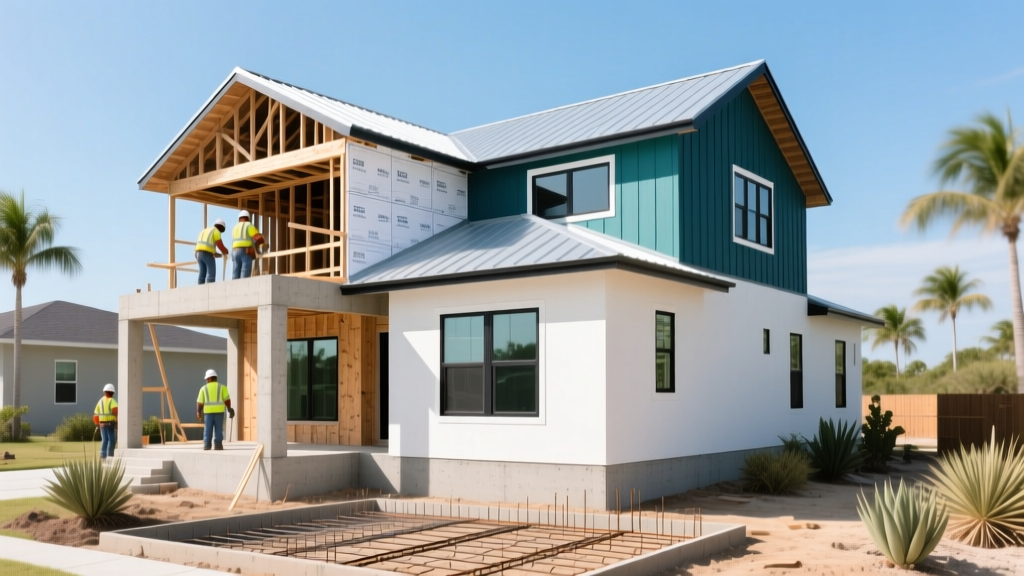
The 2026 Florida Size & Cost Matrix
Determining the baseline budget for a new build in Florida requires moving beyond national averages. The state's unique soil composition, strict wind-load requirements, and high-humidity climate demand specialized materials that push baseline costs higher than the national median. According to data tracked by the National Association of Home Builders (NAHB), Florida's construction costs are heavily weighted toward structural resilience and envelope sealing.
Use the matrix below as your foundational size and scope calculator. These 2026 estimates reflect turnkey construction costs (excluding land acquisition) for a single-story, concrete block structure.
| Home Size (Sq Ft) | Base Scope ($165/sq ft) | Mid-Tier Scope ($235/sq ft) | Premium Scope ($320+/sq ft) |
|---|---|---|---|
| 1,500 | $247,500 | $352,500 | $480,000+ |
| 2,000 | $330,000 | $470,000 | $640,000+ |
| 2,500 | $412,500 | $587,500 | $800,000+ |
| 3,500 | $577,500 | $822,500 | $1,120,000+ |
Scope Definitions: Base scope includes standard CBS (Concrete Block Construction) with stucco, builder-grade asphalt shingles, and standard dual-pane windows. Mid-tier upgrades to architectural shingles, upgraded insulation, and semi-custom cabinetry. Premium scope includes full impact-resistant envelopes, high-end custom finishes, and smart-home integration.
Scope Variable 1: Foundation & Elevation Requirements
Florida's geology is primarily composed of sand, clay, and porous limestone. You cannot simply pour a standard slab-on-grade foundation without rigorous soil testing. The scope of your foundation will drastically alter your final calculator output.
- Slab-on-Grade: Viable in central regions with stable soil. Costs roughly $8 to $12 per square foot. Requires a thickened edge and post-tension cables to prevent cracking from soil shifting.
- Stem Wall Foundation: Required in many coastal and flood-prone zones. Elevates the home 12 to 36 inches above grade. Adds $15 to $25 per square foot to the total build cost but is essential for flood mitigation and termite inspection visibility.
- Driven Piling: Mandatory for direct waterfront or barrier island properties where bedrock or stable load-bearing strata are deep. Expect to pay $35,000 to $75,000 just for the piling and grade beam foundation system on a standard 2,500 sq ft footprint.
Scope Variable 2: The Hurricane Envelope (HVHZ vs. Non-HVHZ)
When calculating how much it costs to build a house in Florida, the single largest variable is your proximity to the coast and whether your lot falls within a High-Velocity Hurricane Zone (HVHZ), primarily Miami-Dade and Broward counties.
Window and Door Specifications
In non-HVHZ regions, standard dual-pane Low-E windows may pass code, but upgrading to impact-resistant glass (like PGT WinGuard or CGI Sentinel series) is highly recommended for insurance premiums. Impact windows add $18,000 to $35,000 to a 2,500 sq ft home. In HVHZ regions, Miami-Dade Notice of Acceptance (NOA) certified impact products are legally mandatory, pushing window budgets 30% higher than the state average.
Roof Tie-Downs and Decking
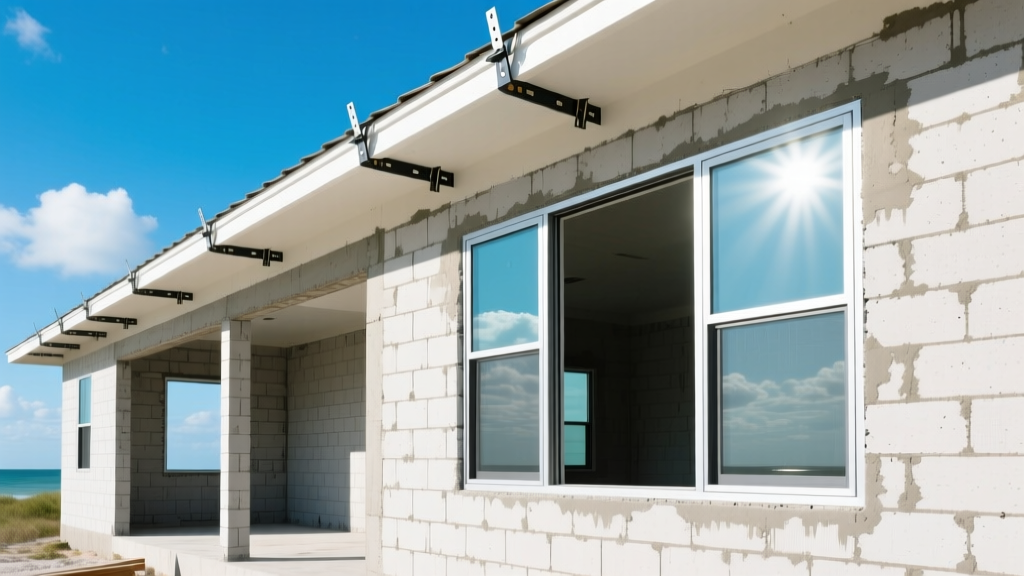
The Florida Building Code (FBC) 8th Edition requires continuous load paths from the roof to the foundation. Builders must use engineered hurricane ties (such as Simpson Strong-Tie H2.5A or equivalent) at every truss-to-wall connection. Furthermore, roof decking must be secured with 8d ring-shank nails at a strict 6-inch spacing pattern. This envelope sealing adds roughly $4.50 to $6.00 per square foot of roof area compared to standard national framing practices.
Scope Variable 3: HVAC & Humidity Control
Sizing an HVAC system in Florida is not about heating; it is about aggressive dehumidification and cooling. A standard rule of thumb is 1 ton of cooling capacity per 500 to 600 square feet of living space, but this must be verified via a Manual J load calculation.
For a 2,500 sq ft home, you will need a 4-ton to 5-ton system. However, the scope of the ductwork is where costs inflate. Florida code requires mastic sealant on all duct joints and R-8 insulated flex ducting in unconditioned attics to prevent condensation and mold. Budget $12,000 to $18,000 for a high-efficiency (16+ SEER2) heat pump system with advanced humidity control, which is roughly 20% more expensive than standard systems used in drier climates.
Regional Cost Multipliers Across the State
Florida is not a monolith. Your zip code dictates labor rates, permitting fees, and material transport costs. Apply these multipliers to your baseline matrix:
- South Florida (Miami, Boca Raton, Naples): Multiply base costs by 1.25x to 1.40x. High labor costs, strict HVHZ codes, and expensive logistics drive prices to the top of the spectrum.
- Central Florida (Orlando, Tampa, Ocala): Multiply base costs by 1.0x to 1.10x. This is the baseline. Labor is more accessible, and wind-load requirements, while strict, do not require the extreme HVHZ impact ratings.
- Panhandle & North Florida (Pensacola, Jacksonville): Multiply base costs by 0.90x to 1.0x. Lower land and labor costs, though coastal Panhandle properties still require robust wind mitigation due to Gulf storm tracks.
Step-by-Step Size & Scope Calculation Framework
To generate a highly accurate estimate for your specific project, follow this sequential calculation framework:
- Establish the Footprint: Multiply your target conditioned square footage by the Base Scope rate ($165/sq ft) for your specific region.
- Add Foundation Scope: Determine your flood zone. If in Flood Zone A or V, add the stem wall or piling premium ($15–$30/sq ft).
- Calculate the Envelope: If opting for impact windows and a sealed attic system, add $22,000 to $40,000 to the hard costs.
- Factor in Soft Costs: According to U.S. Census Bureau construction data, soft costs (architectural fees, engineering, permits, and impact fees) typically account for 15% to 22% of the total project cost in Florida. Municipal impact fees for water and sewer alone can range from $5,000 to $15,000 depending on the county.
- Apply the Contingency: Always add a 10% to 15% contingency for soil remediation surprises or lumber price fluctuations.
Final Considerations for 2026 Builders
Building in Florida requires a defensive approach to construction. Prioritizing the structural envelope—specifically the concrete block shell, the roof tie-downs, and the impact-resistant glazing—will yield massive returns in the form of reduced homeowners insurance premiums and long-term durability. When finalizing your scope, always allocate the majority of your budget to the elements that protect the interior from water and wind intrusion, as these are the primary failure points in Florida residential real estate.
Written by
Priya KapoorPriya Kapoor is a real estate market analyst and construction economics researcher with expertise in housing affordability, development feasibility, and infrastructure investment. She holds a Master of Regional Planning from Cornell University and previously worked as a senior analyst at CBRE's Investment Properties group, where she modeled returns for $4B in mixed-use development pipelines. Priya now runs an independent research practice advising developers, municipalities, and REITs on construction cost forecasting and market timing. She publishes the quarterly "BuildMat Market Pulse" report tracking material price indices across 12 commodity categories. Based in Austin, TX, Priya serves on the board of Habitat for Humanity Austin and is a marathon runner.
More from Priya Kapoor
View all
Construction Cost
Cost to Build a 1600 Sq Ft Home in 2026: Full Breakdown
Accurate 2026 cost to build a 1600 sq ft home—material, labor, and regional pricing breakdowns included. Plan your budget with real-time estimates.
Aug 11, 2026

Wood & Lumber
Name the Types of Wood for Pressure Treatment and Preservation
Learn how to name the types of wood best suited for pressure treatment. Compare species treatability, chemical retention levels, and 2026 preservation costs.
Aug 4, 2026

Stone & Masonry
Stone Veneer Suppliers Lindenhurst: 2026 Cost Analysis
Analyze 2026 stone veneer costs in Lindenhurst, NY. Compare local supplier pricing, delivery fees, and Suffolk County installation labor rates.
Aug 4, 2026