Smart Strategies to Lower the Cost to Build Pool in Florida
Discover actionable strategies to reduce the cost to build pool in Florida. Learn material hacks, timing tips, and design choices that save thousands.
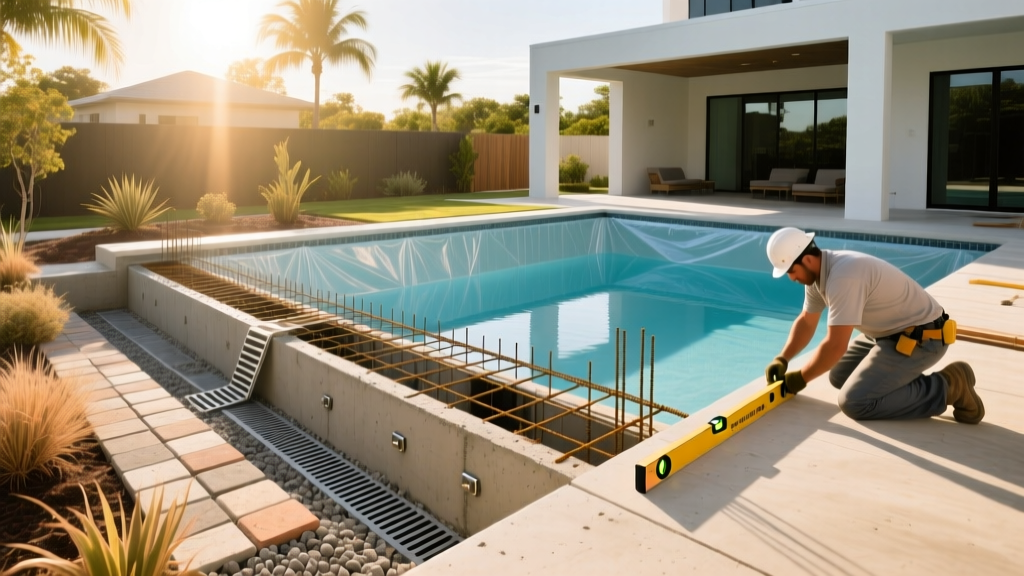
The baseline cost to build pool in Florida typically ranges from $60,000 to $95,000 for a standard gunite installation. However, this figure is highly volatile due to the state's unique geological and regulatory environment. Homeowners who approach construction with a strategic, cost-conscious mindset can shave 15% to 25% off their final invoice without compromising structural integrity. Lowering the cost to build pool in Florida requires targeting the three highest expense drivers: unpredictable soil excavation, over-engineered plumbing runs, and off-season construction timing.
The Florida Soil Tax: Managing Excavation and Dewatering
Florida's coastal plains and central corridors are notorious for 'sugar sand' and high water tables. When excavators hit the water table, the hole begins to fill immediately, requiring a process called dewatering to keep the site dry enough for steel tying and shotcrete application.
Scheduling your dig between June and October (the wet season) can cause dewatering costs to spike from a standard $1,500 to over $4,500. Wellpoint dewatering systems must run continuously to prevent the pool shell from 'floating' out of the ground before the concrete cures.
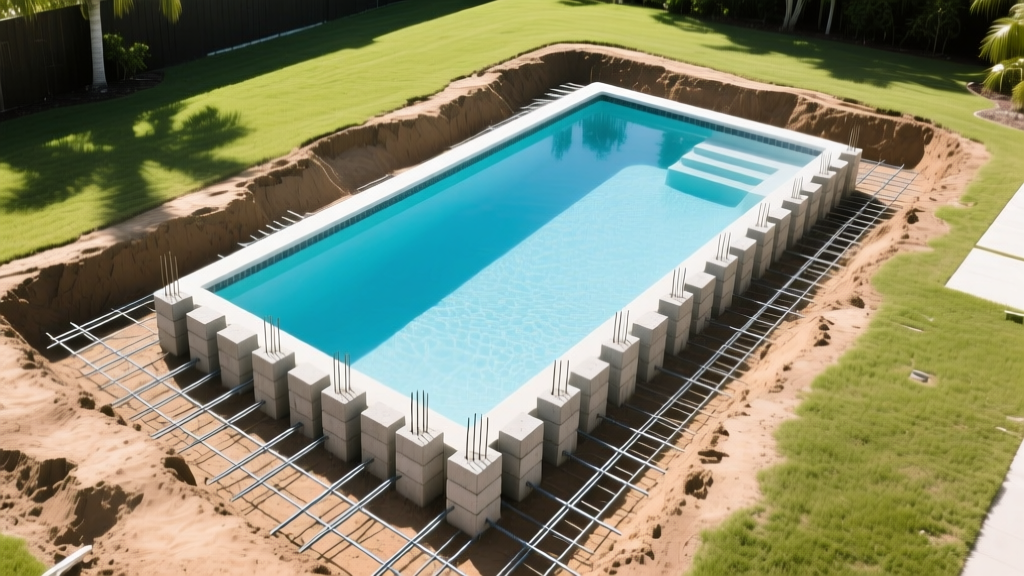
Cost-Saving Strategy: Sign your contract in late summer for a November or December start date. Dry-season excavation minimizes the need for extensive wellpoint dewatering systems and prevents costly cave-ins caused by saturated sandy soil. Furthermore, insist that your contractor specifies 3/8-inch steel rebar on 10-inch centers (rather than the standard 12-inch centers) to provide the necessary tensile strength to resist the lateral pressure of shifting Florida sands.
Shell Material Matrix: Gunite vs. Fiberglass in FL
While vinyl liner pools are popular in northern states, they are highly discouraged in Florida due to UV degradation and the risk of the liner floating due to hydrostatic pressure. The real cost battle is between gunite (concrete) and fiberglass.
| Feature | Gunite (Shotcrete) | Fiberglass Shell |
|---|---|---|
| Average FL Installed Cost | $65,000 - $95,000 | $55,000 - $75,000 |
| Installation Timeline | 60 - 90 Days | 14 - 30 Days |
| Crane Access Required? | No | Yes (Adds $1,500+ if obstructed) |
| Long-Term Algae Resistance | Moderate (Porous surface) | High (Non-porous gelcoat) |
| Customization Level | Unlimited | Limited to manufacturer molds |
Cost-Saving Strategy: If your backyard has clear overhead access (no power lines or massive oak trees blocking the path), a fiberglass shell drastically reduces labor costs and long-term chemical expenses. The non-porous gelcoat requires roughly 30% less chlorine to maintain, a significant savings given Florida's intense UV exposure which rapidly depletes pool sanitizers.
Design Geometry: Why Rectangles Save Thousands
Freeform, lagoon-style pools are visually appealing but inherently more expensive to engineer and build. Every curve in a freeform pool requires custom wooden or foam forming, increases shotcrete rebound waste, and complicates the plumbing layout.
- Standard Dimensions: Stick to standard rectangular dimensions like 14x28 feet or 16x32 feet. These sizes align perfectly with standard material increments, reducing off-cuts and waste in coping and decking materials.
- Depth Profiles: Eliminate the deep-end diving well. A standard 3.5-foot to 5-foot sloped bottom requires significantly less excavation, less concrete, and less water to fill. Diving pools require a minimum 8-foot depth and a much larger overall footprint to meet safety slope ratios.
- Perimeter Overflow: Avoid negative edge or infinity edge designs unless your property borders a protected conservation area where the visual payoff justifies the $15,000+ premium for the secondary catch basin and return pumps.
Equipment Pad Placement and Plumbing Efficiency
The location of your pool equipment pad directly dictates the cost of your plumbing and electrical rough-ins. Many homeowners make the mistake of hiding the equipment pad on the far side of the house for aesthetic reasons.
Keep your equipment pad within 15 feet of the pool's skimmer and main drain. Every additional foot of trenching requires more Schedule 40 PVC, additional wiring conduit, and increased labor. Furthermore, longer plumbing runs increase hydraulic resistance, forcing your pump to work harder and consume more electricity over its lifespan.
Ensure your plumber uses a minimum of 2-inch PVC for all suction and return lines. While 1.5-inch PVC is cheaper upfront, it creates excessive friction loss in Florida's high-flow systems, negating the efficiency of modern variable-speed pumps.
Equipment Selection: Where to Spend vs. Save
Florida's year-round swimming season means your pool pump will operate significantly more hours annually than in cooler climates. Skimping on equipment here is a false economy.
The Variable Speed Pump Mandate
Do not install a single-speed pump. Invest in a high-efficiency variable speed model like the Pentair IntelliFlo3 VSF or the Hayward TriStar VS. According to the EPA Energy Star program, variable speed pumps use up to 70% less energy than single-speed models. In Florida, where utility rates are heavily tiered based on usage, this upgrade pays for itself in roughly 14 to 18 months. Additionally, check with your local utility provider (such as FPL or Duke Energy), as they frequently offer instant rebates ranging from $150 to $300 for installing certified variable speed pumps.
Sanitation Systems
Skip the UV or Ozone systems for residential outdoor pools in Florida; the intense direct sunlight neutralizes these systems before they can provide residual sanitation in the main body of water. Instead, invest in a high-quality salt chlorine generator (like the Hayward AquaRite). While it adds $1,500 to the initial build cost, it eliminates the need to purchase liquid chlorine or trichlor pucks, saving the average Florida pool owner $600 to $800 annually in chemical costs.
Navigating Florida Permitting and Enclosure Costs
Florida has some of the strictest pool barrier and permitting laws in the country to prevent childhood drownings. The Florida Department of Health and local county building departments enforce rigorous fencing and alarm requirements.
You have two primary choices for compliance:
- Perimeter Fencing: Installing a 4-foot minimum barrier with self-closing, self-latching gates around the pool itself. (Cost: $2,500 - $4,500 for aluminum or mesh).
- Screen Enclosures (Lanai): Expanding or building a full aluminum screen enclosure that covers the pool and patio, equipped with child-proof doors. (Cost: $12,000 - $25,000+).
Cost-Saving Strategy: If you do not strictly need a full screen enclosure to keep out debris and insects, opt for a standalone perimeter fence and utilize a motorized safety cover or a high-quality manual mesh safety cover during the off-season. Alternatively, if a screen enclosure is a must-have due to local HOA rules or personal preference, design the pool as close to the house as possible. Tying the new screen enclosure into the existing roofline of the home's lanai is exponentially cheaper than engineering and pouring concrete footers for a freestanding, four-wall enclosure in the middle of the yard.
Decking Materials: Beating the Florida Heat
Pool decking in Florida must withstand relentless UV exposure, torrential downpours, and bare feet. Natural stone options like Travertine or Bluestone are beautiful but can cost $14 to $20 per square foot installed, and darker stones become dangerously hot under the midday sun.
To save money and maintain comfort, specify a modern acrylic-coated concrete system or a traditional 'Kool Deck' application. These specialized concrete toppings are designed to reflect heat and remain cool to the touch. Priced between $6 and $9 per square foot, they offer a massive savings over natural stone while providing superior slip resistance when wet. Ensure your contractor includes control joints every 10 feet to manage the inevitable thermal expansion and contraction caused by Florida's extreme temperature swings.
Written by
Elena RodriguezElena Rodriguez is a civil engineer and technical writer specializing in concrete technology, masonry systems, and ASTM/ACI compliance. She earned her B.S. in Civil Engineering from Texas A&M University and spent a decade at a materials testing laboratory, performing over 2,000 concrete compressive strength tests and masonry prism evaluations. Elena is an ACI-certified Field Testing Technician (Grade I) and a member of ASTM Committee C12 on Natural Building Stone. She currently consults on forensic engineering cases involving concrete failures and moisture intrusion. Based in San Antonio, TX, Elena is a proud member of the Society of Women Engineers (SWE) and coaches her daughter's FIRST Robotics team.
More from Elena Rodriguez
View all
Walls & Panels
Cost Analysis: Light Gauge Steel Framing Advantages and Disadvantages
Evaluate light gauge steel framing advantages and disadvantages through a strict cost analysis lens, comparing material, labor, and lifecycle expenses.
Aug 4, 2026

Walls & Panels
Gypsum Board Types: Exact Specifications, Thickness & Dimensions
Compare standard, Type X, and moisture-resistant gypsum board types. Get exact specifications, thicknesses, dimensions, and ASTM standards for your project.
Aug 4, 2026

Fire Resistance
Best Fire-Resistant Outdoor Decking Materials: 2026 Buyer Guide
Discover the best fire-resistant outdoor decking materials for 2026. Compare Class A PVC, aluminum, and hardwood options for WUI compliance and safety.
Aug 4, 2026