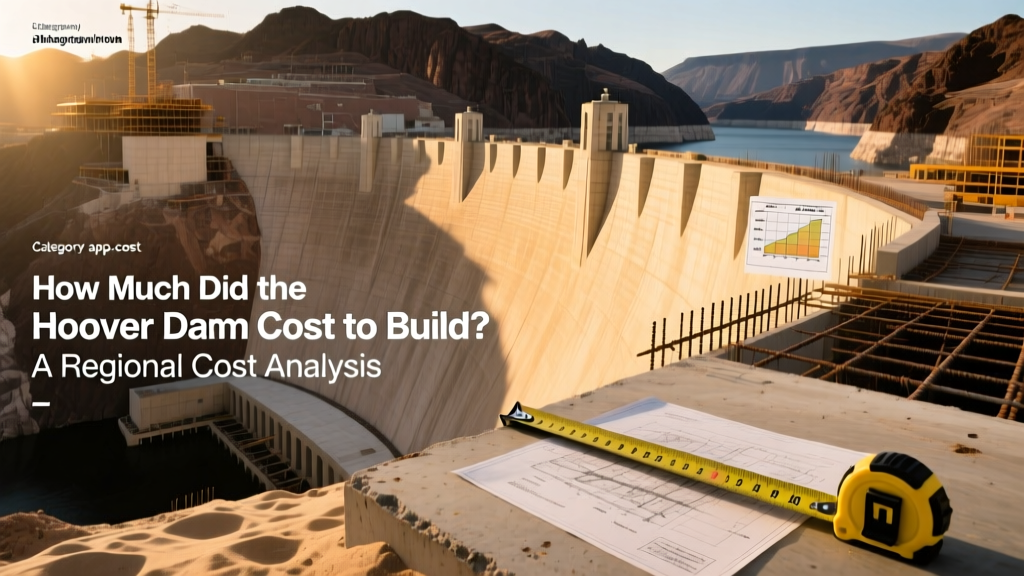
How Much Did the Hoover Dam Cost to Build? A Regional Cost Analysis
Discover how much the Hoover Dam cost to build in 1936, adjusted for modern inflation, and analyze regional price variations for mega-projects today.
The Original Ledger: Breaking Down the $49 Million Price Tag
When analyzing historical megaprojects to inform modern civil estimating, the baseline inquiry is always financial. So, how much did the Hoover Dam cost to build? The original authorized budget was $165 million, but the actual construction cost came in at $49,000,000 (roughly $49 million in 1936 dollars) when Six Companies, Inc. handed the project over to the federal government. This figure covered the dam, the power plant, and the initial generators, but excluded the extensive infrastructure built to support the remote site, such as the Boulder City township and the 22-mile railway spur.
To understand the true scale of this expenditure, estimators must look at the physical quantities. The project required 3.25 million cubic yards of concrete, 45 million pounds of structural steel, and a peak workforce of 5,251 men. Labor was remarkably cheap by modern standards, with wages ranging from $0.50 an hour for general laborers to $1.25 an hour for skilled steelworkers. However, the logistical premium of operating in the Black Canyon of the Colorado River introduced massive hidden costs in material transport and worker housing.
Historical Cost Allocation (1931–1936)
- Concrete & Aggregate: ~$14.5 million (29.5%)
- Structural Steel & Penstocks: ~$8.2 million (16.7%)
- Direct Labor (Six Companies): ~$15.1 million (30.8%)
- Equipment, Transport & Overhead: ~$11.2 million (23.0%)
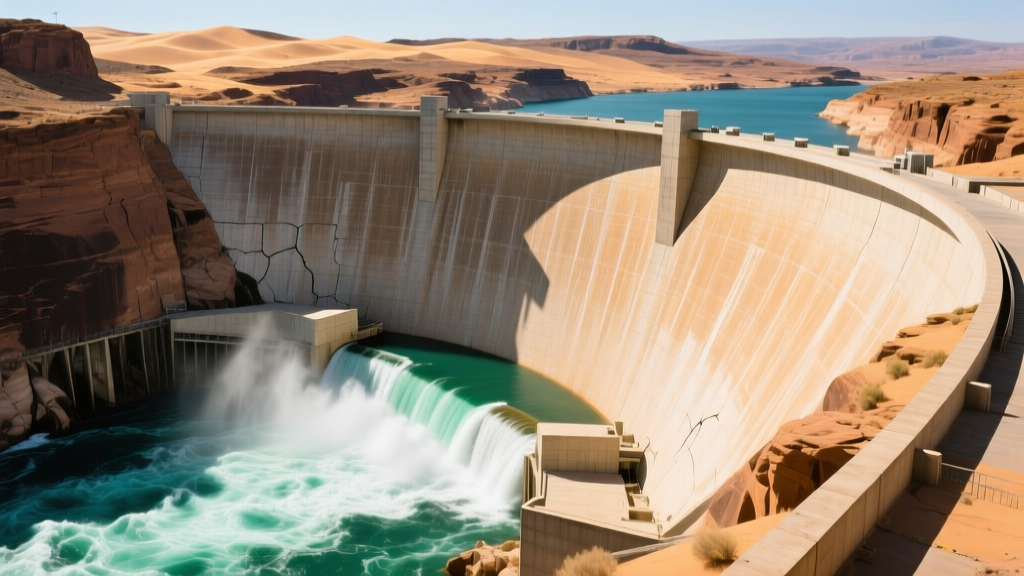
Inflation and the Engineering News-Record (ENR) Index
Simply applying the standard Consumer Price Index (CPI) to historical construction costs yields highly inaccurate estimates for modern estimators. The CPI measures consumer goods, whereas heavy civil construction is driven by commodities (cement, steel, diesel) and specialized labor. According to Federal Reserve Economic Data (FRED), $49 million in 1936 equates to roughly $1.1 billion in general purchasing power today.
However, heavy civil infrastructure scales differently. Using the Engineering News-Record (ENR) Construction Cost Index, which tracks the specific pricing of structural steel, Portland cement, 2x4 lumber, and skilled union labor, the pure material and labor equivalent of the Hoover Dam in 2026 sits closer to $2.8 billion. Yet, this number still falls short of a realistic modern estimate. A contemporary equivalent would require stringent EPA environmental impact mitigation, advanced seismic retrofitting, OSHA-compliant safety protocols, and modern turbine technology, pushing the realistic replacement cost to between $5.5 billion and $7.2 billion.
Regional Price Analysis: Building a Mega-Dam Today
If a consortium were to propose a 726-foot-high arch-gravity dam today, the final price tag would fluctuate wildly based on the geographic region. Using RSMeans regional cost modifiers and current prevailing wage data, we can model how the $6 billion baseline shifts across the United States.
| Region | Primary Cost Drivers | Regional Multiplier | Estimated 2026 Cost |
|---|---|---|---|
| Southwest (NV/AZ) | Water scarcity for batching, extreme heat mitigation, non-union labor pools. | 0.95x | $5.7 Billion |
| Pacific Northwest (WA/OR) | High union density, strict environmental/fishery compliance, heavy rainfall delays. | 1.25x | $7.5 Billion |
| Northeast (NY/PA) | Highest prevailing wages, dense site logistics, expensive aggregate transport. | 1.45x | $8.7 Billion |
| Southeast (GA/SC) | Favorable labor rates, abundant local aggregate, high humidity curing challenges. | 0.88x | $5.2 Billion |
The Southwest Baseline: Heat and Water Logistics
Building in the original Black Canyon location today presents unique regional premiums. Mass concrete requires vast amounts of water for hydration and cooling. With the Colorado River facing chronic Tier 2 shortage declarations, securing the millions of gallons required for a modern dam's concrete batch plants would necessitate expensive water-recycling infrastructure and advanced chemical admixtures to reduce the water-to-cement ratio without sacrificing workability. Furthermore, OSHA-mandated heat stress protocols would require rotating shifts, climate-controlled break trailers, and chilled mixing water, adding roughly 8% to direct labor and overhead costs compared to the 1930s.
The Pacific Northwest: Environmental and Labor Premiums
In regions like Washington State, the cost of the physical concrete is secondary to regulatory compliance. A modern dam in the PNW would require billion-dollar fish ladders, juvenile bypass systems, and temperature-controlled water releases to protect endangered salmon runs. Additionally, the region's heavy reliance on skilled union labor under the Davis-Bacon Act means that carpenters, ironworkers, and equipment operators command fully burdened hourly rates exceeding $85 to $110, drastically inflating the labor component of the estimate.
Modern Material Realities: Concrete Batching and Thermal Control
The most critical engineering challenge of the Hoover Dam was thermal cracking. As concrete cures, it generates heat. A monolithic pour of the dam's base would have taken over a century to cool and would have cracked under its own thermal stress. The original engineers solved this by embedding 582 miles of 1-inch steel cooling pipes through the concrete blocks, circulating river water and later chilled brine.
Today, the Bureau of Reclamation and modern civil firms rely on advanced materials science to reduce these mechanical cooling costs. A modern estimator would spec Type II or Type IV low-heat Portland cement, blended with Class F fly ash or slag cement. This pozzolanic reaction significantly lowers the peak temperature of the curing mass. Furthermore, modern estimators must price in liquid nitrogen injection systems at the batch plant, which cools the concrete mix to 45°F (7°C) before it even enters the agitator trucks, reducing the reliance on embedded post-pour cooling pipes.
When estimating modern mass pours exceeding 4 feet in thickness, do not rely on standard curing costs. You must include line items for thermal monitoring (embedded thermocouples), liquid nitrogen batch chilling, and insulated curing blankets to control the temperature differential between the concrete core and surface, which must remain below 35°F to prevent micro-cracking.
Key Takeaways for Civil Estimators
Understanding how much the Hoover Dam cost to build is more than a historical trivia question; it is a masterclass in megaproject scaling, logistics, and regional variance. For modern estimators pricing large-scale civil, water retention, or heavy foundation projects, apply these frameworks:
- Index Correctly: Never use standard CPI for heavy civil estimates. Rely on the ENR Construction Cost Index and specific commodity trackers for Portland cement and structural steel.
- Regional Logistics Trump Material Costs: In remote or highly regulated regions, the cost of moving materials, securing water rights, and achieving environmental compliance will easily eclipse the raw cost of the concrete and steel.
- Factor in Thermal Mitigation: For any mass concrete structure, line out specific costs for low-heat cement blends, fly ash substitution, and active batch chilling. Treating thermal control as an afterthought will destroy your profit margin on change orders.
- Labor Burden is Highly Localized: Always cross-reference local prevailing wage determinations and regional union agreements. A 40% variance in labor rates between the Southeast and the Northeast can make or break a multi-billion dollar bid.
Written by
James ThorntonJames Thornton is a construction industry veteran with 25 years of hands-on experience in wood framing, lumber grading, and residential building codes. He started as a framing carpenter in rural Oregon, earned his ICC Residential Building Inspector certification, and eventually became a senior plan reviewer for the City of Portland Bureau of Development Services. James holds a B.S. in Wood Science & Technology from Oregon State University and is a certified lumber grader through the West Coast Lumber Inspection Bureau (WCLIB). He has inspected over 3,000 residential construction sites and authored the city's internal guide on advanced framing techniques (2x6 at 24" O.C.). James lives in Bend, OR, where he builds custom timber-frame cabins and competes in lumberjack sports.
More from James Thornton
View all
Insulation
Best Home Insulation Materials: Complete 2026 Guide
Compare top home insulation materials for 2026. Find R-values, installed costs per square foot, and best uses for fiberglass, spray foam, and mineral wool.
Aug 4, 2026

Sustainable Building
Certify Your Green Building Material for LEED and WELL
Step-by-step guide to certifying a green building material for LEED v5 and WELL v2. Master EPDs, HPDs, and VOC limits for 2026 project specifications.
Aug 4, 2026

Stone & Masonry
Veneer Stacked Stone Panels: Interior Design & Style Showcase
Discover how veneer stacked stone panels transform interiors. Explore modern design profiles, material pairings, and technical installation specs.
Aug 4, 2026