How Much Does a Hydroelectric Dam Cost to Build? 2026 Budget Guide
Discover how much a hydroelectric dam costs to build. Explore budget frameworks, cost-per-kW metrics, and hidden financial risks for water power projects.
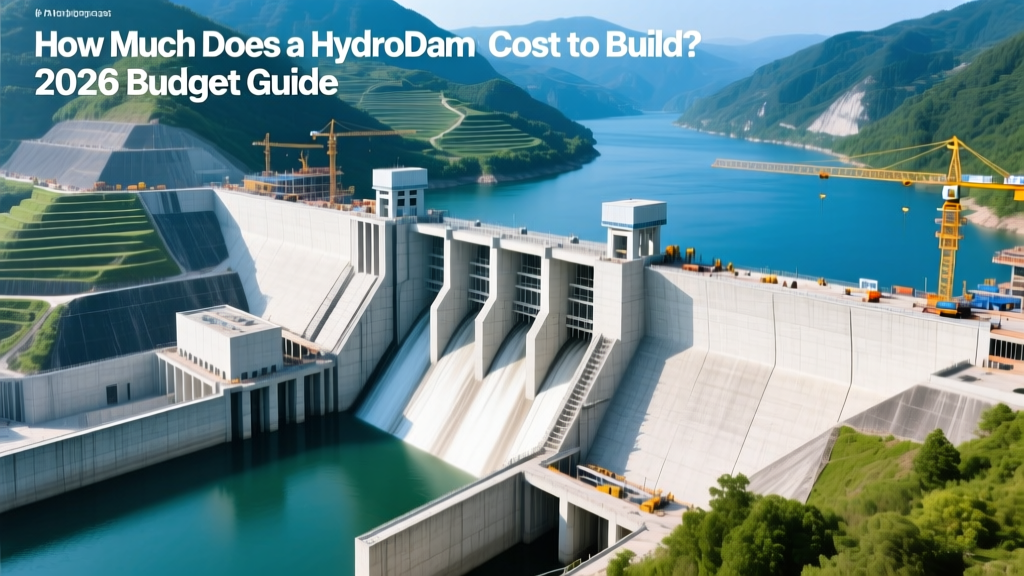
The Financial Reality of Hydroelectric Dam Construction
Estimating the capital expenditure (CapEx) for a hydroelectric dam requires moving beyond simple per-square-foot metrics used in commercial building. When evaluating how much a hydroelectric dam costs to build, project sponsors must account for extreme geological variables, massive civil earthworks, and highly specialized electromechanical equipment. According to data from the U.S. Department of Energy Water Power Technologies Office, hydroelectric projects exhibit vast economies of scale, but the absolute capital requirements remain among the highest in the renewable energy sector.
In 2026, the baseline cost to build a hydroelectric dam ranges from $1,500 to $8,000 per installed kilowatt (kW), heavily dependent on the project's generation capacity, head (water drop), and site accessibility. A 5-megawatt (MW) run-of-river project might cost $20 million, while a 1,000 MW impoundment dam will easily exceed $1.5 billion. Budget planning for these megaprojects demands a phased approach, isolating civil works from electromechanical procurement and grid interconnection.
Cost Breakdown by Project Capacity and Type
Hydroelectric facilities are categorized by their generation capacity and water storage methodology. The following matrix outlines the current capital cost expectations across different project scales.
| Project Scale | Capacity Range | Estimated Cost per kW | Total CapEx Range | Primary Cost Driver |
|---|---|---|---|---|
| Micro Hydro | < 100 kW | $6,000 - $10,000 | $600K - $1M | Custom turbine fabrication, site access |
| Small / Run-of-River | 100 kW - 10 MW | $4,000 - $7,000 | $4M - $70M | Penstock installation, environmental permitting |
| Medium Impoundment | 10 MW - 100 MW | $2,500 - $4,500 | $25M - $450M | Concrete dam structure, spillway gates |
| Large / Mega Dam | 100 MW - 1,000+ MW | $1,500 - $3,000 | $150M - $3B+ | Massive earthmoving, river diversion, resettlement |
While large dams benefit from a lower cost-per-kW ratio, their sheer scale introduces exponential logistical and geological risks that can derail budgets if not properly modeled during the feasibility stage.
The 5-Phase Budget Allocation Framework
Accurate budget planning requires segmenting the CapEx into distinct execution phases. The International Hydropower Association (IHA) recommends the following baseline allocation for medium-to-large impoundment projects:
- Feasibility, Design, and Permitting (8% - 12%): Includes geotechnical drilling, hydrological modeling, and environmental impact statements (EIS). In highly regulated regions, securing a license from authorities like FERC can take 3 to 5 years and cost upwards of $2 million in consulting and legal fees before ground is broken.
- Civil Works and Earthmoving (45% - 55%): The largest budget segment. Covers site clearing, river diversion, foundation excavation, and the pouring of roller-compacted concrete (RCC) or earth-fill embankments.
- Electromechanical Equipment (20% - 25%): Procurement of turbines, generators, transformers, and control systems. These are typically manufactured off-site and require heavy-haul logistics to deliver to remote river gorges.
- Hydraulic Structures & Penstocks (10% - 15%): Fabrication and welding of steel penstocks (often utilizing API 5L X70 high-yield steel), intake towers, and radial spillway gates.
- Grid Interconnection & Commissioning (5% - 10%): Building the step-up substation, high-voltage transmission lines to the nearest grid node, and rigorous wet-testing of the turbines.
Hidden Cost Drivers That Destroy Dam Budgets
Surface-level estimates frequently fail to account for subsurface and environmental variables. When building your financial model, you must stress-test the budget against these specific failure modes:
Warning: Geotechnical Surprises
Discovering karst topography (porous limestone with underground caves) during foundation excavation is a notorious budget killer. To prevent reservoir leakage, engineers must perform deep curtain grouting, injecting cementitious slurries hundreds of feet into the bedrock. If karst is present, foundation preparation costs can spike by 200% to 400%, adding $10 million to $50 million to the civil works budget.
Insight: River Diversion and Cofferdams
You cannot build a dam in a flowing river. Constructing upstream and downstream cofferdams (temporary enclosures to pump water out of the work area) and diversion tunnels can consume up to 15% of the total civil budget. If a 100-year flood event occurs during construction and overtops the cofferdam, the resulting delay and site cleanup can add 12 to 18 months of carrying costs to the project ledger.
Electromechanical Equipment: Turbine Selection Matrix
The choice of turbine is dictated by the site's 'head' (vertical drop of the water) and 'flow' (volume of water). Selecting the wrong turbine type reduces generation efficiency and drastically alters the electromechanical budget. According to IRENA's renewable cost analyses, electromechanical systems represent a highly predictable cost center compared to civil works, provided the correct technology is matched to the hydrology.
| Turbine Type | Optimal Head Range | Optimal Flow | Approx. Cost per MW | Best Application |
|---|---|---|---|---|
| Pelton (Impulse) | > 300 meters | Low to Medium | $1.2M - $1.8M | Steep mountainous terrain, high-pressure penstocks |
| Francis (Reaction) | 40 - 600 meters | Medium to High | $900K - $1.5M | Standard impoundment dams, most versatile design |
| Kaplan (Reaction) | < 40 meters | Very High | $1.5M - $2.5M | Low-head run-of-river, wide rivers with massive volume |
Note: Kaplan turbines are generally more expensive per MW than Francis turbines due to the complex, adjustable blade pitch mechanisms required to maintain efficiency across varying seasonal flow rates.
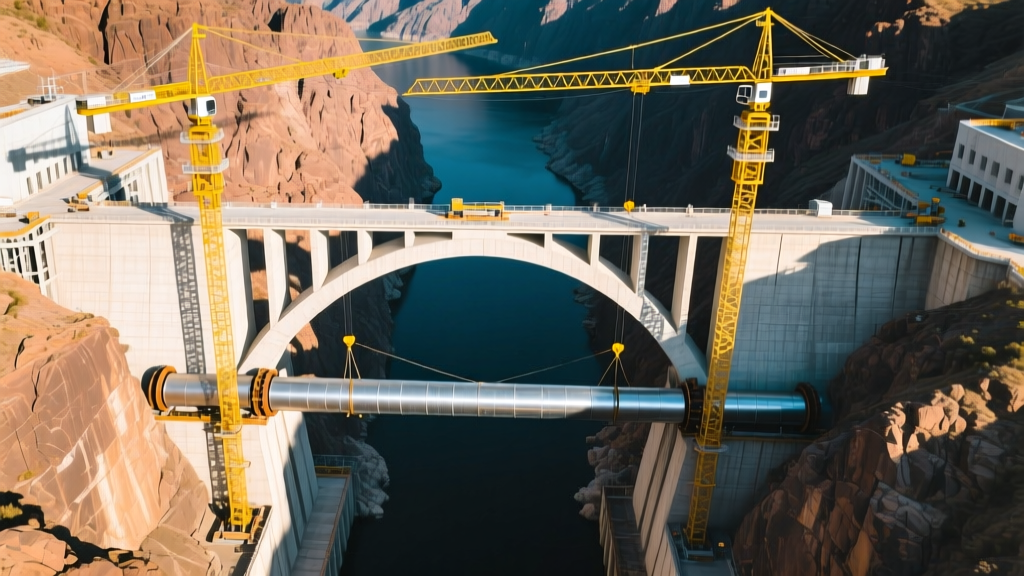
Environmental Mitigation and Fish Passage
Modern hydroelectric budget planning must heavily weight environmental compliance. Impoundment dams block aquatic migration routes, necessitating the construction of fish ladders, fish lifts, or downstream bypass screens. A state-of-the-art nature-like fishway, designed to mimic a natural stream gradient to encourage salmonid migration, can cost between $3 million and $8 million per installation. Furthermore, sediment bypass tunnels—engineered to flush nutrient-rich silt downstream and prevent reservoir capacity loss—require massive tunnel-boring machines (TBMs) and can add $15 million to $30 million to the initial CapEx, though they extend the dam's operational lifespan by decades.
Financial Modeling and Contingency Planning
Due to the multi-year construction timelines of medium and large dams, budget planning must incorporate inflation escalation and robust contingency reserves. Standard commercial construction contingencies of 5% to 10% are wholly inadequate for hydroelectric projects.
'For greenfield hydroelectric projects in complex geological settings, a minimum contingency of 20% to 30% on civil works is standard industry practice. The interaction between water pressure and fractured bedrock always yields unforeseen engineering challenges during the excavation phase.' — Senior Dam Safety Engineer, ICOLD Guidelines.
To secure project financing from institutional lenders or development banks, sponsors must present a probabilistic cost model (such as a Monte Carlo simulation) that accounts for hydrological variance (drought years reducing generation revenue), supply chain delays for custom-forged turbine runners, and fluctuating steel and cement commodities. By isolating the highly predictable electromechanical costs from the highly volatile civil and geotechnical costs, project managers can build a resilient financial framework capable of absorbing the inevitable shocks of megaproject construction.
Written by
David NakamuraDavid Nakamura is a licensed architect (AIA) and construction technology writer focused on sustainable building methods, mass timber engineering, and high-performance building envelopes. He holds a Master of Architecture from the University of Washington and is a certified Passive House Consultant (CPHC). David spent eight years at the Seattle firm Mithun, where he led the design of three LEED Platinum projects, before founding his own practice specializing in net-zero residential design. He serves on the editorial advisory board of GreenBuilder Magazine and has authored peer-reviewed papers on cross-laminated timber (CLT) connections for the Journal of Structural Engineering. In his spare time, David teaches woodworking at Pratt Fine Arts Center and kayaks the Puget Sound.
More from David Nakamura
View all
Construction Cost
Labor Cost to Build a Deck Per Sq Ft: 2026 Installation Guide
Discover the exact labor cost to build a deck per sq ft in 2026. This installation guide breaks down contractor rates, complexity factors, and hidden fees.
Aug 4, 2026

Construction Cost
How Much Does It Cost to Build a 3 Bedroom House? Financing Guide
Learn exactly how much it costs to build a 3 bedroom house and explore 2026 financing options, construction loan types, and budget frameworks for your build.
Aug 4, 2026

Construction Cost
Cost to Build a Tennis Court: 2026 Guide
How much does it cost to build a tennis court in 2026? Breakdowns for asphalt, concrete, and synthetic surfaces plus fencing and lighting.
Jul 30, 2026