Cost to Build an Indoor Tennis Court: 2026 Frame & Surface Guide
Compare the cost to build an indoor tennis court across air domes, metal buildings, and masonry, including surface and HVAC pricing.
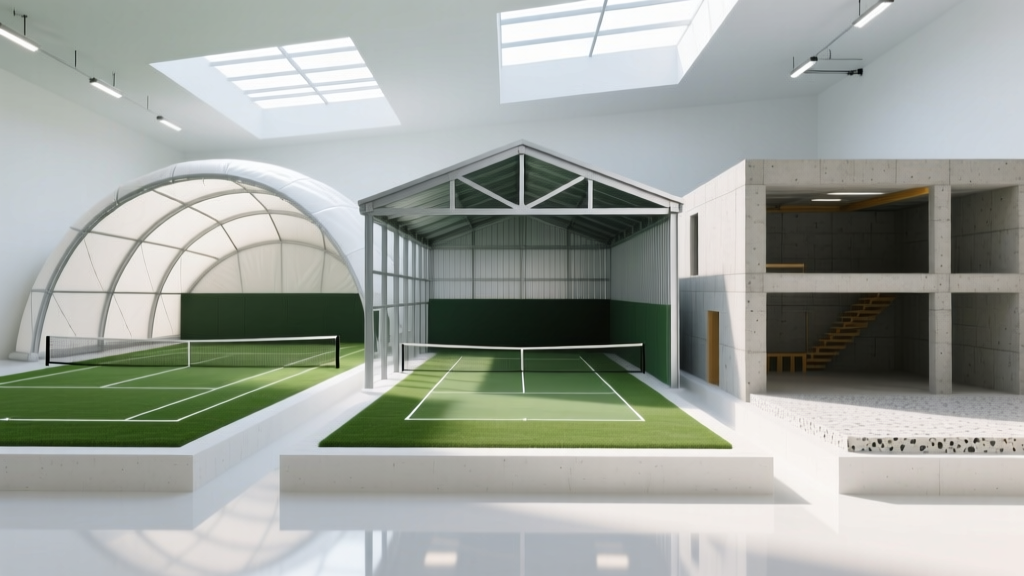
The True Scope of Indoor Tennis Court Construction
Calculating the cost to build an indoor tennis court requires moving beyond simple square-footage multipliers. Unlike outdoor installations, indoor facilities demand specialized clear-span engineering, rigorous climate control, and acoustic treatments to manage the high-decibel impact of tennis balls. According to the American Sports Builders Association (ASBA), a standard indoor facility is not just a court; it is a complex building envelope that must maintain strict temperature and humidity tolerances to preserve the playing surface and ensure athlete safety.
Standard Dimensions and Clear-Span Requirements
The International Tennis Federation (ITF) recommends a minimum building envelope of 120 feet by 60 feet (7,200 square feet) for a single court. This allows for the 78-by-36-foot doubles playing area plus mandatory run-off zones. Crucially, the ceiling must offer a clear span with no support columns. The minimum ceiling height is 30 feet over the net and 40 feet over the baselines. This volumetric requirement heavily influences structural steel costs and HVAC load calculations.
Enclosure Systems: A Cost-Per-Square-Foot Breakdown
The building shell accounts for 60% to 75% of the total project budget. Facility owners generally choose between three structural systems, each with distinct capital and operational expenditure profiles.
| Enclosure Type | Cost per Sq. Ft. (2026) | Lifespan | Best Use Case |
|---|---|---|---|
| Air-Supported Structure (Bubble) | $22 - $38 | 15 - 25 years | Seasonal winter coverage, tight budgets |
| Pre-Engineered Metal Building (PEMB) | $65 - $95 | 40 - 60 years | Year-round clubs, multi-court facilities |
| Traditional Masonry / Wood Frame | $130 - $190+ | 75+ years | Premium country clubs, institutional builds |
Air-Supported Structures (Domes)
Bubbles rely on internal positive air pressure (typically 0.5 to 1.5 inches of water gauge) to support the fabric membrane. Modern domes use a Kevlar or steel cable net system to transfer snow and wind loads to the foundation. While the upfront cost is the lowest, operational costs are higher due to the continuous runtime required for the air handling units (AHUs) and inflation fans.
Pre-Engineered Metal Buildings (PEMB)
PEMBs use rigid steel frames to achieve the necessary 120-foot clear span. They are the industry standard for dedicated year-round tennis centers. To prevent condensation from dripping onto the court—which creates severe slipping hazards and degrades acrylic surfaces—PEMBs require a continuous vapor barrier and R-30 to R-40 fiberglass or spray foam insulation.
Court Surface Materials: Performance Meets Budget
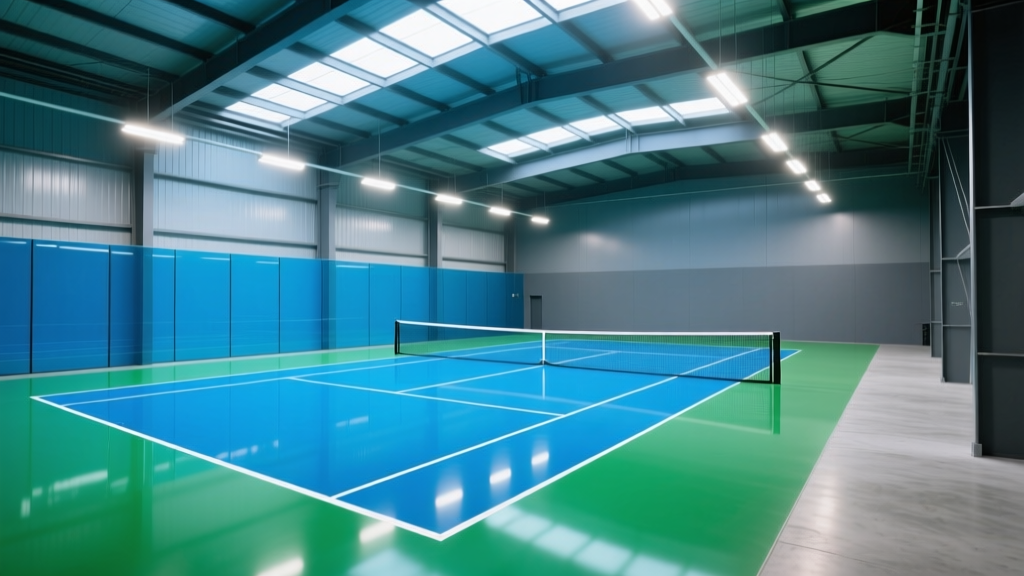
The substrate (base) and the surface (topcoat) are distinct line items. The lighting and surface interaction must be considered simultaneously, as glossy surfaces create dangerous glare under high-bay LEDs.
Substrate: Post-Tensioned Concrete vs. Asphalt
- Post-Tensioned (PT) Concrete ($8.50 - $12.00 / sq. ft.): The gold standard for indoor facilities. Steel cables are tensioned after the concrete cures, compressing the slab and preventing structural cracking. PT concrete virtually eliminates the random cracking that plagues indoor asphalt bases.
- Asphalt ($4.50 - $6.50 / sq. ft.): While cheaper initially, asphalt is prone to settling and frost heave. In heated indoor environments, asphalt can also off-gas oils that break down acrylic topcoats prematurely. It requires a 30-day curing period before surfacing can begin.
Surface Systems
Modular Polypropylene Tile (e.g., Mateflex): Interlocking tiles that snap together over the concrete. Cost: $6.00 - $9.00 per sq. ft. Excellent for multi-use facilities where the court must be converted for basketball or pickleball, though the acoustic 'hollow' sound of a bouncing ball is significantly louder than acrylic.
Hidden Cost Drivers: HVAC, Lighting, and Acoustics
Facility planners frequently underestimate the mechanical and electrical requirements specific to indoor tennis. These systems are non-negotiable for player safety and surface longevity.
Indoor tennis generates massive amounts of moisture from player respiration and perspiration. If your HVAC system lacks dedicated dehumidification (not just cooling), moisture will condense on the interior steel roof deck of a PEMB. This leads to 'indoor rain' dripping onto the court, causing slippery acrylic surfaces and rusting the structural purlins. Budget an additional $45,000 to $85,000 for commercial desiccant dehumidifiers.
Lighting Requirements
Recreational indoor courts require a minimum of 50 foot-candles of illuminance, while tournament-level play demands 100 foot-candles. Modern facilities utilize 4000K to 5000K LED high-bay fixtures with specialized asymmetric lenses to prevent glare when players look up for lobs. Expect to budget $25,000 to $40,000 per court for a premium, glare-optimized LED lighting package.
Acoustic Baffling
The impact of a tennis ball on a hard court and the subsequent echo in a 40-foot high metal building can exceed 95 decibels. Installing suspended fiberglass acoustic baffles or wall-mounted PET felt panels reduces reverberation time (RT60) to acceptable levels, typically adding $12,000 to $22,000 to the project cost.
Total Project Cost Scenarios (2026 Estimates)
The following matrix outlines the total estimated capital expenditure for a single-court (7,200 sq. ft. envelope) indoor facility, including site work, enclosure, surface, and mechanicals.
| Project Tier | Enclosure | Surface System | Total Estimated Cost |
|---|---|---|---|
| Tier 1: Budget / Seasonal | Air-Supported Bubble | Asphalt + Standard Acrylic | $180,000 - $260,000 |
| Tier 2: Standard Year-Round | PEMB (Metal Building) | PT Concrete + Cushioned Acrylic | $520,000 - $710,000 |
| Tier 3: Premium Institutional | Masonry / Architectural Steel | PT Concrete + Premium Cushion + ITF Certified | $950,000 - $1,350,000+ |
Strategic Decision Framework for Facility Owners
To determine the most cost-effective path for your specific situation, apply this decision matrix:
- Assess Land Use Duration: If you lease the land or plan to operate for less than 15 years, an air-supported structure over an existing outdoor court yields the fastest ROI. If you own the land outright, a PEMB provides a 50-year asset that increases property valuation.
- Evaluate Multi-Sport Needs: If the facility must generate revenue from pickleball, basketball, or corporate events during off-peak tennis hours, invest in a PEMB with a modular tile surface. The higher initial cost is offset by diversified booking revenue.
- Prioritize Substrate Over Aesthetics: Never compromise on the post-tensioned concrete slab to afford a more expensive building facade. A beautiful masonry building with a cracking asphalt base will result in unplayable conditions and exorbitant repair costs within five years.
By aligning your structural enclosure with the correct substrate and mechanical systems, you can accurately forecast the true cost to build an indoor tennis court and ensure a high-performance facility that minimizes long-term maintenance liabilities.
Written by
Elena RodriguezElena Rodriguez is a civil engineer and technical writer specializing in concrete technology, masonry systems, and ASTM/ACI compliance. She earned her B.S. in Civil Engineering from Texas A&M University and spent a decade at a materials testing laboratory, performing over 2,000 concrete compressive strength tests and masonry prism evaluations. Elena is an ACI-certified Field Testing Technician (Grade I) and a member of ASTM Committee C12 on Natural Building Stone. She currently consults on forensic engineering cases involving concrete failures and moisture intrusion. Based in San Antonio, TX, Elena is a proud member of the Society of Women Engineers (SWE) and coaches her daughter's FIRST Robotics team.
More from Elena Rodriguez
View all
Walls & Panels
Cost Analysis: Light Gauge Steel Framing Advantages and Disadvantages
Evaluate light gauge steel framing advantages and disadvantages through a strict cost analysis lens, comparing material, labor, and lifecycle expenses.
Aug 4, 2026

Walls & Panels
Gypsum Board Types: Exact Specifications, Thickness & Dimensions
Compare standard, Type X, and moisture-resistant gypsum board types. Get exact specifications, thicknesses, dimensions, and ASTM standards for your project.
Aug 4, 2026

Fire Resistance
Best Fire-Resistant Outdoor Decking Materials: 2026 Buyer Guide
Discover the best fire-resistant outdoor decking materials for 2026. Compare Class A PVC, aluminum, and hardwood options for WUI compliance and safety.
Aug 4, 2026