Average Cost to Build a House in Washington State (2026 Guide)
Discover the 2026 average cost to build a house in Washington State. Get regional price breakdowns, material costs, and county-specific construction data.
Understanding the Baseline: 2026 Construction Costs
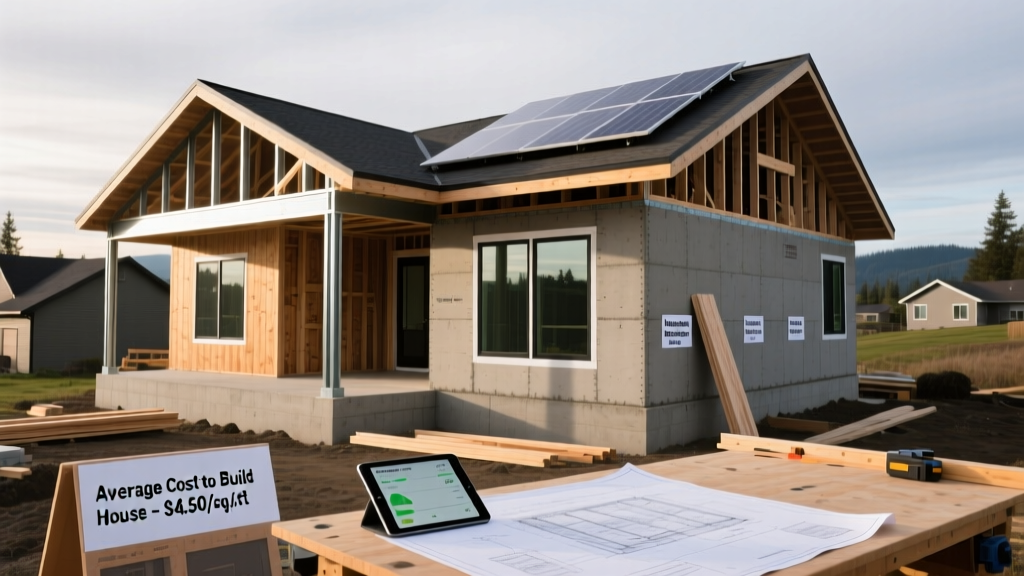
Calculating the average cost to build a house in Washington State requires moving beyond national averages, which often fail to capture the unique regulatory, geographic, and labor dynamics of the Pacific Northwest. As of 2026, the statewide baseline for a custom, single-family home ranges from $185 to $275 per square foot for hard construction costs. However, this figure is highly deceptive without geographic context. A 2,500-square-foot home in Spokane will cost drastically less than the exact same floor plan in Bellevue or Bellingham.
According to recent construction cost indexing by the National Association of Home Builders (NAHB), regional labor shortages and stringent state-level energy codes push Washington's construction costs roughly 12% to 18% above the national median. Below is a breakdown of estimated hard costs (materials and labor, excluding land and soft fees) for a mid-tier custom build in 2026.
| Home Size (Sq Ft) | Eastern WA (e.g., Spokane, Yakima) | Central WA (e.g., Wenatchee) | Western WA (e.g., Seattle, King County) |
|---|---|---|---|
| 1,500 | $240,000 - $285,000 | $270,000 - $320,000 | $330,000 - $420,000 |
| 2,000 | $320,000 - $380,000 | $360,000 - $430,000 | $440,000 - $560,000 |
| 2,500 | $400,000 - $475,000 | $450,000 - $535,000 | $550,000 - $700,000 |
| 3,500+ | $560,000 - $680,000 | $630,000 - $770,000 | $770,000 - $1,050,000+ |
The Geographic Divide: Western vs. Eastern Washington
The Cascade Mountain range creates more than just a weather divide; it creates a massive disparity in construction economics. When budgeting your project, you must account for these regional variances.
Western Washington (The I-5 Corridor & Puget Sound)
Building in King, Snohomish, or Pierce counties involves premium labor rates and intense logistical challenges. Framing labor in the Seattle metro area frequently commands $14 to $19 per square foot, compared to the national average of $8 to $12. Furthermore, urban infill lots often require crane-assisted material delivery, narrow-site staging, and strict adherence to local noise and runoff ordinances, all of which add 5% to 8% to general contractor overhead.
Eastern and Central Washington
Cities like Spokane, the Tri-Cities, and Wenatchee offer significant cost relief on labor and site logistics. However, Eastern Washington presents its own environmental cost drivers: extreme temperature swings require robust HVAC sizing, and expansive clay soils in areas like the Tri-Cities often necessitate specialized post-tensioned slab foundations or deeper drilled piers, adding $8,000 to $15,000 to the foundation budget.
Cost-Saving Insight: The Commuter Belt Strategy
Many buyers are targeting the 'commuter belt'—areas like Skagit County, Thurston County, or the outskirts of Spokane Valley. Land acquisition here is 40% to 60% cheaper than core urban centers. However, do not assume hard construction costs drop proportionally. Subcontractors still travel from major hubs, meaning you will pay a 'travel radius premium' (usually a 5% to 10% markup on labor) if your site is more than 45 minutes from a major supplier or trade center.
The WSEC Premium: Washington State Energy Code Impacts
You cannot accurately estimate building costs in this state without factoring in the Washington State Energy Code (WSEC). Washington has some of the most aggressive residential energy mandates in the country, heavily pushing toward building electrification and ultra-tight building envelopes.
Compared to building the same home in a state with baseline IRC (International Residential Code) adoption, the WSEC adds approximately 4% to 7% to your total hard costs. Here is where that money goes:
- Window U-Factor Mandates: The WSEC heavily restricts window U-factors (often requiring 0.20 or lower). This effectively mandates triple-pane, argon-filled fiberglass or uPVC windows (e.g., Andersen 100 Series or Milgard Essence). Upgrading from standard dual-pane to code-compliant triple-pane adds $6,500 to $12,000 to an average home's envelope budget.
- Insulation and Air Sealing: Ceiling insulation requirements frequently hit R-49 to R-60, and wall assemblies require R-21+ (often achieved via 2x6 framing with high-density batts plus continuous exterior rigid foam). Blower door testing is mandatory, requiring you to budget $400 to $800 for a third-party energy rater to verify the home achieves 3.0 to 5.0 ACH50 (Air Changes per Hour).
- Electrification and HVAC: With many municipalities restricting or banning natural gas hookups in new construction, you must budget for high-efficiency electric heat pumps. A ducted system (like the Bosch IDS 2.0) or a multi-zone ductless mini-split system (like the Mitsubishi Hyper-Heat) will cost $12,000 to $22,000 installed, compared to an $8,000 traditional gas furnace and standard AC split system.
Site Preparation and Critical Areas Ordinances (CAO)
Under the Washington State Growth Management Act (GMA), local jurisdictions enforce Critical Areas Ordinances (CAO). If your lot contains steep slopes, wetlands, fish-bearing streams, or is in a designated landslide hazard zone, your site preparation costs will skyrocket.
Warning: The Geotechnical Trap
Never purchase a sloped lot in Western Washington without a completed geotechnical report. A standard geotech study costs $3,500 to $7,000. If the engineer identifies unstable soils, you may be required to install soil nails, retaining walls engineered for seismic loads, or specialized pier foundations. We have seen site prep budgets jump from $25,000 to over $90,000 due to unforeseen CAO engineering requirements on seemingly beautiful, wooded lots.
Standard Site Prep vs. Complex Site Prep
| Site Prep Element | Standard Lot (Flat, Clear, Urban Services) | Complex Lot (Sloped, Wooded, Rural/CAO) |
|---|---|---|
| Clearing & Grubbing | $2,000 - $5,000 | $12,000 - $25,000+ |
| Geotechnical Engineering | $0 - $2,500 | $4,000 - $10,000 |
| Septic System (if no sewer) | N/A | $18,000 - $35,000 (Mound/Engineered) |
| Retaining Walls | $0 | $15,000 - $60,000+ |
| Driveway & Access | $4,000 - $8,000 | $15,000 - $40,000 (Switchbacks/Bridges) |
Soft Costs: Permits, Impact Fees, and Design
The 'sticker price' of construction materials is only part of the equation. Washington's soft costs—fees paid before a single shovel hits the dirt—are notoriously high, particularly in the Puget Sound region.
According to data tracked by the Washington State Department of Commerce, local jurisdictions rely heavily on impact fees to fund infrastructure. In King and Snohomish counties, expect to pay between $18,000 and $35,000 in combined building permits, school impact fees, park mitigation fees, and utility connection charges for a single-family home. In contrast, similar fees in rural Eastern Washington counties might total less than $6,000.
Architectural and Engineering Fees: Because of the seismic zone classifications (particularly the Seattle Fault and South Whidbey Island Fault zones) and strict energy codes, you cannot rely on basic 'plan book' designs. Budget 8% to 12% of your total hard construction costs for an architect, structural engineer, and energy modeler to produce a permit-ready set of plans.
Actionable Framework: Where to Allocate Your Budget
To maximize your ROI and ensure long-term durability in Washington's unique climate, follow this allocation framework:
- Over-invest in the Envelope: Spend heavily on fluid-applied weather-resistive barriers (like Henry Blueskin or Prosoco R-Guard) rather than traditional housewrap. Western Washington's wind-driven rain will exploit any weak point in standard Tyvek installations. Budget an extra $3,500 for premium flashing and air-sealing.
- Roofing Material Selection: Avoid standard 3-tab or basic architectural asphalt shingles if you are building west of the Cascades. The damp climate promotes moss and algae, degrading asphalt quickly. Upgrade to standing seam metal roofing (e.g., 24-gauge concealed fastener) or synthetic slate. It adds $10,000 to $18,000 upfront but eliminates the 15-year replacement cycle.
- Dehumidification Integration: Do not rely solely on your primary heat pump for humidity control in the shoulder seasons (October and April). Integrate a whole-home dehumidifier (like the Aprilaire E100) tied into your central duct system to prevent interior mold growth in ultra-tight WSEC-compliant homes.
Building in Washington State demands a highly localized approach to cost estimation. By respecting the geographic labor divides, proactively budgeting for the WSEC energy mandates, and thoroughly investigating site-specific CAO restrictions, you can transform a volatile construction process into a predictable, financially sound investment.
Written by
Elena RodriguezElena Rodriguez is a civil engineer and technical writer specializing in concrete technology, masonry systems, and ASTM/ACI compliance. She earned her B.S. in Civil Engineering from Texas A&M University and spent a decade at a materials testing laboratory, performing over 2,000 concrete compressive strength tests and masonry prism evaluations. Elena is an ACI-certified Field Testing Technician (Grade I) and a member of ASTM Committee C12 on Natural Building Stone. She currently consults on forensic engineering cases involving concrete failures and moisture intrusion. Based in San Antonio, TX, Elena is a proud member of the Society of Women Engineers (SWE) and coaches her daughter's FIRST Robotics team.
More from Elena Rodriguez
View all
Walls & Panels
Cost Analysis: Light Gauge Steel Framing Advantages and Disadvantages
Evaluate light gauge steel framing advantages and disadvantages through a strict cost analysis lens, comparing material, labor, and lifecycle expenses.
Aug 4, 2026

Walls & Panels
Gypsum Board Types: Exact Specifications, Thickness & Dimensions
Compare standard, Type X, and moisture-resistant gypsum board types. Get exact specifications, thicknesses, dimensions, and ASTM standards for your project.
Aug 4, 2026

Fire Resistance
Best Fire-Resistant Outdoor Decking Materials: 2026 Buyer Guide
Discover the best fire-resistant outdoor decking materials for 2026. Compare Class A PVC, aluminum, and hardwood options for WUI compliance and safety.
Aug 4, 2026