Cost to Build Icon of the Seas: Mega-Ship Budget Breakdown
Explore the $2B cost to build Icon of the Seas. Learn how mega-project budgeting, shipyard costs, and contingency planning apply to commercial builds.
The Scale of the Investment: Understanding the $2 Billion Price Tag
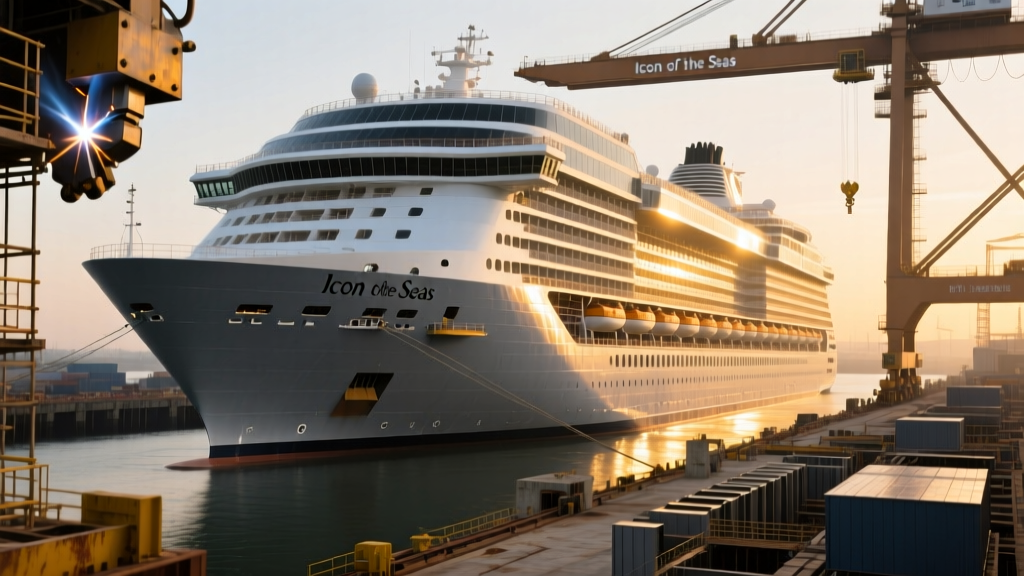
When Royal Caribbean Group commissioned the Icon of the Seas, it was not merely ordering a vessel; it was underwriting a floating, self-sustaining municipality. The widely reported cost to build Icon of the Seas sits at approximately $2 billion, making it one of the most expensive single-unit commercial construction projects in modern history. For construction estimators and budget planners, analyzing this mega-project provides a masterclass in complex supply chain management, heavy MEP (Mechanical, Electrical, and Plumbing) coordination, and phased contingency deployment.
Project Snapshot: Icon of the Seas
- Total Estimated Cost: $2.0 Billion USD
- Gross Tonnage: 248,663 GT (Yielding ~$8,045 per GT)
- Shipyard: Meyer Turku (Turku, Finland)
- Dimensions: 1,198 feet length, 20 decks
- Capacity: 2,805 cabins (max capacity 7,600 passengers)
- Propulsion: 6 x Wärtsilä 12V46DF dual-fuel (LNG) engines
According to Ship Technology's project profile, the sheer volume of materials and labor required to deliver a vessel of this magnitude within a strict 36-month drydock window demands a budget structure that terrestrial commercial estimators can adapt for high-rise, hospital, and large-scale hospitality projects.
Shipyard Economics: Deconstructing the Budget Matrix
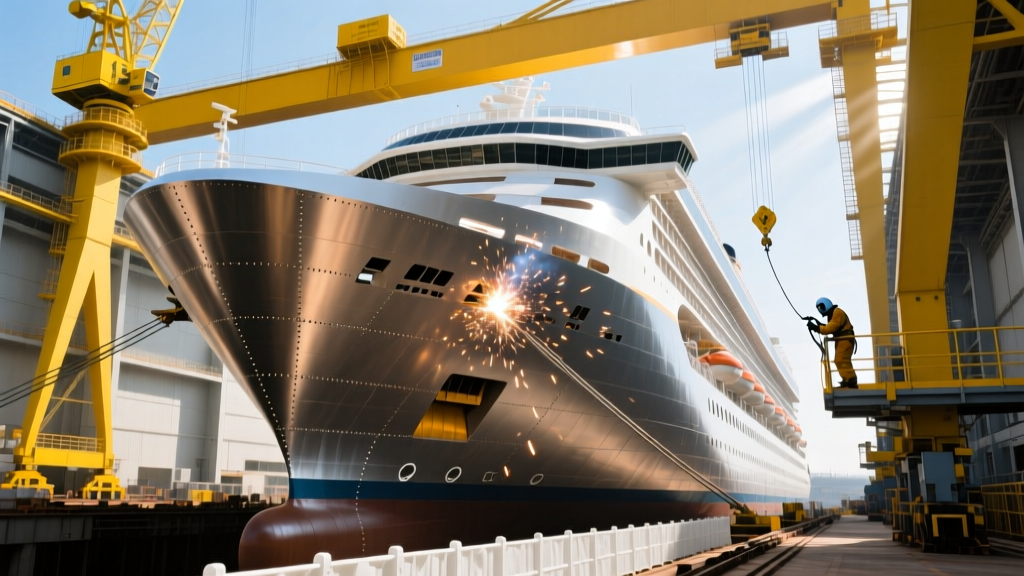
Unlike standard commercial real estate where land acquisition and site work consume significant capital, shipbuilding concentrates the budget heavily into specialized outfitting and propulsion. The Meyer Turku shipyard operates on a modular assembly logic, where massive steel blocks are pre-outfitted with piping and electrical conduits before being welded together in the drydock.
| Cost Category | Est. % of Budget | Key Cost Drivers & Estimator Notes |
|---|---|---|
| Hull & Steel Fabrication | 15% | Over 60,000 tons of marine-grade steel; drydock leasing and gantry crane operations. |
| Propulsion & Heavy MEP | 25% | LNG cryogenic storage tanks, Wärtsilä engines, desalination plants, and HVAC for 7,600+ occupants. |
| Interior Outfitting | 40% | 2,805 prefabricated cabin modules, custom theaters, waterpark structural supports, and specialty finishes. |
| Labor & Naval Engineering | 12% | 10M+ man-hours; 3D BIM modeling for clash detection in hyper-dense pipe corridors. |
| Contingency & Sea Trials | 8% | Regulatory compliance (SOLAS), fuel efficiency testing, and phased risk-release funds. |
The Hidden Cost Multiplier: LNG Propulsion and Complex MEP
The most critical budget variance risk on the Icon of the Seas was its transition to Liquefied Natural Gas (LNG). As noted in Royal Caribbean Group Investor Relations disclosures regarding their fleet modernization, LNG requires specialized cryogenic storage tanks operating at -260°F (-162°C).
When budgeting for specialized fuel or utility systems (like hospital medical gas or data center liquid cooling), standard MEP square-footage multipliers fail. The cryogenic piping on the Icon required specialized metallurgy and weld certifications that increased the mechanical budget by an estimated 22% compared to traditional heavy fuel oil (HFO) systems. Always isolate novel technology into a separate line-item with a dedicated 15-20% contingency.
Furthermore, the ship generates its own water and power. The desalination plants and waste-heat recovery systems act as a micro-grid. For terrestrial estimators, this mirrors the budgeting required for net-zero commercial campuses or off-grid mining facilities, where utility self-sufficiency shifts costs from operational expenditure (OpEx) to massive upfront capital expenditure (CapEx).
Budget Planning Lessons for Terrestrial Estimators
What can a commercial construction estimator building a $100M hospital or a 40-story mixed-use tower learn from a $2B cruise ship? The answer lies in modularization and contractual design freezes.
1. Modular Prefabrication and Off-Site Logistics
The 2,805 passenger cabins on the Icon of the Seas were not built inside the hull. They were manufactured as complete, fully furnished modular pods at off-site facilities in Poland and Finland, then transported to the shipyard and slid into the vessel via massive side-hatches using gantry cranes.
- The Terrestrial Application: For multi-family residential or hospitality projects, budgeting for off-site volumetric modular construction reduces on-site labor density by up to 40%. However, estimators must add line items for heavy-lift crane rentals, specialized transport permits, and temporary staging yards, which are often omitted in traditional stick-built estimates.
2. The "Design Freeze" Penalty Structure
In shipbuilding, once the steel is cut, design changes are exponentially expensive. Meyer Turku enforces a strict "design freeze" milestone. If the owner requests a layout change after the 3D BIM model is frozen and steel cutting begins, the change order cost includes not just the new materials, but the scrap value of the cut steel and the delay penalties for the drydock schedule.
"Mega-projects fail when the design phase bleeds into the procurement phase. The Icon of the Seas succeeded because the 3D clash detection was resolved before a single ton of steel was ordered." — Maritime Construction Analyst
Estimators should advise owners to implement contractual design-freeze dates. Post-freeze change orders should carry a predefined premium multiplier (e.g., 2.5x base cost) to discourage scope creep and protect the critical path.
3. Labor Peak Management and Density
At peak construction, over 4,000 workers were simultaneously active on the Icon of the Seas. Managing labor density in a confined space (a ship hull) requires rigorous 4D scheduling (3D model + time). If the pipefitters are scheduled in a corridor at the same time as the HVAC installers, productivity drops to zero.
When estimating labor hours for confined, high-MEP-density environments (like hospital interstitial spaces or ship engine rooms), apply a 1.15 to 1.25 labor inefficiency factor to your base RSMeans or proprietary labor rates. Standard labor tables assume open-floor productivity, which does not exist in mega-project MEP corridors.
Risk Allocation and Supply Chain Hedging
The budget for the Icon of the Seas was locked in years before the first steel was cut. To protect the $2 billion cap, Royal Caribbean and Meyer Turku utilized aggressive supply chain hedging. Steel prices, copper for electrical wiring, and specialized marine components were locked via forward contracts.
For modern construction budget planners dealing with volatile material markets, the lesson is clear: your estimate must include a procurement strategy matrix. Identify long-lead, high-volatility materials (e.g., switchgear, structural steel, custom HVAC chillers) and budget for early procurement deposits or warehouse storage fees to buy materials at today's prices, rather than risking market escalation at the time of installation.
Final Takeaways for Construction Budgeting
The cost to build Icon of the Seas is a testament to the power of extreme modularization, rigorous 3D BIM coordination, and uncompromising design-freeze milestones. While terrestrial estimators are not building 248,000-ton floating cities, the underlying mathematics of risk allocation, off-site prefabrication logistics, and MEP density inefficiencies are universally applicable. By adopting the shipyard mentality of treating a building as a series of pre-outfitted blocks rather than a stick-built puzzle, commercial estimators can deliver tighter budgets, reduce change orders, and protect project margins in an increasingly complex construction economy.
Written by
David NakamuraDavid Nakamura is a licensed architect (AIA) and construction technology writer focused on sustainable building methods, mass timber engineering, and high-performance building envelopes. He holds a Master of Architecture from the University of Washington and is a certified Passive House Consultant (CPHC). David spent eight years at the Seattle firm Mithun, where he led the design of three LEED Platinum projects, before founding his own practice specializing in net-zero residential design. He serves on the editorial advisory board of GreenBuilder Magazine and has authored peer-reviewed papers on cross-laminated timber (CLT) connections for the Journal of Structural Engineering. In his spare time, David teaches woodworking at Pratt Fine Arts Center and kayaks the Puget Sound.
More from David Nakamura
View all
Construction Cost
Labor Cost to Build a Deck Per Sq Ft: 2026 Installation Guide
Discover the exact labor cost to build a deck per sq ft in 2026. This installation guide breaks down contractor rates, complexity factors, and hidden fees.
Aug 4, 2026

Construction Cost
How Much Does It Cost to Build a 3 Bedroom House? Financing Guide
Learn exactly how much it costs to build a 3 bedroom house and explore 2026 financing options, construction loan types, and budget frameworks for your build.
Aug 4, 2026

Construction Cost
Cost to Build a Tennis Court: 2026 Guide
How much does it cost to build a tennis court in 2026? Breakdowns for asphalt, concrete, and synthetic surfaces plus fencing and lighting.
Jul 30, 2026