Average Cost to Build an Inground Pool: 2026 Budget Guide
Discover the true average cost to build an inground pool in 2026. Compare gunite, fiberglass, and vinyl prices, plus hidden excavation fees.
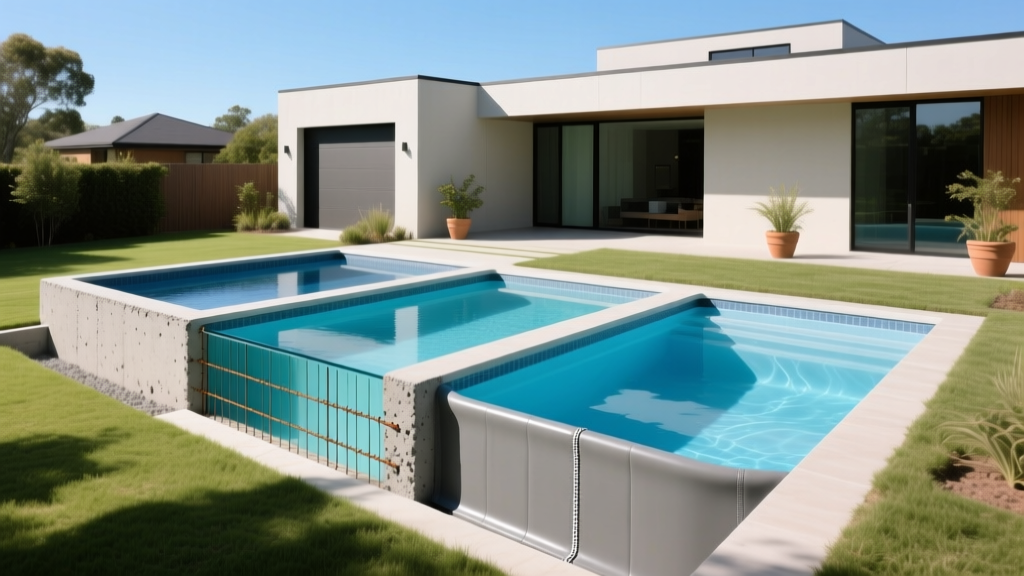
The True Average Cost to Build an Inground Pool
When calculating the average cost to build an inground pool, homeowners are frequently misled by national averages that ignore site-specific variables. In 2026, the baseline national average for a standard 14x28-foot inground pool sits at approximately $72,000. However, this figure assumes flat terrain, standard soil conditions, and basic equipment packages. Real-world construction budgets must account for material lifespans, mechanical efficiency, and localized excavation challenges. According to industry data compiled by Angi and HomeGuide, final contract prices routinely fluctuate between $45,000 for a basic vinyl liner setup and $150,000+ for a fully customized gunite installation with integrated hardscaping.
Quick 2026 Budget Baselines (14x28 ft. Standard)
- Vinyl Liner: $40,000 – $65,000 (Lowest upfront, highest 10-year maintenance)
- Fiberglass Shell: $55,000 – $85,000 (Fastest install, limited shape options)
- Gunite/Shotcrete: $75,000 – $125,000+ (Highly customizable, longest lifespan)
Material Matrix: Gunite vs. Fiberglass vs. Vinyl
Selecting your pool shell material dictates not only the initial capital outlay but also the long-term operational costs. Each material requires a distinct structural approach and carries specific failure modes that budget planners must anticipate.
| Feature | Gunite (Concrete) | Fiberglass | Vinyl Liner |
|---|---|---|---|
| Shell Thickness | 8 to 12 inches | 3/8 to 1/2 inch | 20-30 mil liner over steel/polymer walls |
| Installation Time | 3 to 6 months | 3 to 6 weeks | 4 to 8 weeks |
| Interior Finish | Marcite, Quartz, or PebbleTec | Factory-applied Gelcoat | Replaceable PVC Liner |
| Primary Failure Mode | Structural cracking, calcium scaling | Gelcoat blistering (osmosis), floating | Liner tearing, UV degradation, algae in seams |
| 10-Year Maintenance | $3,500 - $5,000 (Acid washing, resurfacing prep) | $1,200 - $2,000 (Lowest chemical demand) | $6,000 - $9,000 (Liner replacement at year 8-10) |
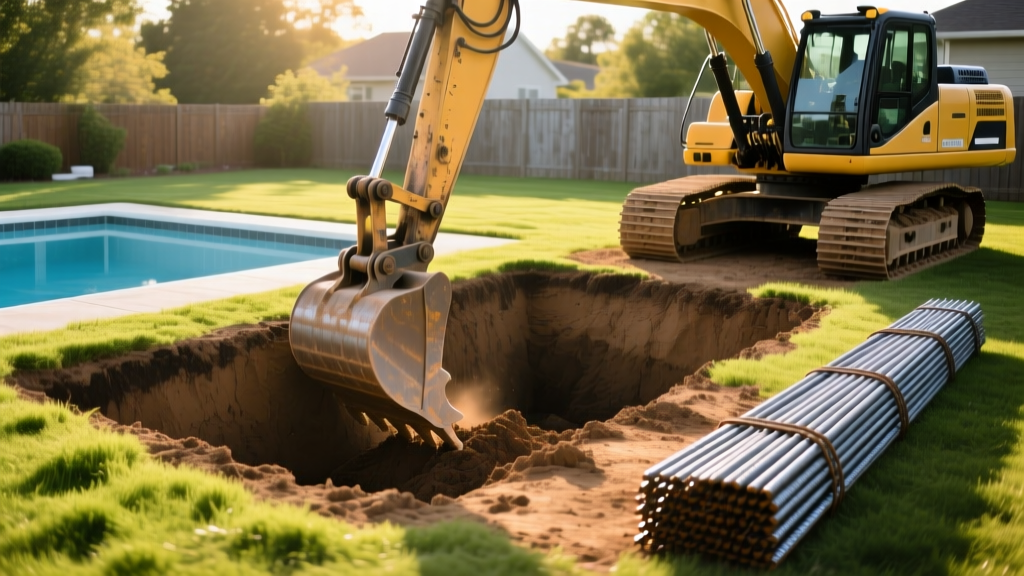
The 5 Hidden Budget Killers in Pool Excavation
Most pool contractors provide a base bid that assumes 'normal' digging conditions. When site conditions deviate, change orders can inflate your budget by 20% to 40%. Forbes Home highlights that site preparation and access issues are the leading causes of budget overruns in residential pool construction.
Always review your contract's excavation clause. Many standard contracts include a 'rock encounter' clause that shifts the cost of breaking or blasting bedrock directly to the homeowner. If you live in an area with shallow bedrock (e.g., parts of Texas, the Carolinas, or New England), budget an immediate $5,000 to $15,000 contingency for rock hammering.
- Spoil Hauling and Dirt Removal: A standard 14x28x5-foot pool yields roughly 75 to 100 cubic yards of excavated soil. Because dirt expands when dug (swell factor), this translates to 12 to 15 dump truck loads. If you cannot use the dirt to grade your yard, hauling and dump fees will cost between $1,800 and $3,500.
- Crane Access for Fiberglass Shells: Fiberglass pools are delivered in one piece. If your property lacks a wide side yard or alleyway for a semi-truck and backhoe to access the backyard, a crane must lift the shell over your house. Crane mobilization and lift fees range from $3,500 to $8,500 depending on boom reach requirements.
- Utility Rerouting: Excavating directly over existing gas, water, or sewer lines requires rerouting. Moving a primary residential gas line typically costs $1,500 to $3,000 and requires municipal inspections.
- High Water Table Dewatering: If you live in a coastal or low-lying area, hitting the water table during excavation requires continuous dewatering pumps and potentially a specialized gravel underlayment to prevent the empty pool shell from 'floating' out of the ground during heavy rains. Expect a $2,500 to $5,000 surcharge.
- Engineering and Soil Reports: In regions with expansive clay or unstable soils, municipalities require a geotechnical soil report and engineered structural plans before issuing a permit. This adds $1,500 to $3,000 to the pre-construction budget.
Mechanical and Equipment Specifications
The equipment pad is where long-term energy costs are determined. Skimping on mechanicals to save $2,000 upfront will cost you double in electrical usage and premature replacements over a decade.
High-ROI Equipment Investments
Always specify a variable-speed pump (VSP). The Pentair IntelliFlo3 VSF or Hayward TriStar VS (typically $2,200 to $2,800 installed) uses up to 85% less energy than single-speed pumps, paying for itself in energy savings within 18 to 24 months. Additionally, upgrade your sanitation system to a Salt Water Chlorine Generator (SWCG) like the Hayward AquaRite ($1,800 installed). While it requires an initial investment and a $400 cell replacement every 3-5 years, it eliminates the need to purchase liquid chlorine weekly and provides a vastly superior swimming experience.
Features to Defer or Cut
If your budget is tightening, eliminate water features (sheer descents, deck jets, and bubblers). These require dedicated plumbing lines, additional pump capacity, and complex automation integration, easily adding $4,000 to $8,000 to the contract. Similarly, defer automated pool covers; while excellent for safety and heat retention, a high-end motorized track cover (like a Cover-Pools system) costs $12,000 to $18,000 and can be retrofitted later if you choose a rectangular pool design without complex curves or raised spas.
Pro-Tip on Interior Finishes: If building a gunite pool, bypass standard white marcite plaster. It is prone to mottling and requires acid washing within 5 years. Upgrade to an exposed aggregate finish like PebbleTec or Wet Edge Primera Stone. The upgrade costs roughly $3,500 to $5,500 more than marcite but extends the interior lifespan from 7-10 years to 15-20+ years, drastically lowering your cost-per-year of ownership.
Budget Planning Framework: Structuring Your Capital
To maintain control over your financial outlay, structure your pool budget using the 60/20/20 framework. This ensures that the core structural integrity is never compromised by aesthetic desires.
- 60% - Shell, Excavation, and Core Plumbing: This is non-negotiable. Ensure your contractor is using #3 or #4 steel rebar spaced no more than 10 to 12 inches on center for gunite pools, and Schedule 40 PVC for all pressure-side plumbing. Do not accept flexible PVC on the suction side, as it is vulnerable to rodent chewing and crushing.
- 20% - Equipment, Automation, and Electrical: Allocate this to high-efficiency pumps, oversized cartridge filters (minimum 300-400 sq. ft. for standard pools to reduce cleaning frequency), and a smart automation panel (e.g., Pentair IntelliCenter) that allows remote monitoring of water chemistry and pump schedules.
- 20% - Hardscaping, Coping, and Decking: Standard brushed concrete decking is the most cost-effective ($12-$16 per sq. ft.), but it cracks and retains heat. If budget allows, upgrade the immediate coping (the pool edge) to natural travertine or bluestone ($35-$50 per linear ft.) while keeping the outer deck concrete. This provides a premium look and a cool-to-the-touch surface where swimmers actually sit, without paying for a full stone deck.
By understanding the granular costs of materials, anticipating subterranean excavation risks, and prioritizing mechanical efficiency, you can accurately forecast the true average cost to build an inground pool and avoid the financial pitfalls that derail most residential aquatic projects.
Written by
James ThorntonJames Thornton is a construction industry veteran with 25 years of hands-on experience in wood framing, lumber grading, and residential building codes. He started as a framing carpenter in rural Oregon, earned his ICC Residential Building Inspector certification, and eventually became a senior plan reviewer for the City of Portland Bureau of Development Services. James holds a B.S. in Wood Science & Technology from Oregon State University and is a certified lumber grader through the West Coast Lumber Inspection Bureau (WCLIB). He has inspected over 3,000 residential construction sites and authored the city's internal guide on advanced framing techniques (2x6 at 24" O.C.). James lives in Bend, OR, where he builds custom timber-frame cabins and competes in lumberjack sports.
More from James Thornton
View all
Insulation
Best Home Insulation Materials: Complete 2026 Guide
Compare top home insulation materials for 2026. Find R-values, installed costs per square foot, and best uses for fiberglass, spray foam, and mineral wool.
Aug 4, 2026

Sustainable Building
Certify Your Green Building Material for LEED and WELL
Step-by-step guide to certifying a green building material for LEED v5 and WELL v2. Master EPDs, HPDs, and VOC limits for 2026 project specifications.
Aug 4, 2026

Stone & Masonry
Veneer Stacked Stone Panels: Interior Design & Style Showcase
Discover how veneer stacked stone panels transform interiors. Explore modern design profiles, material pairings, and technical installation specs.
Aug 4, 2026