How Much Did It Cost to Build Mercedes-Benz Stadium? Financing Breakdown
Discover how much it cost to build Mercedes-Benz Stadium. We analyze the $1.5B capital stack, NFL loans, public subsidies, and private equity.
The $1.5 Billion Question: Final Cost vs. Initial Estimates
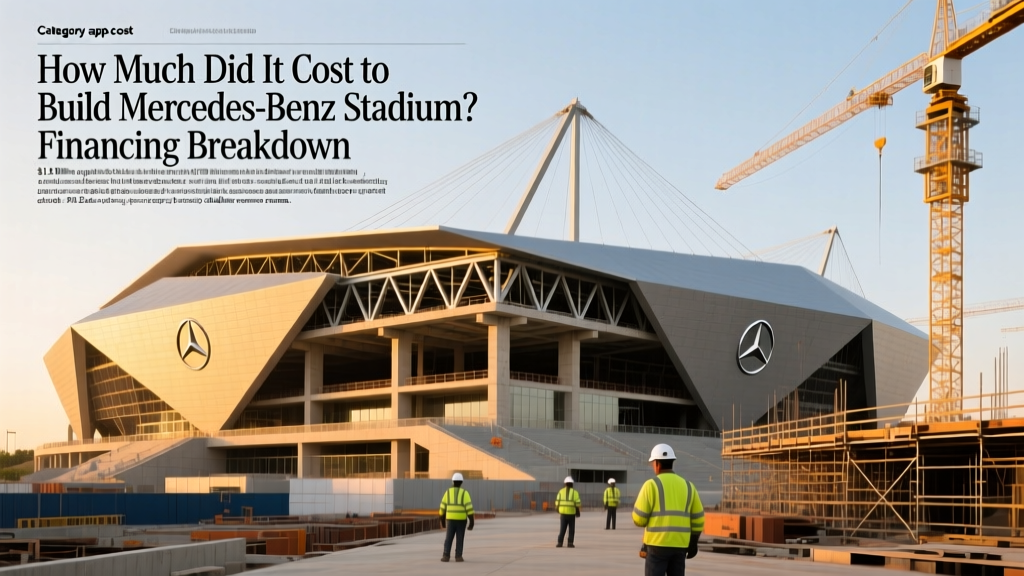
When the Atlanta Falcons and Atlanta United first proposed a new downtown venue in 2012, the headline figure was a neat $1 billion. However, the question of how much did it cost to build Mercedes-Benz Stadium ultimately yielded a vastly different answer by the time the doors opened in August 2017. The final all-in project cost ballooned to approximately $1.5 billion to $1.6 billion, making it one of the most expensive sports venues ever constructed in North America.
For construction estimators, commercial developers, and sports franchise owners analyzing mega-project feasibility in 2026, the Atlanta stadium serves as a masterclass in capital stack engineering, bespoke material risk, and the hidden costs of urban site preparation. The $500 million gap between the initial estimate and the final ledger was not merely the result of inflation; it was driven by aggressive design enhancements, complex land assemblage, and the engineering realities of a kinetic, multi-panel retractable roof.
Quick Cost Summary: Mercedes-Benz Stadium
- Initial 2012 Estimate: $1.0 Billion
- Final All-In Cost (2017): ~$1.5 Billion - $1.6 Billion
- Cost per Square Foot: ~$714 (based on 2.1M sq ft total footprint)
- Primary Cost Driver: Kinetic ETFE Oculus Roof & Urban Land Assemblage
Deconstructing the Capital Stack: Who Paid for What?
Financing a $1.5 billion mega-structure requires a highly stratified capital stack. Arthur Blank, owner of the Falcons and founder of The Home Depot, utilized a hybrid model of personal equity, private debt, league-backed loans, and targeted public subsidies. According to data compiled by StadiumDB, the funding matrix was structured to shield the ownership group from catastrophic downside risk while leveraging tax-advantaged debt.
1. Private Equity and Ownership Capital
Arthur Blank and the AMB Group committed approximately $700 million in personal equity and private family office capital. This massive skin-in-the-game requirement was necessary to secure favorable terms from private lenders and the NFL. By front-loading equity, the ownership group avoided over-leveraging the franchise's future cash flows, a critical risk-mitigation strategy for modern stadium development.
2. The NFL G-3 Stadium Loan Program
The NFL's G-3 Stadium Loan Program provides tax-exempt, league-backed loans to franchise owners to incentivize new stadium construction. For Mercedes-Benz Stadium, the NFL approved a $200 million G-3 loan. This debt is serviced primarily through stadium-specific revenue streams, including Personal Seat Licenses (PSLs), luxury suite leases, and naming rights (Mercedes-Benz paid an estimated $20M-$25M annually for naming rights). The G-3 program effectively acts as a senior debt tranche with league guarantees, drastically lowering the interest rate compared to traditional commercial construction loans.
3. Private Bank Syndication
To bridge the gap between the equity contribution and the G-3 loan, AMB Group secured roughly $400 million to $500 million in private bank debt. A syndicate led by Bank of America and other major institutional lenders provided this capital, secured against the franchise's enterprise value and future broadcast revenue distributions.
4. Public Subsidies and Infrastructure Funding
While the stadium's hard construction costs were privately funded, the public sector absorbed a significant portion of the site preparation and infrastructure burden. The City of Atlanta and the State of Georgia contributed approximately $200 million to $250 million. Crucially, this was not a direct cash grant for concrete and steel. Instead, it was funded via a hotel-motel tax extension and allocated toward land acquisition, environmental remediation, road widening, and MARTA (transit) station upgrades. As noted in research by the Brookings Institution regarding sports economics, separating public infrastructure funding from private hard costs is a common political strategy to secure taxpayer approval.
| Funding Source | Estimated Amount | Capital Type | Risk Profile |
|---|---|---|---|
| AMB Group / Arthur Blank Equity | ~$700 Million | Private Equity | High (First-loss capital) |
| NFL G-3 Loan Program | $200 Million | Tax-Exempt Debt | Low (League-backed) |
| Private Bank Syndicate | ~$450 Million | Senior Commercial Debt | Medium (Secured by revenues) |
| City/State (Hotel-Motel Tax) | ~$200 - $250 Million | Public Infrastructure Grant | N/A (Taxpayer-funded) |
Hidden Costs: Land Acquisition, Infrastructure, and Overruns
When evaluating how much it cost to build Mercedes-Benz Stadium, amateur estimators often look only at the hard construction costs (materials and labor). Professional cost consultants know that urban mega-projects carry massive soft costs and site-prep expenses. The stadium was built on a 50-acre site in downtown Atlanta, previously occupied by the Georgia Dome, parking lots, and two historic churches.
The True Cost of Urban Land Assemblage
Acquiring the necessary parcels cost upwards of $70 million. This included complex eminent domain negotiations, relocation assistance for displaced congregations (Friendship Baptist Church), and environmental soil remediation. In 2026, urban land assemblage in tier-1 US cities has only grown more expensive, making this historical data point a vital baseline for modern feasibility studies.
Infrastructure and Transit Integration
A 75,000-seat venue cannot rely on existing municipal grids. The project required:
- MARTA Station Upgrades: Expanding the adjacent transit hub to handle 30,000+ simultaneous pedestrians.
- Utility Relocation: Rerouting major municipal water, sewer, and high-voltage electrical lines that ran directly beneath the proposed footprint.
- Streetscaping: Widening Northside Drive and integrating pedestrian plazas, funded largely by the public subsidy tranche.
The Oculus Roof: A Case Study in Bespoke Material Risk
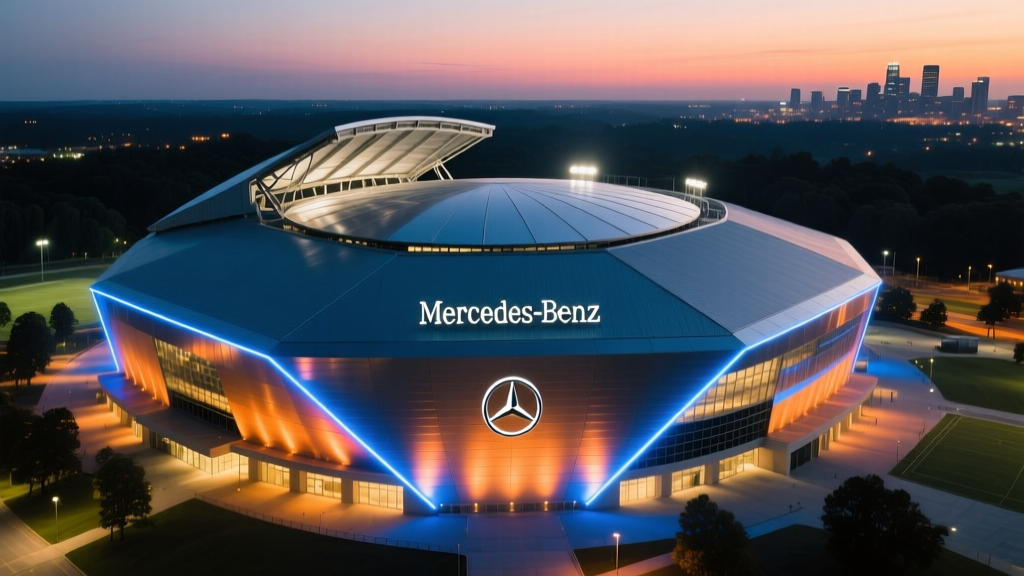
The single largest driver of the $500 million cost overrun was the kinetic oculus roof. Originally conceived as a standard fixed dome, the design evolved into an eight-panel, retractable system inspired by a falcon's wing. This design pivot introduced severe engineering and procurement risks.
The roof panels utilize ETFE (Ethylene Tetrafluoroethylene) rather than traditional glass. While ETFE is 1% the weight of glass and allows for higher UV transmission (crucial for natural turf growth), it requires highly specialized fabrication. The kinetic steel tracks supporting the ETFE pillows required custom-milled tolerances of less than 2 millimeters. When the primary steel contractor faced fabrication delays, the project schedule slipped by over a year, triggering hundreds of millions in liquidated damages, extended overhead, and inflation-adjusted material repricing.
Lessons for Mega-Project Financing in 2026
For developers and cost estimators planning large-scale commercial, sports, or entertainment venues today, the Mercedes-Benz Stadium case study provides three non-negotiable frameworks for financial modeling:
1. Separate Hard Costs from 'All-In' Project Costs
Never present a hard-construction estimate to stakeholders as the final project cost. A professional capital stack model must include a minimum 20% allocation for land assemblage, utility relocation, and transit integration. If the site is a brownfield or requires eminent domain, increase the soft-cost contingency to 30%.
2. Cap Bespoke Architectural Features Early
The oculus roof cost overruns occurred because the design evolved after the initial Guaranteed Maximum Price (GMP) was conceptualized. In modern Construction Management at-Risk (CMAR) delivery, bespoke kinetic or tensile structures must be locked in at the 30% design development phase. Any architectural pivot post-GMP must be accompanied by an immediate, independently verified change-order reserve.
3. Leverage Tax-Advantaged League or Municipal Debt
Private equity is the most expensive capital in the stack. Maximizing tax-exempt municipal bonds (for infrastructure) and league-backed loans (like the NFL G-3 or MLB equivalent) drastically lowers the Weighted Average Cost of Capital (WACC). Ensure your financing timeline accounts for the 12-to-18-month approval cycles required for public subsidy referendums and league finance committee votes.
"The sticker price of a stadium is just the entry fee. The true cost of a mega-project is defined by the site's existing infrastructure deficits and the owner's appetite for bespoke architectural risk." — Senior Sports Facilities Financial Analyst
Sources and Further Reading
For deeper analysis into stadium economics, historical cost data, and public subsidy impacts, consult the following authoritative resources:
Written by
Sarah WhitfieldSarah Whitfield is a chartered quantity surveyor (MRICS) and construction cost analyst with 15 years of experience in material pricing, procurement strategy, and project budgeting. She earned her degree in Construction Management from the University of Reading (UK) and has worked on projects ranging from $2M custom homes to $180M mixed-use developments across North America and Europe. Sarah currently leads cost estimating for BuildMat Insight, maintaining a proprietary database of 4,000+ material price points updated quarterly. She is a frequent contributor to RSMeans cost data panels and has presented at the International Cost Engineering Council (ICEC) congress. Based in Denver, CO, Sarah is an avid trail runner and volunteer mentor for Women in Construction.
More from Sarah Whitfield
View all
Wood & Lumber
What Are the Different Types of Wood? A Builder's Guide
Compare structural softwoods, finish hardwoods, and engineered lumber. Analyze Janka ratings, MOE values, and 2026 pricing for construction.
Aug 4, 2026

Walls & Panels
Steel Framing vs Wood Framing: Corrosion and Moisture Defense
Compare steel framing vs wood framing for moisture resistance. Learn about galvanized coatings, condensation risks, and corrosion protection strategies.
Jul 21, 2026

Stone & Masonry
How to Cut Stone Veneer: Wet Saw vs Grinder Comparison
Compare the best tools for cutting stone veneer. We review wet saws, angle grinders, and chop saws to help you achieve clean, chip-free cuts.
Jul 21, 2026