Norwegian Encore Cost to Build: Regional Shipyard Analysis
Explore the Norwegian Encore cost to build across global regions. We analyze German, Chinese, and US shipyard pricing, materials, and fit-out metrics.
The Baseline: Norwegian Encore Cost to Build in Germany
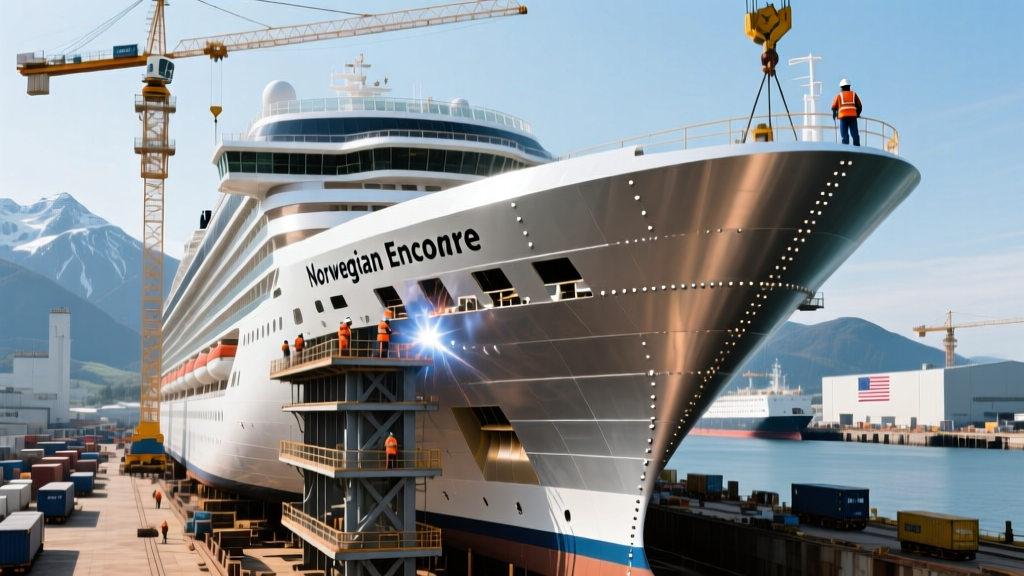
When evaluating mega-scale commercial hospitality structures, few projects rival the complexity of a Breakaway Plus class cruise vessel. The Norwegian Encore, delivered in 2019 by Meyer Werft in Papenburg, Germany, represents a benchmark in marine commercial construction. While the original contract value was estimated between $1.2 billion and $1.4 billion USD, analyzing the Norwegian Encore cost to build from a 2026 perspective requires adjusting for post-2024 inflation, marine-grade steel volatility, and advanced HVAC supply chain shifts.
• Gross Tonnage: 169,116 GT
• Length: 1,094 feet (333.45 meters)
• Staterooms: 1,925 (Capacity: 3,998 guests)
• 2026 Adjusted Replacement Cost: ~$1.55 Billion USD
• Primary Shipyard: Meyer Werft (Papenburg, Germany)
According to project overviews by Ship Technology, the vessel's construction is split into two distinct phases: the hull/machinery (approx. 45% of total cost) and the interior outfitting (approx. 55%). Unlike terrestrial commercial buildings, the outfitting phase must integrate SOLAS (Safety of Life at Sea) fireproofing, marine vibration damping, and saltwater-resistant HVAC systems into every square foot of the 1,925 cabins.
Regional Shipyard Price Matrix: Where Else Could It Be Built?
If a commercial developer or cruise line were to commission a direct replica of the Norwegian Encore today, regional shipyard dynamics would drastically alter the final ledger. Below is a comparative matrix analyzing the theoretical cost to build this exact 169,116 GT specification across four major global maritime regions in 2026.
| Region / Shipyard Hub | Est. Total Cost (2026) | Labor Cost Index | Supply Chain & Fit-Out Constraints |
|---|---|---|---|
| Papenburg, Germany (Meyer Werft) | $1.55 Billion | High | Unmatched luxury fit-out; local European supply chain for ABB Azipods and MAN engines. |
| Saint-Nazaire, France (Chantiers de l'Atlantique) | $1.52 Billion | High | Direct competitor; slightly lower structural steel costs but equal interior outfitting expenses. |
| Shanghai, China (CSSC) | $1.15 Billion | Low/Medium | Hull fabrication is 30% cheaper, but luxury interior modules must still be imported from Italy/Germany. |
| Norfolk, USA (Hypothetical Jones Act Build) | $3.80+ Billion | Very High | Jones Act mandates US steel and labor; lacks specialized cruise-ship dry docks and outfitting supply chains. |
Material & Labor Breakdown by Region
Marine-Grade Steel & Hull Fabrication
The hull of a Breakaway Plus class vessel requires approximately 30,000 to 35,000 metric tons of specialized marine steel, primarily AH36 and DH36 high-tensile grades. In Germany and France, the cost of AH36 steel plate, including cutting, welding, and block assembly, averages $3,200 per ton. In Shanghai, domestic steel sourcing drops this to roughly $2,100 per ton. However, the Norwegian Encore's official specifications dictate precise weight-distribution metrics for stability; Chinese shipyards historically struggle with the weight-creep tolerances required for ultra-large cruise vessels, often resulting in a 2-4% material overage that negates the base steel savings.
Interior Fit-Out & Entertainment Rigs
The Norwegian Encore features a massive 1,100-foot go-kart track, a laser tag arena, and a 900-seat theater. Constructing these on land is a standard commercial entertainment build. Constructing them on Deck 18 and 19 of a floating structure requires extreme engineering:
- Dynamic Load Reinforcement: The go-kart track requires localized high-tensile steel cross-bracing to handle the dynamic lateral loads of 10 karts cornering simultaneously while the ship rolls in 15-foot swells. This localized reinforcement adds an estimated $12M–$15M to the upper deck structural budget.
- Acoustic & Vibration Damping: The 900-seat theater utilizes floating floors and resilient mounts to isolate acoustic vibrations from the ship's main diesel-electric generators. Marine-grade acoustic dampening materials cost roughly 3.5x more than terrestrial commercial equivalents due to strict IMO (International Maritime Organization) fire toxicity standards.
- Modular Cabin Construction: The 1,925 staterooms are built as prefabricated "wet units" (cabins with pre-installed plumbing and HVAC) in off-site factories, then slid into the hull. In Europe, a luxury marine cabin module costs $280,000 to $340,000 per key, compared to $150,000 to $200,000 for a luxury terrestrial hotel room.
Terrestrial Commercial Comparison: Ship vs. Skyscraper
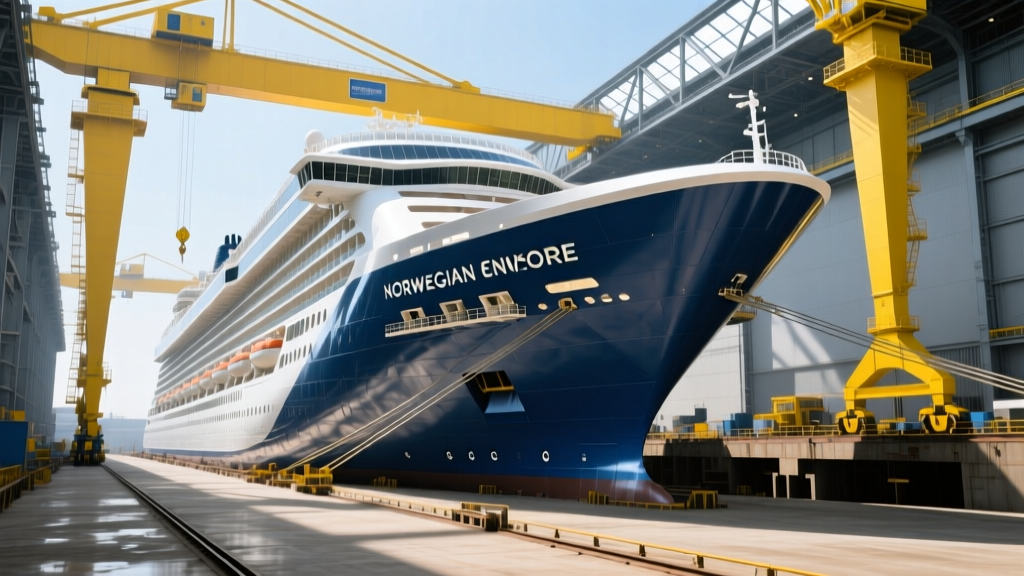
To contextualize the Norwegian Encore cost to build for commercial real estate estimators, it is highly effective to compare the vessel to a terrestrial luxury resort or high-rise. The Norwegian Encore contains roughly 2.1 million square feet of interior space. At a 2026 adjusted cost of $1.55 billion, the construction cost equates to approximately $738 per square foot.
"Building a mega-ship is essentially constructing a 20-story luxury resort, but you must build it inside a moving, vibrating, saltwater-exposed steel tube that generates its own power and processes its own waste. The premium you pay over terrestrial construction is almost entirely dedicated to marine survivability, SOLAS compliance, and compact MEP (Mechanical, Electrical, Plumbing) routing."
By comparison, a Class-A luxury high-rise hotel in a major US metropolitan area (e.g., Miami or New York) averages $550 to $650 per square foot in 2026. The ship's 15-20% premium over land-based luxury construction is driven by the miniaturization of MEP systems, marine-grade fireproofing (which requires non-combustible A-60 class bulkheads instead of standard drywall), and the logistical nightmare of outfitting a vessel in a dry dock rather than an open construction site.
Propulsion and Machinery Costs
The propulsion system represents a massive capital expenditure. The Norwegian Encore utilizes a diesel-electric configuration powered by MAN B&W engines driving ABB Azipod azimuth thrusters. The Azipods alone, which provide 360-degree maneuverability without traditional rudders, cost upwards of $25 million per unit. Sourcing these specialized propulsion units remains heavily monopolized by European manufacturers (ABB, Wärtsilä, Kongsberg), meaning that even if the hull is fabricated in China, the propulsion machinery costs remain fixed at European pricing tiers, creating a hard floor for global shipbuilding costs.
FAQs on Mega-Ship Construction Costs
Why is the US cost to build a cruise ship so much higher?
The Jones Act (Merchant Marine Act of 1920) requires vessels operating between US ports to be built in the US, using US steel and US labor. The US lacks the specialized supply chain for cruise ship outfitting, meaning every marine-grade fixture, HVAC unit, and entertainment rig would need to be imported and installed at US shipyard labor rates (often exceeding $80-$120/hour), driving the theoretical cost well past $3.5 billion.
How long does it take to build a ship of this scale?
From the initial steel-cutting ceremony to final sea trials, a Breakaway Plus class vessel typically requires 32 to 36 months. However, the design, engineering, and prefabrication of cabin modules begin up to 18 months before the first steel is cut, making the total project lifecycle nearly five years.
What is the most expensive single component of the interior?
While the theater and go-kart track are highly visible, the most expensive interior system is the marine HVAC and freshwater generation network. Pumping, treating, and climate-controlling air and water for nearly 6,000 passengers and crew in a sealed, saltwater environment requires custom titanium-plate heat exchangers and massive reverse-osmosis desalination plants, easily exceeding $80 million in equipment and installation costs.
Written by
Sarah WhitfieldSarah Whitfield is a chartered quantity surveyor (MRICS) and construction cost analyst with 15 years of experience in material pricing, procurement strategy, and project budgeting. She earned her degree in Construction Management from the University of Reading (UK) and has worked on projects ranging from $2M custom homes to $180M mixed-use developments across North America and Europe. Sarah currently leads cost estimating for BuildMat Insight, maintaining a proprietary database of 4,000+ material price points updated quarterly. She is a frequent contributor to RSMeans cost data panels and has presented at the International Cost Engineering Council (ICEC) congress. Based in Denver, CO, Sarah is an avid trail runner and volunteer mentor for Women in Construction.
More from Sarah Whitfield
View all
Wood & Lumber
What Are the Different Types of Wood? A Builder's Guide
Compare structural softwoods, finish hardwoods, and engineered lumber. Analyze Janka ratings, MOE values, and 2026 pricing for construction.
Aug 4, 2026

Walls & Panels
Steel Framing vs Wood Framing: Corrosion and Moisture Defense
Compare steel framing vs wood framing for moisture resistance. Learn about galvanized coatings, condensation risks, and corrosion protection strategies.
Jul 21, 2026

Stone & Masonry
How to Cut Stone Veneer: Wet Saw vs Grinder Comparison
Compare the best tools for cutting stone veneer. We review wet saws, angle grinders, and chop saws to help you achieve clean, chip-free cuts.
Jul 21, 2026