Oasis of the Seas Cost to Build: Regional Shipyard Analysis
Discover the true Oasis of the Seas cost to build, comparing European, South Korean, and Chinese shipyard pricing, material expenses, and labor rates.
The Blueprint: Original vs. 2026 Replacement Cost
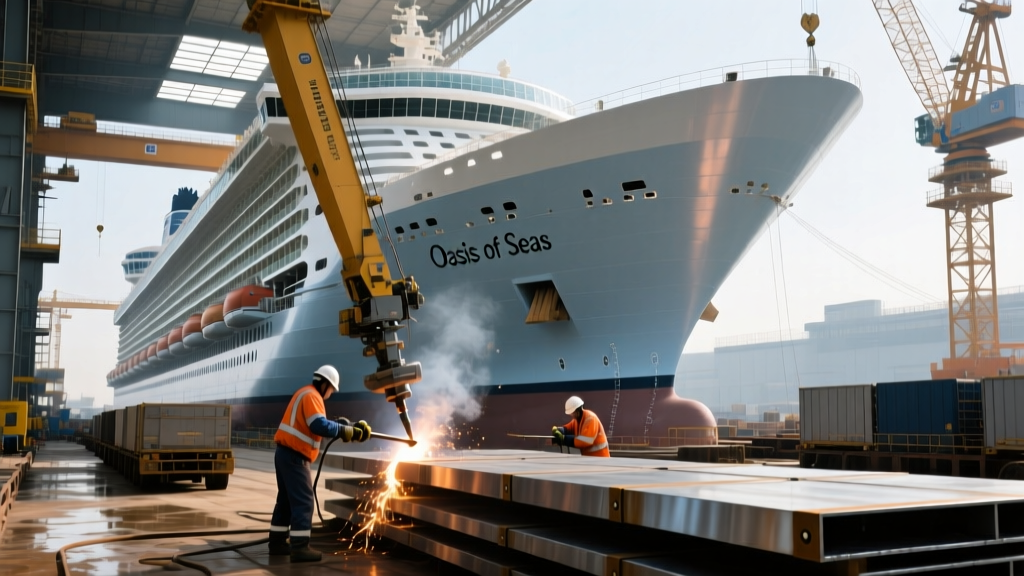
When Royal Caribbean International commissioned the first Oasis-class vessel, the maritime construction industry fundamentally shifted its understanding of scale. Analyzing the oasis of the seas cost to build requires looking past the initial 2009 price tag of $1.4 billion USD. If a shipyard were to lay the keel for an exact replica of this 225,282-gross-tonnage mega-structure today, the 2026 replacement cost would range between $2.15 billion and $2.45 billion USD. This 60%+ increase is not merely a product of general inflation; it reflects the compounding costs of advanced maritime emissions compliance, high-tensile steel volatility, and the extreme complexity of hospitality outfitting.
2026 Cost Baseline Highlight
Total Estimated Cost: $2.3 Billion USD
Steel & Hull Fabrication: ~$350 Million (15%)
Propulsion & Mechanical: ~$450 Million (20%)
Interior Outfitting & Hospitality: ~$1.5 Billion (65%)
The most critical takeaway for construction estimators is the 65% outfitting ratio. Unlike commercial cargo vessels where the steel hull and propulsion represent the vast majority of the budget, a floating resort requires thousands of individual plumbing, electrical, and HVAC nodes. According to project specifications documented by Ship Technology, the vessel contains over 2,700 staterooms, 24 passenger lifts, and miles of specialized fire-rated bulkheads, making the interior build-out the primary cost driver.
Regional Shipyard Pricing Matrix
To understand the global economics of mega-ship construction, we must evaluate how different regional shipyards would price this project in 2026. While Asia dominates global shipbuilding tonnage, the cruise sector remains heavily concentrated in Europe. The table below models the theoretical cost to build the Oasis of the Seas across four major maritime hubs.
| Shipyard Region | Est. 2026 Cost | Labor Rate (Avg) | Outfitting Supply Chain | Feasibility |
|---|---|---|---|---|
| Turku, Finland (Meyer) | $2.30 Billion | $55 - $75 / hr | Tier 1 (Local) | Highly Proven |
| Saint-Nazaire, France | $2.45 Billion | $60 - $85 / hr | Tier 1 (Local) | Highly Proven |
| Busan, South Korea | $2.60 Billion | $35 - $50 / hr | Tier 3 (Imported) | Low / High Risk |
| Shanghai, China (CSSC) | $2.10 Billion | $20 - $35 / hr | Tier 4 (Imported) | Moderate / Unproven |
The Outfitting Paradox: Why Europe Dominates
At first glance, the Asian shipyards in South Korea and China appear to offer massive cost advantages due to lower labor rates and highly efficient steel fabrication yards. However, the oasis of the seas cost to build in Asia actually inflates or carries prohibitive risk. This phenomenon is known in maritime economics as the 'Outfitting Paradox'.
The Interior Finishing Bottleneck
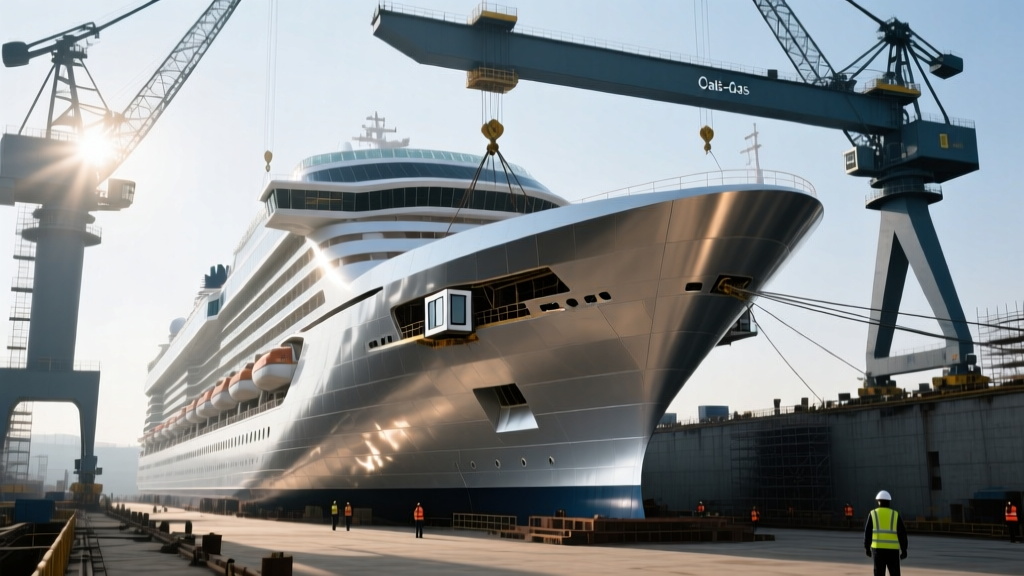
Building the steel hull of a 360-meter vessel is a commodity process. The true complexity lies in the 'hotel' systems. An Oasis-class ship requires the installation of modular cabin units, complex theatrical rigging, ice rinks, and water parks. European shipyards like Meyer Turku and Chantiers de l'Atlantique are surrounded by a dense, localized supply chain of specialized maritime interior contractors. In South Korea, the supply chain is optimized for LNG containment systems and bulk cargo holds, not luxury hospitality finishes.
If a Korean shipyard were to build this vessel, they would be forced to import European modular cabins, specialized marine HVAC units, and SOLAS-compliant interior materials. The logistical cost of shipping thousands of prefabricated hotel modules from Italy or Finland to Busan entirely erases the local labor savings, while introducing severe schedule risks.
Fire Safety and SOLAS Compliance
Passenger vessels are governed by strict safety regulations. The International Convention for the Safety of Life at Sea (SOLAS) mandates rigorous fire zoning, requiring main vertical zones to be separated by A-60 class fire-rated bulkheads. Managing the thousands of cable penetrations, pipe transits, and fire dampers in a vessel with 2,744 staterooms requires a workforce deeply trained in passenger ship compliance. Asian yards, which primarily build commercial freight vessels with minimal crew accommodations, currently lack the specialized engineering talent pool to execute this at scale without massive cost overruns.
Material and Systems Cost Breakdown
To accurately estimate the construction budget, estimators must break down the primary capital expenditure categories. The following list details the specific heavy equipment and material costs required for a 2026 Oasis-class build:
- High-Tensile Steel (AH36 Grade): The hull requires approximately 55,000 metric tons of steel. At 2026 shipbuilding steel prices averaging $750 per metric ton, the raw material cost is roughly $41.2 million. This represents less than 2% of the total build cost.
- Propulsion Systems: The vessel relies on three 20,000 kW ABB Azipod azimuth thrusters and four 5,500 kW bow thrusters. Combined with six massive Wärtsilä 12V46D diesel generators, the propulsion and power generation package costs upwards of $280 million.
- Modular Cabin Units: Cabins are not built inside the ship; they are manufactured in off-site factories as complete modular blocks (including plumbing, wiring, and furniture) and lifted into the hull by gantry cranes. At an average fully-outfitted cost of $135,000 per unit, the 2,744 staterooms represent a $370 million material and fabrication expense.
- HVAC and Climate Control: Conditioning the air for 6,700 passengers and 2,100 crew members across 18 decks requires industrial marine chillers and over 100 air handling units, costing approximately $85 million.
Estimator Warning: Dry Dock Infrastructure
When calculating regional feasibility, do not ignore dry dock dimensions. The Oasis of the Seas measures 360 meters in length and 60.5 meters in beam. Very few shipyards globally possess dry docks wide and deep enough to accommodate this beam while allowing scaffolding access. Shipyards must invest hundreds of millions in infrastructure expansion before they can even bid on an Oasis-class contract.
Risk Factors in Mega-Ship Construction
Cost estimation for a project of this magnitude must include substantial contingency buffers. The primary risk factors driving budget variance include:
- Supply Chain Fragmentation: A delay in the delivery of the main engines or custom theatrical equipment can halt the entire outfitting sequence, leading to millions in liquidated damages and idle labor costs.
- Weight Management: Cruise ships are hyper-sensitive to weight distribution. If interior materials exceed their specified weight limits, the vessel's draft increases, reducing fuel efficiency and requiring costly ballast adjustments.
- Regulatory Shifts: The International Maritime Organization (IMO) continuously tightens emissions standards. Integrating dual-fuel LNG capabilities or advanced shore-power connectivity mid-build can add $50M to $100M to the final invoice.
Frequently Asked Questions
How long does it take to build a ship of this scale?
From the initial steel cutting to the final sea trials, the construction timeline typically spans 36 to 42 months. However, the design, engineering, and modular cabin fabrication phases begin up to two years before the steel is cut, making the total project lifecycle closer to five years.
Why are Oasis-class ships more expensive per ton than cargo ships?
A bulk carrier might cost $40 million to build using 30,000 tons of steel, equating to roughly $1,300 per ton. An Oasis-class vessel costs over $2 billion using 55,000 tons of steel, equating to nearly $40,000 per ton. The disparity is entirely due to the 'hotel' outfitting, advanced life-safety systems, and luxury finishes required for passenger hospitality.
Could a US-based shipyard build the Oasis of the Seas?
While technically possible, it is economically unviable. US shipyards (such as Newport News or NASSCO) are optimized for naval and military vessel construction. Their labor rates, combined with the Jones Act supply chain requirements and a lack of commercial cruise outfitting infrastructure, would likely push the cost well beyond $5 billion USD, pricing the project out of any commercial return-on-investment model.
Written by
Marcus ChenMarcus Chen is a licensed structural engineer (PE) and building materials analyst with over 12 years of experience across residential, commercial, and industrial construction. He holds a Master of Science in Civil Engineering from UC Berkeley and spent six years at Thornton Tomasetti before transitioning to independent consulting and technical writing. Marcus specializes in material selection for seismic-prone regions, concrete reinforcement strategies, and lifecycle cost analysis. His work has been cited by the American Concrete Institute (ACI) and the Structural Engineers Association of California (SEAOC). When he is not on a job site or at his desk, you will find him hiking the Sierra Nevada or restoring a 1920s craftsman bungalow in Oakland, CA.
More from Marcus Chen
View all
Construction Cost
How Much Did the Eiffel Tower Cost to Build?
How much did the Eiffel Tower cost to build in 1889? We adjust for inflation and compare its budget to modern skyscraper construction.
Aug 4, 2026

Fire Resistance
What Is a Fire Resistant Material? Testing & Certification Guide
Discover what is a fire resistant material through ASTM and UL testing. Learn how fire ratings, certifications, and assemblies work in construction.
Aug 4, 2026

Construction Cost
How Much Did the Burj Khalifa Cost to Build?
How much did the Burj Khalifa cost to build? We break down the $1.5B project and extract 5 money-saving strategies for your next build.
Jul 30, 2026