Regional Cost to Build an Aircraft Carrier: Shipyard Analysis
Analyze the regional cost to build an aircraft carrier, exploring shipyard labor, steel supply chains, and the $13B price tag of nuclear supercarriers.
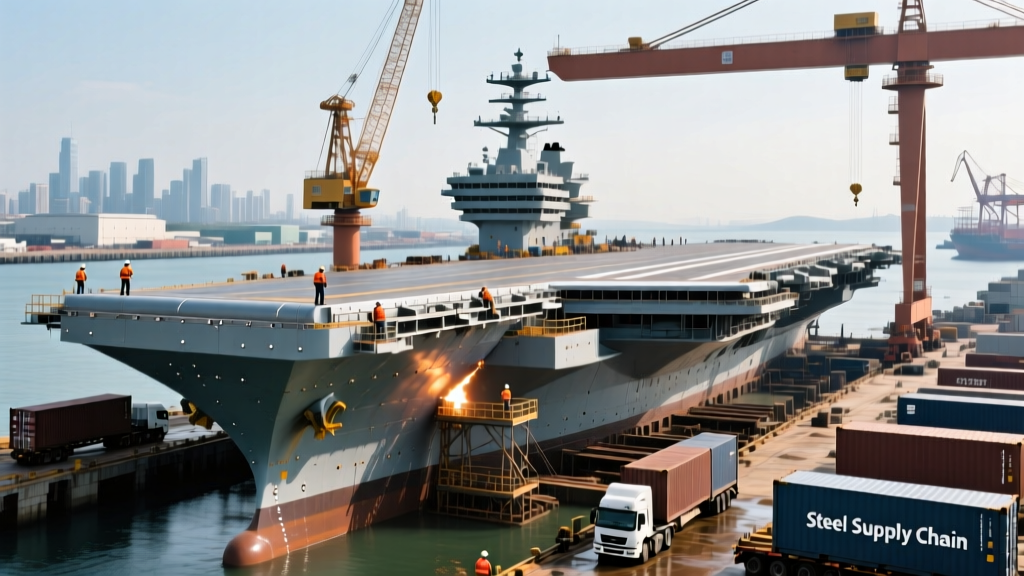
The Anatomy of a $13 Billion Mega-Project
Estimating the cost to build an aircraft carrier requires looking far beyond standard commercial construction metrics. The modern US Navy Ford-class supercarrier represents the most complex, capital-intensive movable structure ever engineered. While the baseline procurement cost for the USS Gerald R. Ford (CVN-78) peaked at roughly $13.3 billion, subsequent vessels like the USS John F. Kennedy (CVN-79) and the two-ship block buy of the USS Enterprise (CVN-80) and USS Doris Miller (CVN-81) target a reduced envelope of $11.5 billion to $12.7 billion per hull, according to the Congressional Research Service.
However, these top-line figures obscure the intense regional economic dynamics that dictate actual build costs. Unlike commercial real estate or standard industrial facilities, a nuclear aircraft carrier cannot be bid out to the lowest global contractor. The cost is inextricably tied to a specific geographic choke point, specialized metallurgical supply chains, and captive regional labor markets.
Strategic Procurement Callout: The Block Buy Advantage
By executing a two-ship block buy for CVN-80 and CVN-81, the Navy leveraged regional supplier stability to lock in material pricing. This strategy mitigates the boom-and-bust cycle of specialized defense manufacturing, yielding an estimated $2.5 billion in savings across both hulls by maintaining continuous production lines at component foundries and steel mills.
Regional Monopoly: The Hampton Roads Shipyard Factor
The most significant regional variable in the cost to build an aircraft carrier is the absolute monopoly held by HII’s Newport News Shipbuilding in Hampton Roads, Virginia. It is the only facility in the United States with the infrastructure, security clearances, and drydock capacity (specifically Dry Dock 12) to construct and refuel nuclear supercarriers. As noted by HII's official program documentation, the shipyard employs over 25,000 workers, creating a localized micro-economy that heavily influences labor rates.
Labor Rates and the Captive Workforce
Because the shipyard is the sole builder, the regional labor pool is entirely captive. The cost of specialized trades—nuclear-qualified welders, marine electricians, and heavy riggers—in the Hampton Roads area commands a premium. In 2026, fully burdened labor rates for nuclear pipefitters at the yard exceed $115 per hour, factoring in benefits, security overhead, and specialized Navy QA training. Unlike commercial construction where labor can be imported from neighboring states to suppress costs, the strict classified nature of the CVN program requires a localized, vetted, and continuously trained workforce.
Supply Chain Geography: Sourcing 40,000 Tons of Naval Steel
A Ford-class carrier requires over 40,000 tons of advanced steel. The regional cost dynamics of this material are governed by the Berry Amendment (10 U.S.C. § 2533a), which mandates that the Department of Defense purchase specialty metals melted and produced in the United States. This eliminates cheaper international steel markets from the estimating equation.
| Material Grade | Application | Est. 2026 Cost per Ton | Primary Regional Source |
|---|---|---|---|
| HSLA-115 | Flight deck, critical bulkheads | $3,800 - $4,500 | Midwest / Great Lakes Mills |
| HY-80 / HY-100 | Underwater hull, torpedo defense | $2,900 - $3,400 | Pennsylvania / Alabama |
| Nuclear-Grade Forgings | Reactor vessel, propulsion shafts | $15,000+ | Specialized Gulf Coast Foundries |
The logistics of moving 40,000 tons of heavy plate steel from Midwestern mills to the Virginia coast via rail and barge adds a substantial freight surcharge to the material estimate. Furthermore, the steel must undergo rigorous ultrasonic testing and naval certification before it can even be staged in the shipyard, adding 15% to 20% in quality assurance overhead compared to commercial structural steel.
Nuclear Propulsion and Advanced Subsystems
The true cost divergence between a standard commercial vessel and a supercarrier lies in the propulsion and launch systems. The Ford-class utilizes two A1B Bechtel nuclear reactors. According to the US Navy Fact File, the A1B plant generates 25% more electrical energy than the legacy A4W reactors on the Nimitz-class, supporting the ship's massive electromagnetic demands.
The EMALS Cost Premium
Replacing traditional steam catapults with the Electromagnetic Aircraft Launch System (EMALS) and the Advanced Arresting Gear (AAG) introduced severe cost overruns during the CVN-78 build. General Atomics, the primary contractor for EMALS, faced immense developmental hurdles. For estimators analyzing future CVN costs, the integration of these systems now represents a stabilized but massive line item, accounting for roughly $1.2 billion to $1.5 billion per ship. The regional footprint of EMALS testing requires specialized land-based facilities in New Jersey and Virginia, further distributing the geographic cost center.
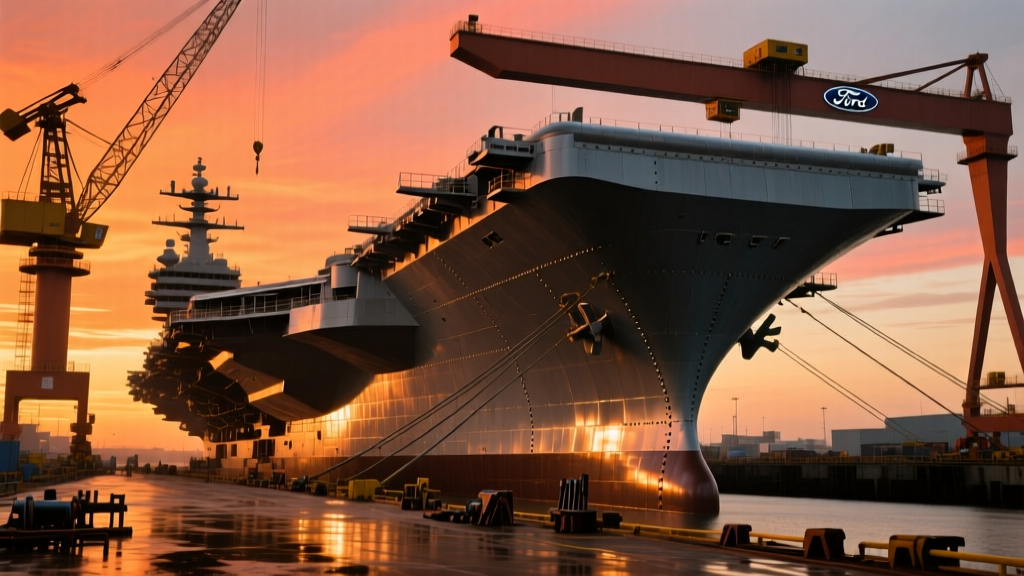
Global Cost Matrix: US vs. International Equivalents
To contextualize the regional US cost to build an aircraft carrier, it is vital to compare it against international programs. The US prioritizes nuclear propulsion, survivability, and unmatched sortie generation rates, which exponentially drives up the price compared to foreign counterparts.
| Nation / Class | Propulsion | Displacement | Est. Unit Cost (USD) |
|---|---|---|---|
| USA (Ford-Class) | Nuclear (A1B) | 100,000+ tons | $12.7B - $13.3B |
| UK (Queen Elizabeth) | Conventional (IFEP) | 65,000 tons | $3.8B - $4.2B |
| China (Fujian Type 003) | Conventional (Steam) | 80,000+ tons | $4.5B - $5.5B (Est.) |
| France (Charles de Gaulle) | Nuclear (K15) | 42,000 tons | $3.5B (Historical) |
The UK's Queen Elizabeth class demonstrates the cost savings of utilizing conventional Integrated Full Electric Propulsion (IFEP) and bypassing the extreme regulatory and security overhead of naval nuclear reactors. However, the US Navy's strategic requirement for unlimited range and massive electrical generation for directed-energy weapons makes the nuclear premium non-negotiable in American cost estimates.
2026 Inflation and Future Cost Trajectories
As the shipyard transitions into the late stages of CVN-79 and begins heavy fabrication on CVN-80, defense estimators must account for compounding inflation in specialized maritime sectors. The Naval Sea Systems Command (NAVSEA) utilizes specific escalation indices that frequently outpace the standard Consumer Price Index (CPI).
- Specialty Metals Escalation: Titanium and high-yield steel alloys have seen localized price spikes due to global supply chain realignments and increased demand from the aerospace sector.
- Submarine Competition: The simultaneous construction of Columbia-class ballistic missile submarines at General Dynamics Electric Boat (and module fabrication at Newport News) creates intense regional competition for nuclear-qualified welders, driving up labor premiums in the Northeast and Mid-Atlantic corridors.
- Digital Twin Integration: Modern CVN builds now mandate comprehensive 3D digital twin modeling prior to steel cutting. While this requires a heavy upfront software and engineering investment (approx. $150M per hull), it drastically reduces costly physical rework in the drydock.
Strategic Takeaways for Defense Estimators
Calculating the cost to build an aircraft carrier is an exercise in analyzing a closed, highly regulated regional economy. Estimators cannot rely on commercial RSMeans data or standard industrial square-footage metrics. The price tag is dictated by the Hampton Roads labor monopoly, the strict domestic sourcing requirements of the Berry Amendment, and the staggering integration costs of next-generation nuclear and electromagnetic subsystems. For future defense budget projections, the primary cost-control lever remains multi-ship block procurement, which stabilizes the national supplier base and prevents the catastrophic cost spikes associated with production line gaps.
Written by
James ThorntonJames Thornton is a construction industry veteran with 25 years of hands-on experience in wood framing, lumber grading, and residential building codes. He started as a framing carpenter in rural Oregon, earned his ICC Residential Building Inspector certification, and eventually became a senior plan reviewer for the City of Portland Bureau of Development Services. James holds a B.S. in Wood Science & Technology from Oregon State University and is a certified lumber grader through the West Coast Lumber Inspection Bureau (WCLIB). He has inspected over 3,000 residential construction sites and authored the city's internal guide on advanced framing techniques (2x6 at 24" O.C.). James lives in Bend, OR, where he builds custom timber-frame cabins and competes in lumberjack sports.
More from James Thornton
View all
Insulation
Best Home Insulation Materials: Complete 2026 Guide
Compare top home insulation materials for 2026. Find R-values, installed costs per square foot, and best uses for fiberglass, spray foam, and mineral wool.
Aug 4, 2026

Sustainable Building
Certify Your Green Building Material for LEED and WELL
Step-by-step guide to certifying a green building material for LEED v5 and WELL v2. Master EPDs, HPDs, and VOC limits for 2026 project specifications.
Aug 4, 2026

Stone & Masonry
Veneer Stacked Stone Panels: Interior Design & Style Showcase
Discover how veneer stacked stone panels transform interiors. Explore modern design profiles, material pairings, and technical installation specs.
Aug 4, 2026