Regional Cost to Build a Septic Tank: 2026 Pricing Guide
Discover the regional cost to build a septic tank in 2026. Compare prices by soil type, system design, and US region with our expert pricing matrix.
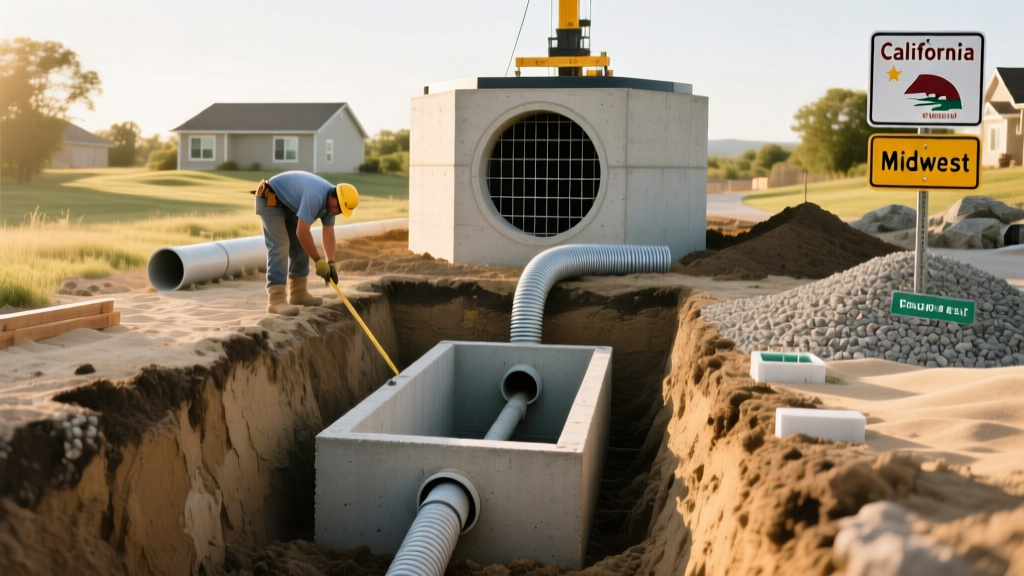
The True Cost to Build a Septic Tank: Why Geography Dictates Your Budget
When calculating the cost to build a septic tank, homeowners and developers frequently make the mistake of relying on national averages. A national median of $7,500 is virtually useless for actual budgeting because subsurface conditions, local health department mandates, and regional labor rates create massive price disparities. A conventional gravity-fed system installed in the sandy, well-draining soils of the Florida Panhandle might cost $6,000, while an engineered aerobic treatment unit (ATU) required for the shallow bedrock of upstate New York can easily exceed $22,000.
As of 2026, the pricing landscape for onsite wastewater treatment systems (OWTS) has shifted due to updated environmental regulations, increased costs for washed aggregate, and heavy equipment operator shortages. To accurately estimate your project, you must evaluate the intersection of your regional soil morphology, the required tank material, and local permitting frameworks. According to the EPA's SepticSmart program, nearly 25% of American homes rely on decentralized systems, making regional cost literacy essential for rural and suburban construction.
Regional Cost Breakdown: 2026 Pricing by US Zone
The following matrix outlines the estimated total installed costs for a standard 3-bedroom residential property (requiring a 1,000 to 1,250-gallon tank capacity) across major US regions. These figures encompass site evaluation, excavation, tank delivery, installation, and final backfill.
| US Region | Dominant Soil Challenge | Typical System Required | Estimated Total Cost (2026) |
|---|---|---|---|
| Northeast (New England, NY, PA) | Shallow bedrock, seasonal high water tables | Engineered Mound or ATU | $14,500 - $26,000 |
| Southeast (FL, GA, Carolinas) | Sandy soils, extreme high water tables | Conventional with Fill or Drip Irrigation | $6,500 - $13,500 |
| Midwest (OH, IL, IN) | Expansive clays, poor percolation | Lagoon, Sand Filter, or ATU | $9,000 - $18,500 |
| West / Southwest (AZ, NM, CO) | Arid conditions, caliche, deep bedrock | Evapotranspiration (ET) or Deep Trench | $11,000 - $24,000 |
| Pacific Northwest (WA, OR) | Heavy winter saturation, clay-loam mixes | Pressure Distribution or Glendon Mound | $13,000 - $21,000 |
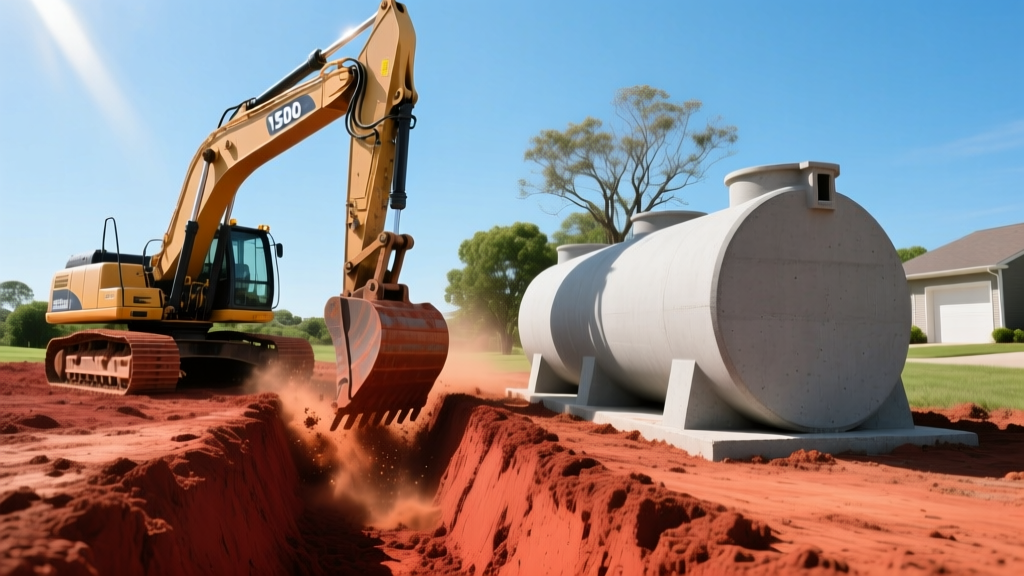
How Soil Morphology and Water Tables Drive System Selection
Before a single trench is dug, a licensed soil scientist must perform a soil morphological evaluation and a percolation (perc) test. The perc test measures the rate at which water absorbs into the ground, typically following guidelines established by university extensions and state DEP agencies. If your soil absorbs water at a rate slower than 60 minutes per inch (MPI), a conventional gravity system is usually prohibited by code.
Many contractors perform perc tests during dry summer months when the water table is at its lowest. If your site has a seasonal high water table (SHWT) that rises within 24 inches of the surface during spring snowmelt or heavy rains, the health department will mandate a raised mound system. Always demand that your soil evaluation includes a SHWT assessment via soil mottling and redoximorphic features to avoid a $10,000 mid-project change order.
High Water Table & Poor Percolation Zones (Northeast & Coastal South)
In areas with high water tables, the primary goal is to keep the effluent above the saturation zone to allow for aerobic bacterial treatment. This requires importing engineered fill sand and constructing a mound system. The cost to build a septic tank in these scenarios is heavily inflated by material transport; a standard mound system requires 80 to 150 tons of washed #57 aggregate and specific coarse-grained sand, which can add $4,000 to $7,000 in material and hauling fees alone.
Expansive Clay & Arid Regions (Southwest & Midwest)
Expansive clays swell when wet and crack when dry, which can crush standard corrugated distribution pipes and cause trench collapse. In these regions, installers must use Schedule 40 PVC for all distribution lines and often utilize pressure distribution networks with effluent pumps (like the Myers or Goulds 1/2 HP grinder pumps) to force effluent through small-diameter drip tubing. In arid regions with caliche (a hardened calcium carbonate crust), excavation requires rock-breaking attachments, pushing equipment rental costs up by $1,500 to $2,500 per day.
Tank Material Cost vs. Longevity Matrix
The physical tank is only a fraction of the total project cost, but choosing the wrong material for your soil type can lead to catastrophic structural failure. Below is a comparison of the three primary tank materials available in 2026.
| Material | 1,250-Gallon Cost | Structural Pros & Cons | Best Regional Application |
|---|---|---|---|
| Precast Concrete (ASTM C1227) | $1,600 - $2,400 | Extremely heavy, requires crane. Immune to buoyancy. Lasts 40+ years. | High water table areas, heavy vehicle traffic zones. |
| Fiberglass | $2,100 - $3,200 | Lightweight, easy to install. Prone to floating out of the ground if empty during high water events. | Arid regions, sandy soils with low water tables. |
| Polyethylene (Ribbed) | $1,400 - $2,100 | Flexible, resists cracking. Can deform under heavy clay loads if not properly bedded. | Remote sites where crane access for concrete is impossible. |
Hidden Regional Costs: Permitting, Engineering, and Site Prep
When budgeting the cost to build a septic tank, line-item blindness is a common pitfall. The tank and the trench are obvious expenses, but the ancillary requirements vary wildly by county and state. Factor these 2026 regional variables into your estimating spreadsheet:
- Soil Morphological Evaluation: $450 to $900. Required in almost all states before a permit is issued. Must be performed by a licensed soil scientist, not just the excavator.
- Engineering Stamps for Alternative Systems: $1,500 to $3,500. If your site fails a standard perc test, an engineer must design a custom ATU or mound system and stamp the blueprints for the health department.
- Crane Rental and Rigging: $900 to $1,600 per day. A 1,250-gallon precast concrete tank weighs over 12,000 lbs. If the installation site is more than 50 feet from the road, you will need a 50-ton boom crane.
- Effluent Filters and D-Boxes: $250 to $600. Modern codes in states like Massachusetts and Washington mandate inline effluent filters (e.g., Polylok or Zabel models) to prevent drainfield clogging. Distribution boxes must be cast-in-place concrete or heavy-duty polymer to prevent shifting.
- Decommissioning Old Systems: $1,200 to $2,800. If you are replacing a failed system, many counties require the old tank to be pumped, crushed, and filled with sand or gravel to prevent sinkholes and illegal dumping.
Expert Framework: Estimating Your Specific Site's Septic Cost
To move from a rough guess to a highly accurate budget, follow this sequential decision framework:
- Secure the Soil Data First: Do not sign a contractor bid until you have the official soil morphology report in hand. The report will dictate the exact linear footage of trench or square footage of mound required.
- Calculate the Design Flow: Multiply the number of bedrooms by your state's daily design flow (typically 110 to 150 gallons per bedroom per day). A 4-bedroom home requires a minimum 1,000 to 1,250-gallon tank, regardless of the actual square footage of the house.
- Assess Site Access: Walk the path from the street to the installation site. Can a fully loaded dump truck and a backhoe fit without destroying existing landscaping or retaining walls? If access is restricted, add 15% to your excavation budget for manual labor or mini-excavator limitations.
- Verify Setback Distances: Check local codes for mandatory setbacks. Most jurisdictions require the tank to be at least 10 feet from the foundation, 50 feet from property lines, and 100 feet from private wells. If your lot is narrow, you may be forced into a more expensive, compact alternative treatment system.
Common Site-Specific Septic Cost Questions
Does adding a garbage disposal increase the cost to build a septic tank?
Not directly during construction, but it impacts the design. Health departments in states like New York and Massachusetts often require a 25% increase in drainfield size or a larger tank capacity if a garbage disposal is planned, which can add $1,500 to $3,000 to the overall system cost due to extra trenching and aggregate.
Are aerobic treatment units (ATUs) worth the extra upfront cost?
An ATU will cost $8,000 to $12,000 more than a conventional system upfront. However, if your lot has zero usable area for a conventional drainfield due to poor soils or proximity to a water body, an ATU is often the only legal pathway to obtain a building permit, effectively making it a mandatory cost for development on difficult parcels.
How much does it cost to maintain these regional systems annually?
Conventional systems require pumping every 3 to 5 years ($350 to $550 per pump). However, engineered systems like ATUs and sand filters require quarterly maintenance inspections and annual filter cleanings, pushing annual maintenance costs to $400 to $800. Always factor the 20-year lifecycle maintenance cost into your initial regional price analysis.
Written by
Priya KapoorPriya Kapoor is a real estate market analyst and construction economics researcher with expertise in housing affordability, development feasibility, and infrastructure investment. She holds a Master of Regional Planning from Cornell University and previously worked as a senior analyst at CBRE's Investment Properties group, where she modeled returns for $4B in mixed-use development pipelines. Priya now runs an independent research practice advising developers, municipalities, and REITs on construction cost forecasting and market timing. She publishes the quarterly "BuildMat Market Pulse" report tracking material price indices across 12 commodity categories. Based in Austin, TX, Priya serves on the board of Habitat for Humanity Austin and is a marathon runner.
More from Priya Kapoor
View all
Construction Cost
Cost to Build a 1600 Sq Ft Home in 2026: Full Breakdown
Accurate 2026 cost to build a 1600 sq ft home—material, labor, and regional pricing breakdowns included. Plan your budget with real-time estimates.
Aug 11, 2026

Wood & Lumber
Name the Types of Wood for Pressure Treatment and Preservation
Learn how to name the types of wood best suited for pressure treatment. Compare species treatability, chemical retention levels, and 2026 preservation costs.
Aug 4, 2026

Stone & Masonry
Stone Veneer Suppliers Lindenhurst: 2026 Cost Analysis
Analyze 2026 stone veneer costs in Lindenhurst, NY. Compare local supplier pricing, delivery fees, and Suffolk County installation labor rates.
Aug 4, 2026