How Much Does It Cost to Build a Septic System? 2026 Costs
Discover exactly how much it costs to build a septic system in 2026. Breakdowns by system type, soil conditions, and hidden installation fees.
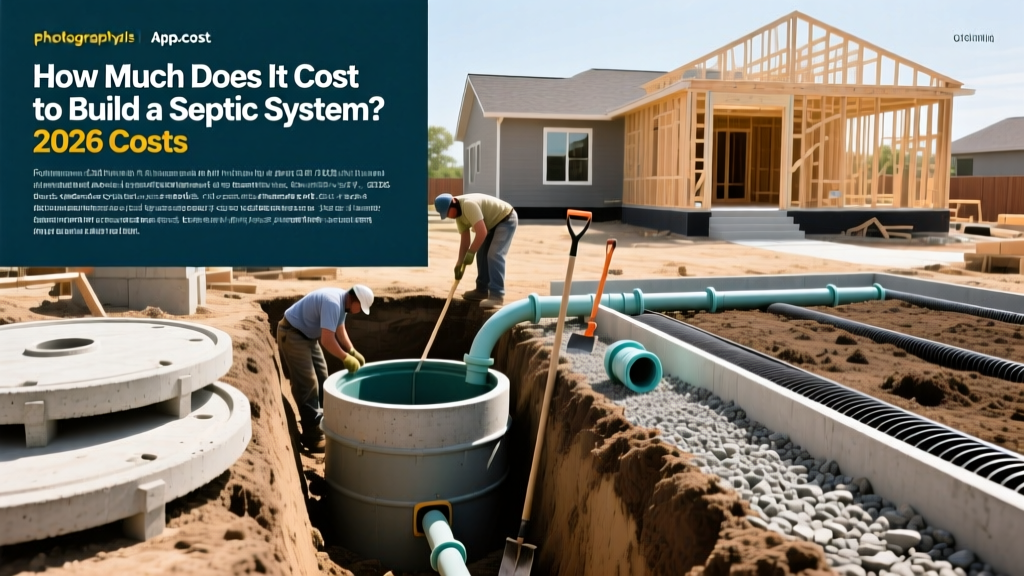
The True Cost to Build a Septic System: Beyond the Tank
Estimating the cost to build a septic system requires looking far beyond the price of the concrete or plastic tank itself. The final installation price is dictated by soil morphology, local health department regulations, site topography, and the specific wastewater treatment technology required. In 2026, the national average cost to build a complete septic system for a standard 3-bedroom home ranges from $6,500 to $14,000, though complex engineered systems can easily exceed $25,000.
• National Average: $9,200
• Cost Per Bedroom: $2,500 - $3,500
• Typical Range (Conventional): $6,500 - $9,500
• Typical Range (Engineered/Alternative): $12,000 - $25,000+
According to the U.S. Environmental Protection Agency (EPA), roughly 20% of American homes rely on decentralized wastewater treatment. Because these systems handle raw sewage, local jurisdictions enforce strict engineering standards, meaning DIY shortcuts are both illegal and environmentally hazardous. Understanding the line-item breakdown ensures you can accurately budget for your specific site conditions.
Septic System Types and Installation Costs
The type of system your local health department mandates depends entirely on your soil's percolation rate and the seasonal high-water table. Below is a comparison matrix of the most common systems installed in 2026.
| System Type | Best Application | Avg Cost (3-Bed) | Maintenance Level |
|---|---|---|---|
| Conventional Gravel | Sandy/loamy soils, deep water table | $6,500 - $9,000 | Low |
| Chamber System | Replaces gravel; easier to install in tight spaces | $7,000 - $10,500 | Low |
| Drip Distribution | Shallow soils, sloped lots | $9,000 - $15,000 | High (Requires filtration & pump) |
| Aerobic Treatment (ATU) | High water tables, poor perc rates, small lots | $12,000 - $18,000 | Very High (Electrical & mechanical) |
| Mound System | Shallow bedrock, extremely high water table | $14,000 - $25,000 | Moderate (Pump maintenance) |
Line-Item Breakdown: Where Your Budget Goes
To understand how much it costs to build a septic system, you must separate the soft costs (engineering and permitting) from the hard costs (materials and heavy equipment). Here is a realistic 2026 line-item estimate for a standard 1,000-gallon conventional system.
- Site Evaluation & Soil Testing ($300 - $1,200): A licensed soil scientist performs a morphological soil evaluation or traditional percolation test. This determines the soil's absorption rate (measured in minutes per inch, or MPI) and identifies the seasonal high-water table.
- Engineering Design & Permits ($500 - $2,000): If your site requires an engineered alternative system, expect to pay a licensed professional engineer (PE) to draft the blueprints. Local health department permit fees typically range from $250 to $600.
- Excavation & Trenching ($1,500 - $3,500): Heavy equipment rental and operator labor. This includes digging the tank pit (typically 6 to 8 feet deep) and trenching the leach field. Rocky soil or heavy clay can double excavation time.
- The Septic Tank ($1,200 - $2,800): A 1,000-gallon precast concrete tank (manufactured to ASTM C1227 standards) costs between $1,400 and $2,200 delivered. Fiberglass and polyethylene tanks are slightly cheaper ($900 - $1,600) but require specialized anchoring in areas with high groundwater to prevent floating.
- Leach Field Materials ($1,500 - $3,000): Modern installations increasingly use plastic chamber systems (like Infiltrator Quick4 Standard chambers) which cost $40 to $60 per linear foot installed, compared to $30 to $45 per linear foot for traditional washed gravel and perforated PVC pipe.
- Backfill & Final Grading ($800 - $1,500): Covering the system with the correct type of soil (avoiding heavy clay or large rocks that could crush the pipes) and grading the surface to divert stormwater runoff away from the drain field.
Decision Framework: Choosing the Right System for Your Soil
You rarely get to choose your septic system based on preference; the soil dictates the design. Use this framework to anticipate which system your site will require based on preliminary observations.
Soil Percolation Decision Tree
Scenario A: Soil percs between 5 and 60 MPI (Minutes Per Inch)
→ Result: Conventional gravel or chamber system. This is the best-case scenario, yielding the lowest installation costs.
Scenario B: Soil percs faster than 5 MPI (Coarse sand/gravel)
→ Result: The soil absorbs water too quickly to filter pathogens. You will need a specialized sand filter or a low-pressure drip distribution system to ensure adequate treatment before the effluent reaches groundwater.
Scenario C: Soil percs slower than 60 MPI, or fails entirely (Heavy clay/shale)
→ Result: Conventional systems will flood and fail. You must install an engineered Mound system (importing specific sand fill to create an artificial absorption bed) or an Aerobic Treatment Unit (ATU) that injects oxygen to break down waste before discharging to a smaller, specialized drain field.
Hidden Costs and Edge Cases That Blow Up Budgets
Contractor bids often exclude site-specific anomalies. When calculating how much it costs to build a septic system, factor in these common budget-killers:
- Bedrock Blasting or Ripping: If the soil scientist finds bedrock within 24 to 48 inches of the surface, the leach field must be shallow or relocated. If you must blast bedrock to set a deep concrete tank, expect to add $2,000 to $5,000 to the excavation budget.
- Dewatering During Installation: If you dig the tank pit and hit the seasonal high-water table, the contractor must bring in trash pumps to continuously dewater the hole while setting the tank and making pipe connections. This adds $500 to $1,500 in labor and equipment.
- Effluent Pumps and Dosing Chambers: If the leach field is located uphill from the septic tank, or if the system requires pressure dosing (common in drip and mound systems), you will need a separate pump tank equipped with a high-head effluent pump (such as a Goulds Pumps WE0512 or Franklin Electric equivalent). Add $1,200 to $2,500 for the pump tank, pump, control panel, and electrical trenching.
- Tree Root Removal: Health departments require a 10-foot clearance between the leach field and large trees. Removing mature trees and grinding stumps to clear the absorption area can add $800 to $3,000 depending on the species and size.
Tank Material Comparison: Concrete vs. Fiberglass vs. Poly
The tank represents a significant portion of your material costs. Selecting the right material impacts both the upfront price and the long-term structural integrity of the system.
- Precast Concrete: The industry standard. Heavy enough to resist buoyancy in wet soils. Must meet ASTM C1227 specifications. Drawback: Requires a large crane or heavy-duty excavator to lift, and the internal rebar can rust if the concrete cover is inadequate, leading to structural collapse after 25-30 years.
- Fiberglass: Highly resistant to the corrosive hydrogen sulfide gases produced inside the tank. Lightweight, making it easier to transport. Drawback: Because it is lightweight, an empty fiberglass tank can literally float out of the ground during heavy rains if the water table rises. It must be anchored with concrete deadmen or specialized ribbing.
- Polyethylene (Plastic): Ribbed designs provide excellent structural support against soil loading. Completely impervious to rust and corrosion. Drawback: Similar buoyancy issues as fiberglass; requires strict backfill procedures (often using a slurry mix) to prevent shifting.
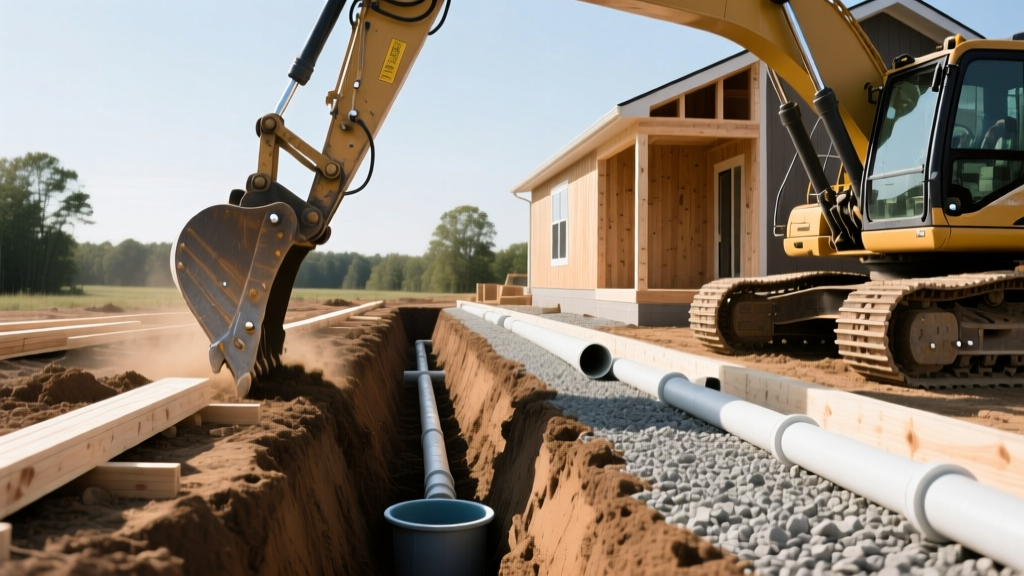
Long-Term Maintenance vs. Upfront Investment
Cutting corners on the initial build guarantees catastrophic failure later. According to the Washington State Department of Health, replacing a failed drain field costs between $10,000 and $30,000, largely due to the extraction and disposal of biologically contaminated soil. To protect your investment, install an effluent filter (such as a Tuf-Tite or Zabel model, costing roughly $100 to $150) in the tank's outlet baffle. This simple device prevents suspended solids from migrating into and clogging the leach field trenches. Budget $300 to $500 every three to five years for professional pumping, and avoid driving any heavy vehicles over the absorption area to prevent soil compaction and pipe crushing.
Frequently Asked Questions
Can I install a septic system myself to save money?
In most jurisdictions, it is illegal for an unlicensed homeowner to install a complete septic system. While you may be allowed to perform the final backfill or landscaping, the tank setting, pipe sloping, and electrical connections must be performed or directly supervised by a licensed installer to pass the mandatory health department inspection.
How long does the installation process take?
From the initial soil evaluation to final approval, the process typically takes 4 to 8 weeks, heavily dependent on local permitting backlogs. The actual physical excavation and installation usually takes 2 to 4 days for a conventional system, and up to 2 weeks for complex engineered mound or ATU systems.
Written by
Priya KapoorPriya Kapoor is a real estate market analyst and construction economics researcher with expertise in housing affordability, development feasibility, and infrastructure investment. She holds a Master of Regional Planning from Cornell University and previously worked as a senior analyst at CBRE's Investment Properties group, where she modeled returns for $4B in mixed-use development pipelines. Priya now runs an independent research practice advising developers, municipalities, and REITs on construction cost forecasting and market timing. She publishes the quarterly "BuildMat Market Pulse" report tracking material price indices across 12 commodity categories. Based in Austin, TX, Priya serves on the board of Habitat for Humanity Austin and is a marathon runner.
More from Priya Kapoor
View all
Construction Cost
Cost to Build a 1600 Sq Ft Home in 2026: Full Breakdown
Accurate 2026 cost to build a 1600 sq ft home—material, labor, and regional pricing breakdowns included. Plan your budget with real-time estimates.
Aug 11, 2026

Wood & Lumber
Name the Types of Wood for Pressure Treatment and Preservation
Learn how to name the types of wood best suited for pressure treatment. Compare species treatability, chemical retention levels, and 2026 preservation costs.
Aug 4, 2026

Stone & Masonry
Stone Veneer Suppliers Lindenhurst: 2026 Cost Analysis
Analyze 2026 stone veneer costs in Lindenhurst, NY. Compare local supplier pricing, delivery fees, and Suffolk County installation labor rates.
Aug 4, 2026