How Much Does It Cost to Build a Septic Tank? Complete Budget Guide
Discover how much it costs to build a septic tank and full system. Get current pricing for concrete, fiberglass, and alternative setups to plan your budget.
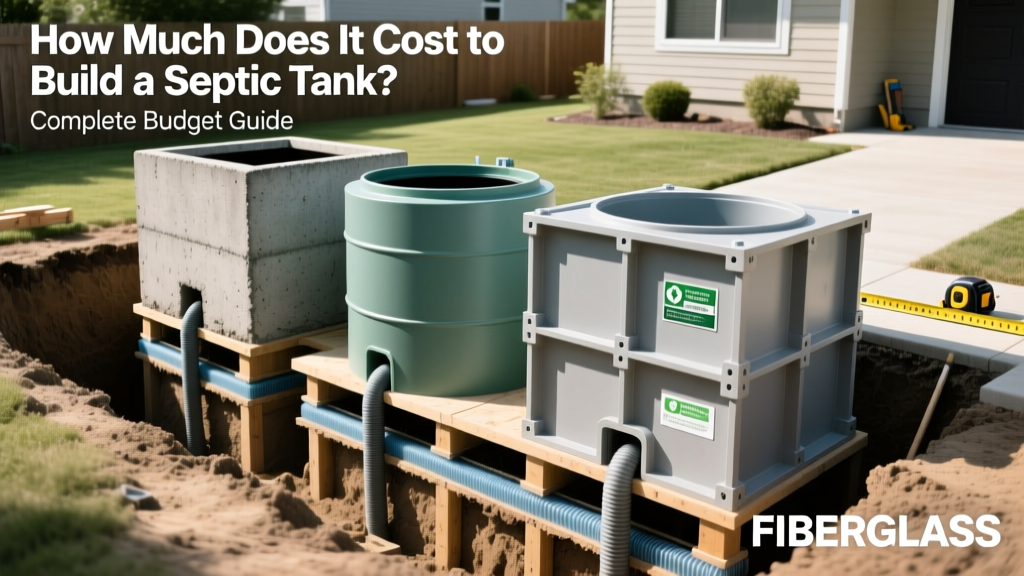
The True Cost to Build a Septic System: Beyond the Tank
When homeowners ask how much does it cost to build a septic tank, they are often surprised to learn that the physical tank itself accounts for only 15% to 25% of the total project budget. A complete septic system includes the tank, the distribution box, the drain field (leach field), excavation, soil testing, and local permitting. While a standalone 1,000-gallon concrete tank might cost between $1,200 and $2,200, the fully installed system typically ranges from $6,500 to $22,000, with complex alternative systems exceeding $30,000.
Material Breakdown: Concrete vs. Fiberglass vs. Polyethylene
Selecting the right tank material is the first major budget decision. Each material has distinct structural properties, lifespans, and installation requirements that directly impact your bottom line. According to the Environmental Protection Agency (EPA), proper material selection based on local soil conditions is critical for preventing groundwater contamination and structural failure.
| Material | Avg. Cost (1,000 Gal) | Lifespan | Pros & Cons |
|---|---|---|---|
| Precast Concrete | $1,200 - $2,200 | 30-50 years | Highly durable, withstands heavy soil loads. Heavy, requires crane for installation. Can crack in highly acidic soils. |
| Fiberglass | $1,500 - $2,800 | 30-40 years | Lightweight, immune to rust/corrosion. Prone to floating in high water tables if not properly anchored with concrete deadmen. |
| Polyethylene (Plastic) | $900 - $1,800 | 25-35 years | Cheapest option, easy to install. Ribbed designs (like Norwesco Bruiser) resist soil pressure, but vulnerable to crushing under heavy vehicular traffic. |
For most residential builds, precast concrete remains the gold standard. Ensure your supplier adheres to ASTM C1227 standards for precast concrete septic tanks, which mandates minimum wall thickness and reinforcement to prevent catastrophic collapse under soil load. If your site features a high water table, polyethylene or fiberglass may be necessary, but you must budget an additional $800 to $1,500 for anti-flotation anchoring systems.
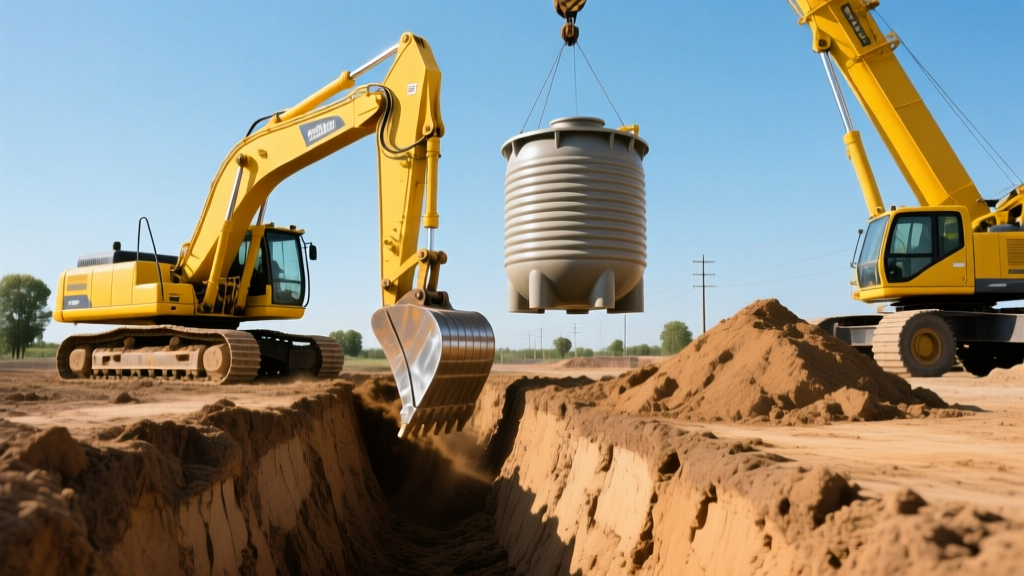
System Types and Excavation Variables
The configuration of your drain field is the most volatile variable in your budget. The EPA outlines several types of septic systems, each engineered for specific environmental challenges. Your local health department will mandate a specific system based on your property's soil morphology and seasonal water table depth.
Conventional Gravity Systems ($6,500 - $12,000)
Conventional systems rely on gravity to move effluent from the tank into a network of perforated PVC pipes buried in gravel-filled trenches. This is the most budget-friendly option but requires deep, well-draining soil with a percolation rate between 5 and 60 minutes per inch (MPI). If your soil percs too fast (gravel/sand) or too slow (heavy clay), a conventional system will fail inspection.
Chamber Systems ($8,000 - $15,000)
Chamber systems replace the gravel and pipe setup with large, arched plastic chambers (such as Infiltrator Quick4 systems). They are faster to install and require less heavy machinery, saving on labor costs. However, the chambers themselves cost roughly $150 to $250 per unit, and a standard 3-bedroom home may require 30 to 40 chambers, adding $4,500 to $10,000 in material costs alone.
Mound Systems ($15,000 - $25,000)
When the natural soil is too shallow or the seasonal water table is too high, engineers design a mound system. This involves trucking in specific grades of sand and gravel to build an elevated drain field above the natural grade. The extensive earthmoving, specialized fill materials, and required dosing pumps make this one of the most expensive conventional alternatives.
Aerobic Treatment Units (ATUs) ($18,000 - $30,000+)
ATUs function like miniature municipal wastewater plants, injecting oxygen into the tank to accelerate bacterial breakdown of solids. This produces highly treated effluent that can be dispersed via shallow drip irrigation. ATUs are mandatory in many environmentally sensitive areas or properties with near-surface bedrock. Budget for ongoing electrical costs and mandatory bi-annual maintenance contracts, which typically run $300 to $600 annually.
The Hidden Budget Killers: Soil Testing and Site Prep
Homeowners frequently blow their budgets by ignoring pre-construction site evaluation costs. Before a single shovel hits the dirt, you must fund the following prerequisites:
- Deep Hole Soil Morphological Evaluation ($500 - $1,500): A licensed soil scientist digs deep test pits to analyze soil horizons, mottling, and seasonal water table indicators. This replaces the outdated 'perc test' in most jurisdictions and dictates your system design.
- Engineering and Design Fees ($1,000 - $3,000): Alternative systems (mounds, ATUs, drip irrigation) require stamped engineering blueprints approved by the county health department.
- Tree Clearing and Root Removal ($1,500 - $4,000): Drain fields must be completely clear of deep-rooted vegetation. Trees must be removed at least 10 to 20 feet away from the proposed leach field to prevent root intrusion into the perforated pipes.
- Rock Blasting or Ripping ($3,000 - $8,000+): If your soil evaluation hits shallow bedrock or massive glacial erratics, excavators must use hydraulic hammers or controlled blasting to achieve the required 2 to 4 feet of vertical separation between the pipe invert and the bedrock.
Step-by-Step Budgeting Framework for Homeowners
To accurately forecast your financial exposure, follow this sequential budgeting framework before signing a contract with an installer:
- Define Bedroom Count: Septic sizing is legally based on bedrooms, not bathrooms or square footage. A 3-bedroom home requires a minimum 1,000-gallon tank; a 4-5 bedroom home requires a 1,250 to 1,500-gallon tank. Add $300 to $600 to your tank budget for every extra 250 gallons of capacity.
- Fund the Soil Evaluation First: Pay the $500-$1,500 for a soil scientist out of pocket before purchasing unimproved land. If the land requires a $25,000 mound system, you need to know before closing on the real estate transaction.
- Request Itemized Bids: Do not accept lump-sum quotes. Demand an itemized breakdown separating excavation, tank materials, gravel/sand fill, piping, and backfilling. This prevents contractors from hiding excessive markup in the earthwork phase.
- Allocate a 15% Contingency: Subsurface conditions are inherently unpredictable. If an excavator uncovers a hidden spring or an unmapped utility line, work stops until it is resolved. A 15% contingency fund protects you from project abandonment.
Maintenance vs. Replacement: Long-Term Financial Planning
Building the system is only the initial capital expenditure. To protect your investment and avoid a premature $15,000 replacement, strict maintenance protocols must be followed. Pump the tank every 3 to 5 years ($300 to $500 per service) to prevent solid sludge from migrating into the drain field and clogging the soil biomat. Never use chemical septic additives; they disrupt the natural anaerobic bacteria required to break down waste and can actually accelerate drain field failure. Divert all roof gutters and sump pumps away from the leach field, as hydraulic overloading is the leading cause of premature system washout.
Written by
Marcus ChenMarcus Chen is a licensed structural engineer (PE) and building materials analyst with over 12 years of experience across residential, commercial, and industrial construction. He holds a Master of Science in Civil Engineering from UC Berkeley and spent six years at Thornton Tomasetti before transitioning to independent consulting and technical writing. Marcus specializes in material selection for seismic-prone regions, concrete reinforcement strategies, and lifecycle cost analysis. His work has been cited by the American Concrete Institute (ACI) and the Structural Engineers Association of California (SEAOC). When he is not on a job site or at his desk, you will find him hiking the Sierra Nevada or restoring a 1920s craftsman bungalow in Oakland, CA.
More from Marcus Chen
View all
Construction Cost
How Much Did the Eiffel Tower Cost to Build?
How much did the Eiffel Tower cost to build in 1889? We adjust for inflation and compare its budget to modern skyscraper construction.
Aug 4, 2026

Fire Resistance
What Is a Fire Resistant Material? Testing & Certification Guide
Discover what is a fire resistant material through ASTM and UL testing. Learn how fire ratings, certifications, and assemblies work in construction.
Aug 4, 2026

Construction Cost
How Much Did the Burj Khalifa Cost to Build?
How much did the Burj Khalifa cost to build? We break down the $1.5B project and extract 5 money-saving strategies for your next build.
Jul 30, 2026