How Much Did the Titanic Cost to Build? Megaproject Financing Guide
Discover how much the Titanic cost to build, adjusted for modern inflation, and explore megaproject financing lessons for today's construction estimators.
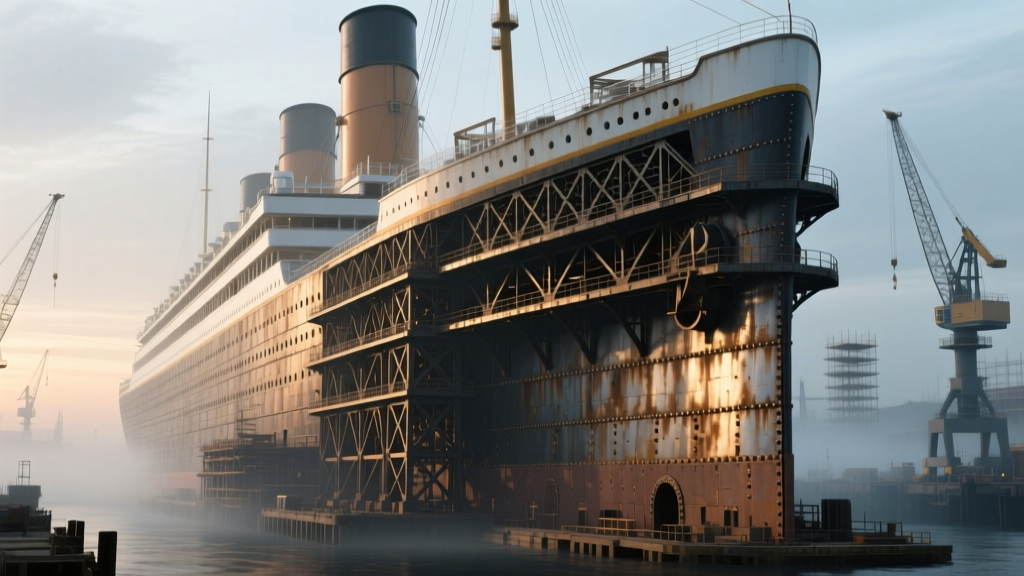
The Original Ledger: Breaking Down the 1912 Construction Costs
When analyzing historical megaprojects, construction estimators must look past the romanticism of the era and examine the raw ledger data. The RMS Titanic, alongside her sister ship the Olympic, was constructed by the Harland & Wolff shipyard in Belfast. According to maritime archives and the Encyclopedia Titanica, the total cost to build the Titanic was approximately £1.5 million in 1912. At the time, this translated to roughly $7.3 million in US dollars.
However, the raw number only tells half the story. The financial structure behind the build is what modern construction finance professionals should scrutinize. Harland & Wolff operated on a pure 'cost-plus' contract structure for the Olympic-class liners. White Star Line covered all material and labor expenses, plus a guaranteed profit margin for the shipyard. From a modern construction estimating perspective, this represents a massive risk transfer to the owner. Today, commercial developers financing a $500M high-rise rarely accept pure cost-plus agreements, opting instead for Guaranteed Maximum Price (GMP) or Integrated Project Delivery (IPD) models to cap exposure.
| Cost Category | 1912 Cost (GBP) | 1912 Cost (USD) | Modern CPI Equivalent (2026) |
|---|---|---|---|
| Hull & Machinery | £1,195,250 | $5,816,883 | $183.5 Million |
| Fittings & Equipment | £300,000 | $1,460,000 | $46.1 Million |
| Insurance & Incidentals | £4,750 | $23,117 | $730,000 |
| Total Estimated Build | £1,500,000 | $7,300,000 | ~$230.3 Million |
The Inflation Illusion: CPI vs. Sector-Specific Megaproject Costs
A common amateur mistake in historical cost estimating is applying the standard Consumer Price Index (CPI) to specialized construction. As the table above demonstrates, a standard CPI calculator suggests the Titanic would cost about $230 million to build today. This is a dangerous underestimation for modern builders and financiers.
The Megaproject Complexity Multiplier
A modern equivalent megaproject, such as Royal Caribbean’s Icon of the Seas, costs roughly $2 billion. Why the 800% discrepancy between CPI and sector-specific inflation? The answer lies in regulatory complexity, material science, and labor specialization. Modern builds require advanced HVAC systems, LNG fuel integration, digital twin modeling (BIM), and strict adherence to the SOLAS (Safety of Life at Sea) convention. Estimators must use sector-specific indices, such as RSMeans or specialized maritime construction indices, rather than general inflation metrics when projecting historical equivalents.

Financing the Leviathan: White Star Line vs. Modern Syndication
The financing of the Titanic was inextricably linked to the ambitions of J.P. Morgan. In 1902, Morgan formed the International Mercantile Marine (IMM), a massive trust designed to monopolize transatlantic travel. The Titanic was not financed through a traditional bank construction loan; it was funded through corporate debt and equity within the IMM trust, essentially functioning as a 1900s private equity roll-up.
Contrast this with how a $2 billion commercial megaproject is financed in 2026. Modern developers rely on a highly structured capital stack to mitigate risk and satisfy institutional investors:
- Senior Secured Construction Debt (40-50%): Provided by commercial banks or syndicates, secured by the land and improvements, with strict draw schedules tied to AIA G702/G703 pay applications.
- Mezzanine Financing / Preferred Equity (10-20%): Higher-yield capital that bridges the gap between senior debt and sponsor equity, often carrying double-digit interest rates.
- Sponsor / Institutional Equity (30-40%): Capital from REITs, pension funds, or private equity firms, bearing the highest risk but capturing the bulk of the development yield.
While J.P. Morgan could self-fund the Titanic through sheer personal wealth and trust leverage, modern megaprojects require rigorous third-party underwriting, independent cost engineering reviews, and environmental impact bonds before a single shovel hits the dirt.
Risk Management and the 'Unsinkable' Contingency Fallacy
The most critical lesson the Titanic offers modern construction estimators is the danger of 'optimism bias' in risk management. As noted by megaproject expert Bent Flyvbjerg in the Harvard Business Review, megaprojects are systematically plagued by cost overruns and benefit shortfalls due to strategic misrepresentation and cognitive biases.
"The Titanic’s watertight bulkheads were a marvel of 1912 engineering, but they failed to extend above the E-Deck. In modern construction terms, this is analogous to installing a 2-hour fire-rated gypsum partition that terminates at the drop-ceiling grid rather than extending to the true structural deck above. The fire simply bypasses the barrier."
Modern estimators must account for continuous smoke and fire barriers, which require additional structural supports, specialized sealants (like 3M Fire Barrier Sealant FD 150+), and extended labor hours. The Titanic’s builders assumed the ship was unsinkable and minimized the budget for lifeboats and extended bulkheads to save on top-side weight and first-class deck space. In modern construction, this equates to value-engineering out critical life-safety or structural redundancy features to meet a pro-forma budget—a practice that inevitably leads to catastrophic liability and change orders later in the project lifecycle.
Actionable Framework: Estimating Modern Megaprojects
Based on the historical successes and failures of early 20th-century megaprojects, modern construction estimators and financial analysts should implement the following framework when underwriting large-scale commercial builds:
- Abandon Pure Cost-Plus for GMP: Shift material escalation and labor inefficiency risks to the general contractor via a Guaranteed Maximum Price contract, complete with a shared-savings clause to incentivize budget adherence.
- Apply Sector-Specific Escalation Indices: Never use standard CPI for multi-year projects. Utilize the Producer Price Index (PPI) for specific construction materials (e.g., structural steel, Portland cement) and forecast supply chain volatility.
- Mandate Independent Peer Reviews: As recommended by the historical archives of British engineering and modern PMI standards, any project exceeding $100M must undergo a third-party cost and schedule risk analysis (CSRA) using Monte Carlo simulations before capital deployment.
- Fund the 'True Deck' Redundancy: Never value-engineer life-safety, waterproofing, or structural redundancy. Allocate a minimum 10-15% hard-cost contingency specifically ring-fenced for unforeseen site conditions and regulatory code upgrades.
Frequently Asked Questions
How long did it take to finance and build the Titanic?
The financing and design phase began around 1907 when the agreement between White Star Line and Harland & Wolff was finalized. The physical construction (from keel laying to sea trials) took approximately three years, from March 1909 to April 1912. Modern megaprojects of similar scale often require 5 to 7 years just for permitting, environmental review, and financial closing before breaking ground.
Did the Titanic's construction experience cost overruns?
Because Harland & Wolff operated on a cost-plus contract, the concept of a 'cost overrun' as we understand it today did not apply in the same way. White Star Line simply absorbed the rising costs of premium materials and labor. However, the ongoing operational costs and the subsequent loss of the vessel resulted in a total financial write-off that heavily impacted the IMM trust's balance sheet, proving that construction cost is only one facet of total project lifecycle risk.
What is the modern equivalent of the Titanic's construction cost?
While a standard inflation calculator places the cost at roughly $230 million in 2026 dollars, the true modern equivalent—accounting for modern maritime safety regulations, advanced propulsion systems, and luxury commercial fit-outs—is closer to $1.5 billion to $2 billion, mirroring the cost of modern Oasis-class and Icon-class cruise ships.
Written by
James ThorntonJames Thornton is a construction industry veteran with 25 years of hands-on experience in wood framing, lumber grading, and residential building codes. He started as a framing carpenter in rural Oregon, earned his ICC Residential Building Inspector certification, and eventually became a senior plan reviewer for the City of Portland Bureau of Development Services. James holds a B.S. in Wood Science & Technology from Oregon State University and is a certified lumber grader through the West Coast Lumber Inspection Bureau (WCLIB). He has inspected over 3,000 residential construction sites and authored the city's internal guide on advanced framing techniques (2x6 at 24" O.C.). James lives in Bend, OR, where he builds custom timber-frame cabins and competes in lumberjack sports.
More from James Thornton
View all
Insulation
Best Home Insulation Materials: Complete 2026 Guide
Compare top home insulation materials for 2026. Find R-values, installed costs per square foot, and best uses for fiberglass, spray foam, and mineral wool.
Aug 4, 2026

Sustainable Building
Certify Your Green Building Material for LEED and WELL
Step-by-step guide to certifying a green building material for LEED v5 and WELL v2. Master EPDs, HPDs, and VOC limits for 2026 project specifications.
Aug 4, 2026

Stone & Masonry
Veneer Stacked Stone Panels: Interior Design & Style Showcase
Discover how veneer stacked stone panels transform interiors. Explore modern design profiles, material pairings, and technical installation specs.
Aug 4, 2026