How Much Does It Cost to Build a Topgolf Venue? Budget Guide
Discover how much it costs to build a Topgolf venue. Explore detailed budget breakdowns, tech costs, and commercial construction estimates.
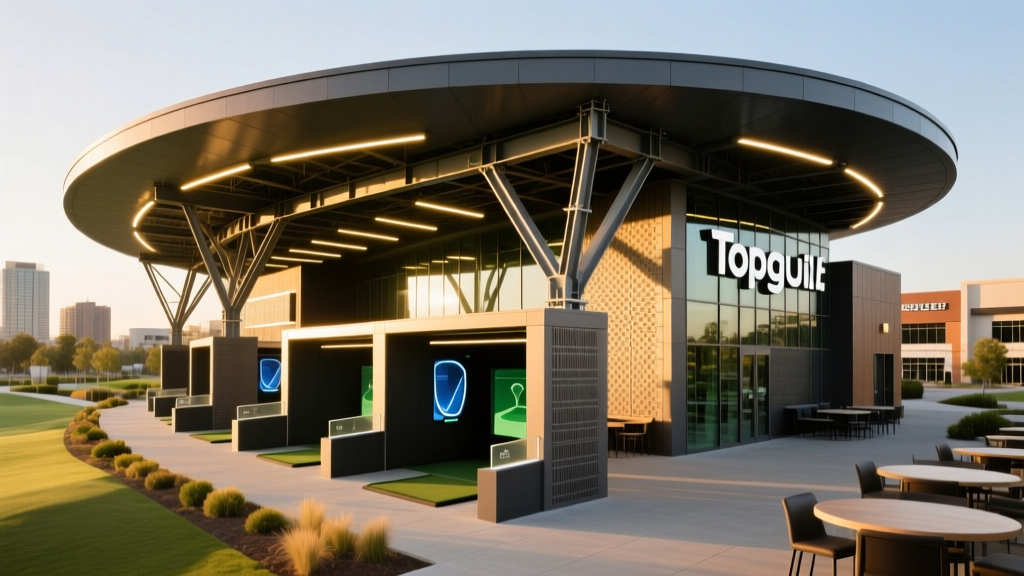
The True Scale of a Topgolf Construction Project
When developers ask how much does it cost to build a Topgolf, the answer requires looking far beyond standard commercial hospitality builds. A modern Topgolf venue is a hybrid between a high-volume sports bar, a commercial kitchen, and a sophisticated data-tracking facility. As of current commercial construction metrics, the total capital expenditure for a standard three-level, 100-bay venue ranges from $18 million to $35 million, excluding land acquisition.
Quick Budget Summary (Excluding Land)
- Low-End (Secondary Market, Basic Finishes): $18,000,000 - $22,000,000
- Average (Suburban Metro, Standard Build): $23,000,000 - $28,000,000
- High-End (Prime Urban, Premium FF&E): $29,000,000 - $35,000,000+
- Average Footprint: 65,000 to 80,000 square feet (indoor) + 10 to 15 acres (total site)
According to Topgolf Callaway Brands Corp investor disclosures, the company's aggressive expansion relies on a standardized yet highly engineered prototype. The sheer volume of structural steel, specialized acoustic treatments, and proprietary tracking technology creates a unique cost profile that general contractors must underwrite carefully.
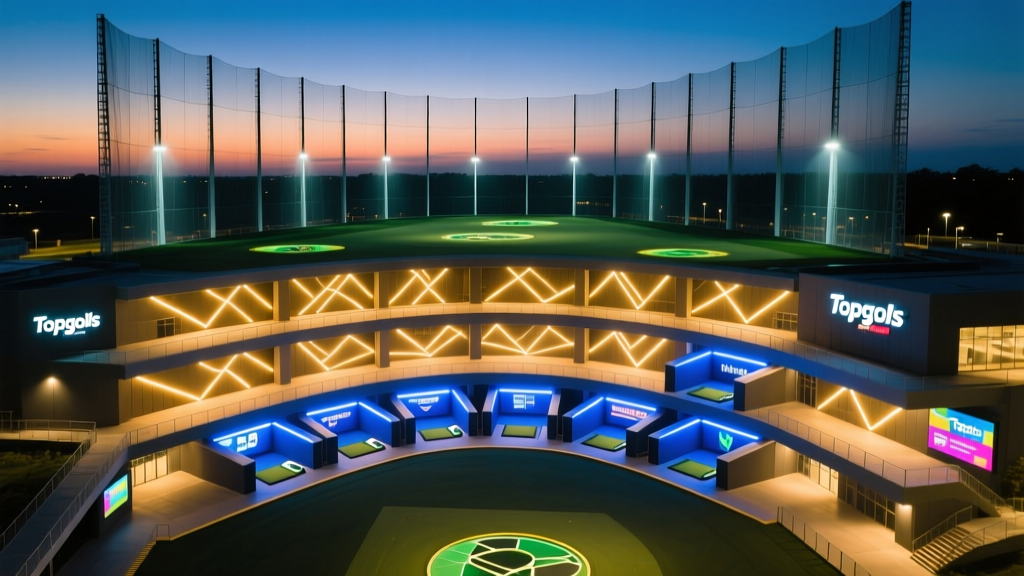
Hard Costs: Steel, Concrete, and Bay Infrastructure
The physical shell of a Topgolf venue is dominated by structural steel. The driving range bays require long-span, open-air cantilevers that eliminate obstructed views while supporting massive roof loads for HVAC equipment and lighting rigs.
| Construction Phase | Estimated Cost Range | Cost per Sq. Ft. (Approx.) |
|---|---|---|
| Site Work & Earthmoving | $1.5M - $3.5M | $20 - $45 / sq ft |
| Concrete & Foundations | $2.5M - $4.0M | $35 - $55 / sq ft |
| Structural Steel & Framing | $5.0M - $8.5M | $70 - $115 / sq ft |
| Exterior Envelope & Roofing | $2.0M - $3.5M | $28 - $45 / sq ft |
| MEP (Mechanical, Electrical, Plumbing) | $4.5M - $7.0M | $65 - $95 / sq ft |
| Interior Finishes & Millwork | $3.0M - $5.5M | $40 - $75 / sq ft |
Data sourced from commercial benchmarking via Gordian RSMeans indicates that hospitality and entertainment venues with heavy MEP requirements consistently push the upper bounds of square-foot pricing. The open-air nature of the bays complicates HVAC design; venues in colder climates require high-capacity infrared radiant tube heaters (such as Roberts Gordon commercial series) mounted in the bay ceilings, while southern venues require high-velocity destratification fans and misting systems.
The Technology Premium: Toptracer and RFID Integration
You are not just building a driving range; you are building a localized data center. The integration of Toptracer Range technology is a non-negotiable capital expense. This optical tracking system uses high-speed, precision cameras mounted in the bay ceilings to track ball flight, speed, and apex in real-time.
Hidden Tech Costs to Budget For:
- Camera & Sensor Arrays: Each of the 100+ bays requires dedicated Toptracer hardware, localized processing nodes, and heavy-duty cabling. Budget $1.5M to $2.5M purely for AV and tracking hardware.
- RFID Ball Inventory: Topgolf uses Callaway golf balls embedded with EPC Gen 2 RFID chips. An initial inventory of 120,000+ RFID balls represents a $150,000 to $200,000 upfront soft cost.
- Bay Touchscreens & POS: Weatherproof, anti-glare commercial touchscreens integrated with the venue's POS and kitchen display systems (KDS) add $3,000 to $4,500 per bay.
- Network Infrastructure: Enterprise-grade fiber backbones and localized server racks are required to process the telemetry data from 100 simultaneous golfers without latency.
Site Work, Earthmoving, and the Netting Challenge
The most visually striking and structurally demanding element of the build is the perimeter netting. The nets must reach 150 to 170 feet into the air to contain errant drives hit with modern, low-spin driver heads.
Engineering Warning: Wind Load & Monopoles
The steel monopoles supporting the netting act as massive sails. Geotechnical engineering and deep foundation pilings are required to resist overturning moments during high-wind events. Do not value-engineer the foundation depth on these poles; a monopole failure compromises the entire venue's liability and operational status. Expect to allocate $800,000 to $1.2M specifically for netting, cables, and monopole foundations.
Furthermore, the driving range field itself requires precise grading. The turf must be sloped to prevent water pooling, and the subsurface requires extensive drainage matrices. The turf used is a highly durable, short-pile synthetic nylon designed to withstand millions of divot impacts and heavy UV exposure, costing roughly $4.50 to $6.00 per square foot installed.
Acoustic Buffering and Zoning Realities
The simultaneous impact of 100 drivers striking golf balls generates a sustained ambient noise floor exceeding 85-90 decibels. Municipal zoning boards frequently mandate acoustic buffering, including specialized sound-absorbing baffles in the bay ceilings and dense vegetative berms along the property lines, before granting commercial entertainment permits.
Commercial Kitchen and FF&E (Furniture, Fixtures, & Equipment)
A Topgolf venue operates with the kitchen volume of a high-end casual dining restaurant, but with the logistical challenge of delivering food to three separate floors and 100+ distinct bay locations.
- Kitchen Buildout: Type 1 exhaust hoods, make-up air units (MAU), and heavy-duty grease traps are mandatory. Budget $1.2M to $1.8M for the commercial kitchen shell and equipment.
- Dumbwaiters & Food Elevators: To prevent staff from carrying heavy trays up and down stairs, commercial-grade food elevators are installed in the core. Add $150,000 to $250,000 for vertical transport systems.
- Custom Millwork & Seating: The bays feature custom-built, spill-proof seating, integrated cooler boxes, and durable composite tabletops. FF&E costs typically run $2.5M to $4M for a full-scale venue.
Regional Cost Variations and Labor Markets
Where you build drastically alters the final ledger. Union labor markets, local seismic codes, and material transport logistics create wide variances.
- Tier 1 Markets (e.g., Southern California, Northeast Corridor): Expect total costs to push $30M - $38M due to prevailing wage requirements, strict seismic steel moment-frame detailing, and high permit impact fees.
- Tier 2 Markets (e.g., Texas, Southeast, Midwest): Costs generally stabilize in the $20M - $26M range. Favorable geotechnical conditions (reducing deep piling needs) and non-union labor markets keep hard costs manageable.
Budget Contingency and ROI Planning
When underwriting the development budget, a standard 5% contingency is insufficient for a tech-heavy entertainment build. Developers should carry a 10% to 12% hard cost contingency to account for supply chain delays in specialized AV equipment, structural steel price indexing, and unforeseen geotechnical remediation.
Understanding how much does it cost to build a Topgolf is only half the equation. The high upfront capital expenditure is offset by the venue's massive revenue density, driven by high-margin food and beverage sales, dynamic bay pricing, and corporate event bookings. Proper budget planning ensures the physical asset is engineered for maximum durability and minimal operational downtime.
Frequently Asked Questions
How much land is required to build a Topgolf?
A standard three-level Topgolf venue requires a minimum of 10 to 15 acres. This accounts for the 65,000+ sq ft building footprint, the 300+ yard driving range, the 150-foot netting setbacks, and surface parking for 300+ vehicles.
Can I build a Topgolf franchise as an independent owner?
Topgolf Callaway Brands primarily operates through corporate-owned models or massive joint-venture partnerships with elite commercial developers. Traditional single-unit franchise models are generally not available to independent mom-and-pop operators.
What are the highest maintenance costs after construction?
Post-construction, the highest operational expenses are synthetic turf replacement (every 3-5 years in high-traffic bay zones), RFID ball attrition (replacing lost or damaged smart balls), and HVAC maintenance for the open-air bay heating and cooling systems.
Written by
James ThorntonJames Thornton is a construction industry veteran with 25 years of hands-on experience in wood framing, lumber grading, and residential building codes. He started as a framing carpenter in rural Oregon, earned his ICC Residential Building Inspector certification, and eventually became a senior plan reviewer for the City of Portland Bureau of Development Services. James holds a B.S. in Wood Science & Technology from Oregon State University and is a certified lumber grader through the West Coast Lumber Inspection Bureau (WCLIB). He has inspected over 3,000 residential construction sites and authored the city's internal guide on advanced framing techniques (2x6 at 24" O.C.). James lives in Bend, OR, where he builds custom timber-frame cabins and competes in lumberjack sports.
More from James Thornton
View all
Insulation
Best Home Insulation Materials: Complete 2026 Guide
Compare top home insulation materials for 2026. Find R-values, installed costs per square foot, and best uses for fiberglass, spray foam, and mineral wool.
Aug 4, 2026

Sustainable Building
Certify Your Green Building Material for LEED and WELL
Step-by-step guide to certifying a green building material for LEED v5 and WELL v2. Master EPDs, HPDs, and VOC limits for 2026 project specifications.
Aug 4, 2026

Stone & Masonry
Veneer Stacked Stone Panels: Interior Design & Style Showcase
Discover how veneer stacked stone panels transform interiors. Explore modern design profiles, material pairings, and technical installation specs.
Aug 4, 2026