Tamko Shingles Taxonomy: Selecting the Right Asphalt Roof Line
Navigate the Tamko shingles taxonomy. Compare Heritage, Titan XT, and Elite Glass-Seal lines by impact rating, wind warranty, and material pricing.
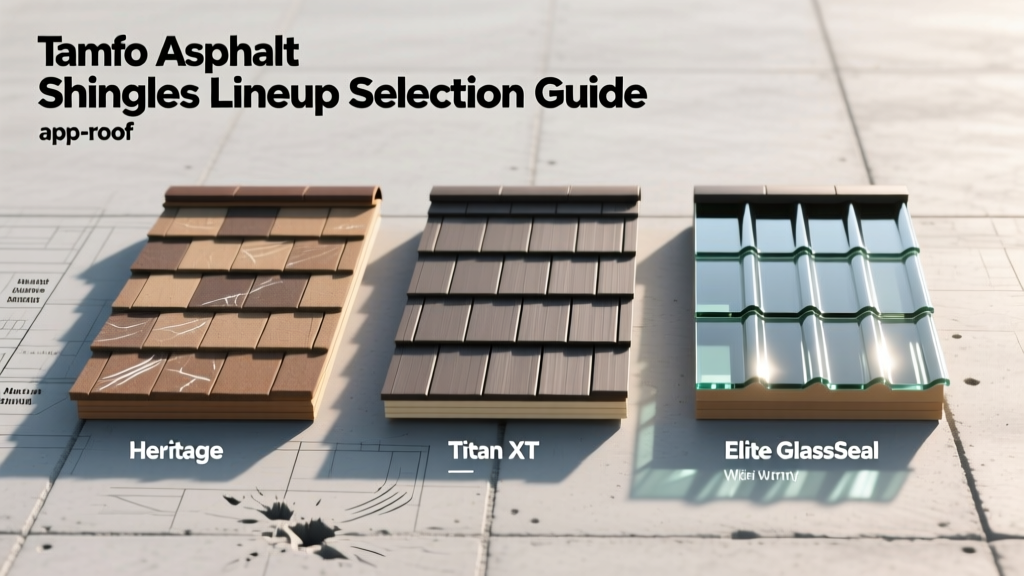
The TAMKO Asphalt Shingle Hierarchy
Selecting the correct asphalt shingle requires moving beyond basic color choices and understanding the structural taxonomy of the manufacturer's lineup. TAMKO Building Products categorizes its residential fiberglass asphalt shingles into three distinct tiers based on mat thickness, asphalt formulation, and surface granule engineering. As of 2026, material costs for fiberglass asphalt shingles have stabilized, but the performance delta between entry-level 3-tab and premium SBS-modified designer shingles dictates long-term lifecycle costs and insurance premium eligibility.
This guide deconstructs the TAMKO shingle taxonomy, providing exact specifications, wind and impact ratings, and material pricing to help contractors and homeowners match the right product to specific environmental stressors.
Tier 1: 3-Tab and Entry-Level (Elite Glass-Seal)
The Elite Glass-Seal line represents TAMKO's foundational 3-tab shingle. Engineered with a standard fiberglass mat and traditional oxidized asphalt, these shingles provide a flat, uniform appearance with a single shadow line. They are strictly rated for 60 mph wind resistance under ASTM D3161 Class A standards. While they carry a 25-year limited warranty, their primary use case in 2026 is restricted to budget-conscious re-roofs, low-slope shed structures, or matching existing legacy 3-tab roofs in neighborhoods with strict aesthetic continuity rules. Material pricing averages $90 to $110 per square (100 sq. ft.).
Tier 2: Architectural and Dimensional (Heritage Series)
The Heritage and Heritage Premium lines dominate the mid-market architectural segment. These laminated shingles feature a dual-layer construction that creates deep, randomized shadow lines mimicking natural wood shakes. The standard Heritage line carries a 130 mph wind warranty (ASTM D3161 Class H) and a 50-year limited transferable warranty. Heritage Premium utilizes a heavier fiberglass mat and increased asphalt coating weight, providing superior flexibility in freeze-thaw cycles. Material costs for the Heritage series range from $120 to $145 per square, while Heritage Premium commands $140 to $160 per square.
Tier 3: Designer and Impact-Resistant (Titan XT & Astonish)
For severe weather zones, TAMKO engineers its top-tier shingles with SBS (Styrene-Butadiene-Styrene) modified asphalt. The Titan XT is a Class 4 impact-resistant architectural shingle designed specifically to absorb and dissipate the kinetic energy of hail strikes without fracturing the fiberglass mat. The Astonish line takes this further with a luxury, multi-layered profile that replicates the thick, staggered edges of natural slate. Both lines carry 130 mph wind ratings and UL 2218 Class 4 impact certifications. Titan XT material costs hover between $180 and $220 per square, while Astonish ranges from $250 to $300+ per square.
Technical Comparison Matrix
The following matrix isolates the critical engineering specifications across the primary TAMKO residential lines. Use this data to verify compliance with local building codes and insurance underwriting requirements.
| Product Line | Shingle Type | Wind Warranty | Impact Rating | Algae Resistance | Est. Material Cost / Sq. |
|---|---|---|---|---|---|
| Elite Glass-Seal | 3-Tab Strip | 60 mph (Class A) | None | 10-Year | $90 - $110 |
| Heritage | Laminated Architectural | 130 mph (Class H) | None | Lifetime | $120 - $145 |
| Heritage Premium | Heavy Laminated | 130 mph (Class H) | None | Lifetime | $140 - $160 |
| Titan XT | SBS Modified Architectural | 130 mph (Class H) | UL 2218 Class 4 | Lifetime | $180 - $220 |
| Astonish | SBS Modified Designer | 130 mph (Class H) | UL 2218 Class 4 | Lifetime | $250 - $300+ |
Climate-Driven Selection Framework
Choosing a shingle based purely on aesthetics leads to premature system failure. According to the Asphalt Roofing Manufacturers Association (ARMA), environmental stressors must dictate the asphalt formulation and mat weight.
Hail and High-Impact Zones (Texas, Colorado, Midwest)
In regions with high hail frequency, standard oxidized asphalt shingles will suffer from granule loss and mat bruising, leading to UV degradation and leaks. You must specify the Titan XT or Astonish lines. The SBS rubberized asphalt allows the shingle to flex upon impact rather than shatter. Furthermore, installing a UL 2218 Class 4 rated roof often qualifies homeowners for significant discounts on their annual property insurance premiums, effectively offsetting the higher initial material cost over a 10-year period.
High-Wind and Coastal Regions (Gulf Coast, Southeast)
For areas prone to hurricanes and tropical storms, the 60 mph rating of the Elite Glass-Seal is entirely inadequate. You must utilize the Heritage or higher lines, which carry a 130 mph wind warranty. However, the shingle rating is only valid if installed with the manufacturer's mandated 6-nail fastening pattern (rather than the standard 4-nail pattern) and sealed with proper asphalt roof cement at the eaves and rakes, as outlined by the Insurance Institute for Business & Home Safety (IBHS) FORTIFIED Home standards.
High-Humidity and Heavy Canopy Zones (Pacific Northwest, Deep South)
North-facing roof slopes in heavily wooded areas are highly susceptible to Gloeocapsa magma (blue-green algae). While all TAMKO architectural and designer shingles feature lifetime algae resistance via copper-infused granules, the 3-tab Elite Glass-Seal only offers a 10-year algae warranty. In these microclimates, upgrading to the Heritage line is a strict requirement to prevent black streaking and premature aesthetic degradation.
Many contractors install TAMKO shingles over third-party underlayments to save margin. To qualify for TAMKO's enhanced system warranties (which extend the non-prorated coverage period), the roof must be installed as a complete TAMKO system. This requires TAMKO TW Underlayment, TAMKO Starter Shingles at the eaves and rakes, and matching TAMKO Hip & Ridge caps. Mixing brands voids the enhanced warranty provisions.
Installation Edge Cases and Fastener Specifications
The structural integrity of any TAMKO shingle relies entirely on the fastener protocol. A common failure mode in architectural shingle installations is improper nail placement.
- Nail Type: Use minimum 12-gauge galvanized steel roofing nails with a 3/8-inch diameter head.
- Nail Length: Standard 1-inch nails are sufficient for single-layer tear-offs. If installing over an existing layer of shingles (where local codes permit), you must use 1.25-inch or 1.5-inch nails to ensure penetration through the roof decking.
- Placement Zone: For the Heritage and Titan XT lines, nails must be placed in the designated double-layer nail line, approximately 5.75 inches from the exposed butt edge. Driving nails too high (into the single-layer sealant strip) or too low (exposed to the weather) will immediately void the wind warranty.
- Sealant Activation: TAMKO utilizes a thermally activated asphalt sealant. In installations where the ambient temperature is below 40°F (4°C), the sealant will not activate naturally. Contractors must manually hand-seal each tab with four 1-inch diameter spots of ASTM D4586 compliant asphalt roof cement to prevent winter blow-offs.
Frequently Asked Questions
Can I mix TAMKO Heritage shingles with a different brand of hip and ridge caps?
While physically possible, mixing brands creates a visual mismatch in granule coloration and profile thickness. More importantly, utilizing a non-TAMKO hip and ridge product disqualifies the roof from TAMKO's extended system warranty. Always pair Heritage field shingles with TAMKO Heritage Hip & Ridge accessories.
Does the Titan XT Class 4 impact rating guarantee the roof will never dent in a hailstorm?
No. The UL 2218 Class 4 rating means the shingle will not fracture or crack when struck by a 2-inch steel ball dropped from 20 feet, which simulates severe hail. However, cosmetic bruising or minor granule displacement can still occur in extreme, golf-ball-sized hail events. The rating ensures the waterproofing integrity of the fiberglass mat remains intact, preventing leaks.
How does the weight of Astonish designer shingles affect roof decking requirements?
Astonish shingles are significantly heavier than standard architectural shingles, weighing approximately 350 to 400 lbs per square. Before installation, the roof decking (typically 1/2-inch or 5/8-inch OSB or plywood) must be inspected for deflection. If the decking shows signs of sagging between trusses, it must be reinforced or replaced to support the increased dead load, especially in regions with heavy winter snow accumulation.