The Evolution of Lime as Building Material in Historical Masonry
Discover how lime as building material shaped historical masonry, from Roman concrete to Gothic cathedrals, and why modern restorers still rely on it.
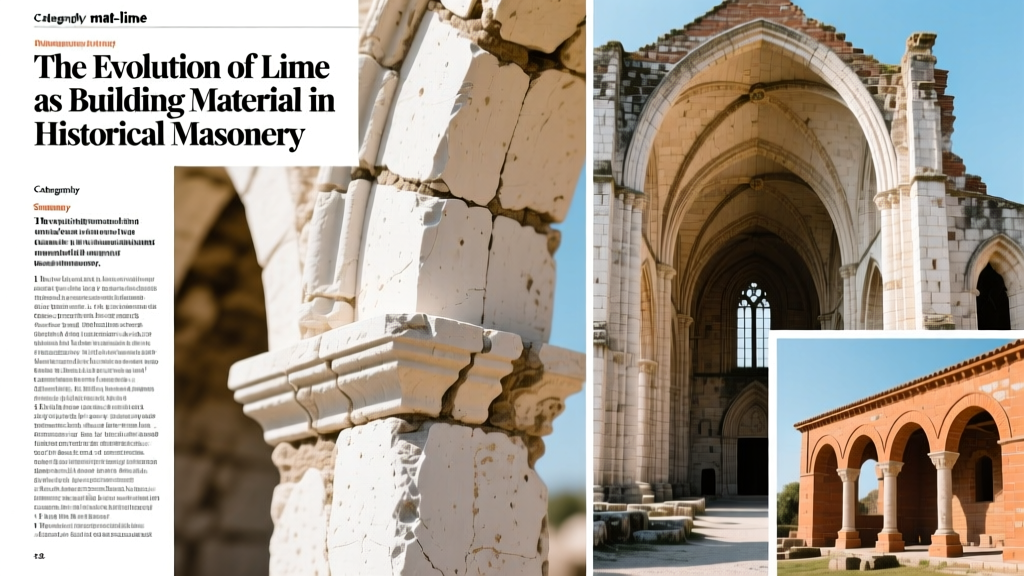
The Enduring Legacy of Lime in Antiquity
Long before the invention of Portland cement in the 19th century, lime as building material was the undisputed foundation of global architecture. From the pyramids of Egypt to the soaring vaults of Gothic cathedrals, calcium-based binders dictated the structural limits and aesthetic possibilities of their eras. Understanding the historical application of lime is not merely an academic exercise; it is a critical prerequisite for modern heritage conservation. In 2026, preservation architects and structural engineers rely on the exact chemical principles mastered by ancient builders to ensure that historical masonry survives for future centuries.
Chronology of Calcination: How Empires Built with Lime
The mastery of lime required early builders to understand the calcination cycle: heating limestone (calcium carbonate) to drive off carbon dioxide, creating quicklime (calcium oxide), and subsequently slaking it with water to form lime putty (calcium hydroxide). This knowledge evolved distinctly across major civilizations:
- Ancient Egypt (c. 3000 BCE): Early builders utilized a hybrid binder of lime and gypsum to reduce the calcination temperature required, primarily for interior plasters and the bedding of massive limestone blocks.
- Minoan and Greek Eras (c. 1500–400 BCE): The Greeks refined the slaking process, aging lime putty in subterranean pits for years to increase plasticity, resulting in the ultra-fine, durable stuccoes seen on Hellenistic temples.
- Roman Empire (c. 300 BCE–476 CE): Roman engineers revolutionized masonry by introducing pozzolanic additives, creating the first true hydraulic concretes capable of setting underwater and supporting massive domed structures.
- Medieval Europe (c. 1000–1500 CE): Master masons utilized "hot-mixed" fat limes to construct the intricate rib vaults and flying buttresses of Gothic architecture, prioritizing workability and flexibility over sheer compressive strength.
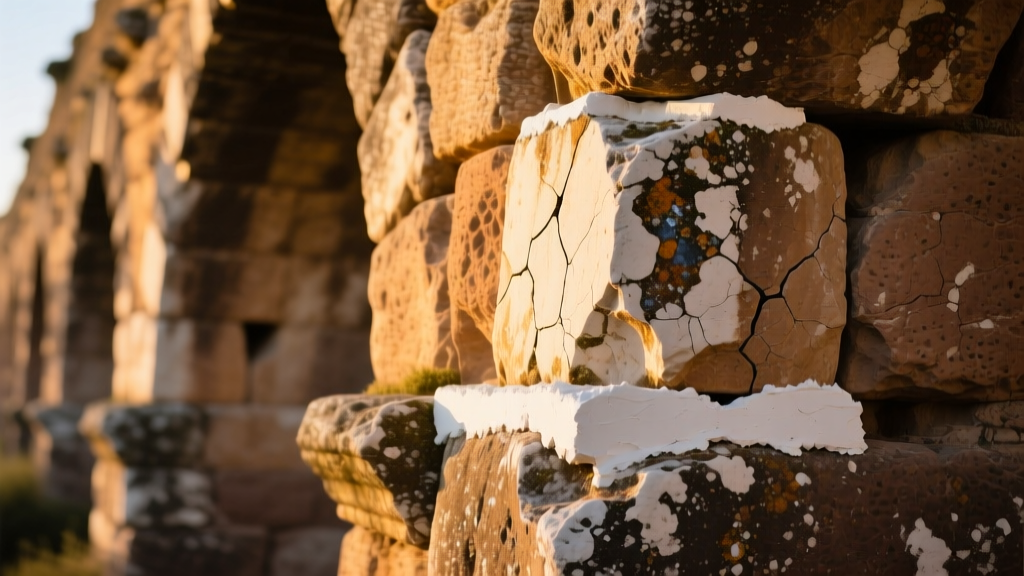
Roman Opus Caementicium: The Pozzolanic Revolution
The most significant leap in the history of lime as building material occurred when Roman engineers discovered that mixing lime putty with pulvis Puteolanus (volcanic ash from Pozzuoli) created a binder that hardened through a chemical hydration reaction rather than relying solely on atmospheric carbonation. This pozzolanic reaction between the calcium hydroxide and the aluminosilicates in the volcanic ash yielded calcium-aluminate-silicate-hydrate (C-A-S-H) gels.
"The architect must proportion the mortar so that it is neither too rich in lime, which causes shrinkage and cracking, nor too lean, which lacks cohesion. For marine structures, the ash must be mixed in equal parts with lime." — Adapted from Vitruvius, De Architectura, Book II.
Vitruvius mandated a 1:3 ratio of lime to sand for standard masonry, but a 1:2 ratio of lime to pozzolana for marine environments. Modern petrographic analysis of Roman marine concrete reveals that the use of quicklime clasts (unslaked lime nodules) allowed the mortar to self-heal micro-cracks over centuries, a phenomenon modern materials scientists are currently attempting to replicate in contemporary sustainable concretes.
Matrix of Historical Lime Binders
The table below illustrates the evolution of lime binders, highlighting the distinct chemical mechanisms and structural properties that defined different architectural epochs.
| Era | Binder Type | Primary Aggregate | Setting Mechanism | Approx. Compressive Strength |
|---|---|---|---|---|
| Egyptian / Early Greek | Non-hydraulic (Fat) Lime + Gypsum | Desert sand, crushed limestone | Carbonation (absorbs CO2) | 1.5 – 3.0 MPa |
| Roman (Imperial) | Hydraulic Lime + Pozzolana | Pumice, volcanic tuff, brick dust | Hydration + Carbonation | 10.0 – 20.0+ MPa |
| Medieval / Gothic | Hot-mixed Fat Lime | Sharp river sand, wood ash | Carbonation | 2.0 – 5.0 MPa |
| 18th Century (Smeaton) | Blue Lias Hydraulic Lime | Local pit sand | Hydration (natural clay impurities) | 5.0 – 12.0 MPa |
Medieval Hot-Mixing and the Gothic Cathedrals
While the Romans mastered hydraulic chemistry, Medieval masons perfected the physical manipulation of non-hydraulic lime. The construction of Gothic cathedrals relied heavily on "hot mixing," a technique where quicklime (calcium oxide) was added directly to damp sand and water on the scaffold or in a mixing pit. The exothermic slaking reaction generates temperatures exceeding 250°C (482°F).
This method produced a mortar rich in lime putty that remained flexible. Because Gothic structures were designed to move and settle dynamically, a rigid binder would have shattered under the wind loads and thermal expansion. The lime mortar acted as a sacrificial, flexible gasket between the rigid ashlar stones.
Specifying Historical Lime for Modern Restoration
In contemporary heritage conservation, the cardinal rule is that the repair mortar must always be slightly weaker and more permeable than the historic masonry units. The introduction of Ordinary Portland Cement (OPC) into historical fabric is widely recognized as a primary cause of masonry decay. OPC traps moisture inside soft, porous bricks and stones; when this moisture freezes or crystallizes, the masonry unit spalls and crumbles, while the cement mortar remains intact.
For authentic restoration, professionals specify Natural Hydraulic Lime (NHL) or carefully formulated lime putty mixes. The Society for the Protection of Ancient Buildings (SPAB) strongly advocates for matching the original mortar's porosity, vapor permeability, and compressive strength rather than simply matching its color.
Natural Hydraulic Lime (NHL) Classifications
Governed by the European standard EN 459-1 (widely adopted globally for heritage specs), NHL is produced by burning argillaceous (clay-bearing) limestones. It is classified by its 28-day compressive strength:
- NHL 2 (Feebly Hydraulic): 2.0 to 5.0 MPa. Used for interior plasters, soft terracotta, and highly friable historic bricks. Sets slowly, allowing maximum carbonation.
- NHL 3.5 (Moderately Hydraulic): 3.5 to 10.0 MPa. The workhorse of historical restoration. Ideal for general exterior repointing, bedding mortars, and standard masonry substrates.
- NHL 5 (Eminently Hydraulic): 5.0 to 15.0 MPa. Reserved for exposed environments, below-grade foundations, and marine structures where rapid set and high weather resistance are required.
Decision Framework: Matching Mortar to Historic Substrates
Restoration architects and masonry contractors must follow a rigorous, evidence-based framework before specifying a lime mortar mix. Relying on visual estimation leads to catastrophic moisture entrapment.
- Petrographic and Acid Digestion Analysis: Extract a core sample of the original mortar. Use acid digestion to dissolve the calcium carbonate binder, leaving the original aggregate intact. Sieve the aggregate to determine the exact particle size distribution and shape (e.g., sharp vs. rounded sand).
- Determine the Original Binder Type: Identify whether the historic mortar was a simple fat lime (non-hydraulic) or contained pozzolans/brick dust (hydraulic). This dictates whether to use aged lime putty or an NHL binder.
- Match the Aggregate: Source local sand that matches the historic aggregate in mineralogy, gradation, and color. The aggregate constitutes up to 80% of the mortar's volume and dictates its vapor permeability and texture.
- Apply the Sacrificial Principle: Formulate a mix where the mortar's compressive strength is approximately 70% to 80% of the masonry unit's strength. The mortar must always be the "sacrificial" element that degrades over 50-100 years, protecting the irreplaceable historic stone or brick.
By respecting the chemical and physical properties that made lime as building material the cornerstone of human civilization, modern conservationists ensure that historical structures remain breathable, flexible, and structurally sound for generations to come.
Written by
James ThorntonJames Thornton is a construction industry veteran with 25 years of hands-on experience in wood framing, lumber grading, and residential building codes. He started as a framing carpenter in rural Oregon, earned his ICC Residential Building Inspector certification, and eventually became a senior plan reviewer for the City of Portland Bureau of Development Services. James holds a B.S. in Wood Science & Technology from Oregon State University and is a certified lumber grader through the West Coast Lumber Inspection Bureau (WCLIB). He has inspected over 3,000 residential construction sites and authored the city's internal guide on advanced framing techniques (2x6 at 24" O.C.). James lives in Bend, OR, where he builds custom timber-frame cabins and competes in lumberjack sports.
More from James Thornton
View all
Insulation
Best Home Insulation Materials: Complete 2026 Guide
Compare top home insulation materials for 2026. Find R-values, installed costs per square foot, and best uses for fiberglass, spray foam, and mineral wool.
Aug 4, 2026

Sustainable Building
Certify Your Green Building Material for LEED and WELL
Step-by-step guide to certifying a green building material for LEED v5 and WELL v2. Master EPDs, HPDs, and VOC limits for 2026 project specifications.
Aug 4, 2026

Stone & Masonry
Veneer Stacked Stone Panels: Interior Design & Style Showcase
Discover how veneer stacked stone panels transform interiors. Explore modern design profiles, material pairings, and technical installation specs.
Aug 4, 2026