What Materials Did Ancient Romans Use to Build Aqueducts? A Comparison
Discover what materials ancient Romans used to build aqueducts. We compare opus caementicium, ashlar masonry, and terracotta for durability and flow.
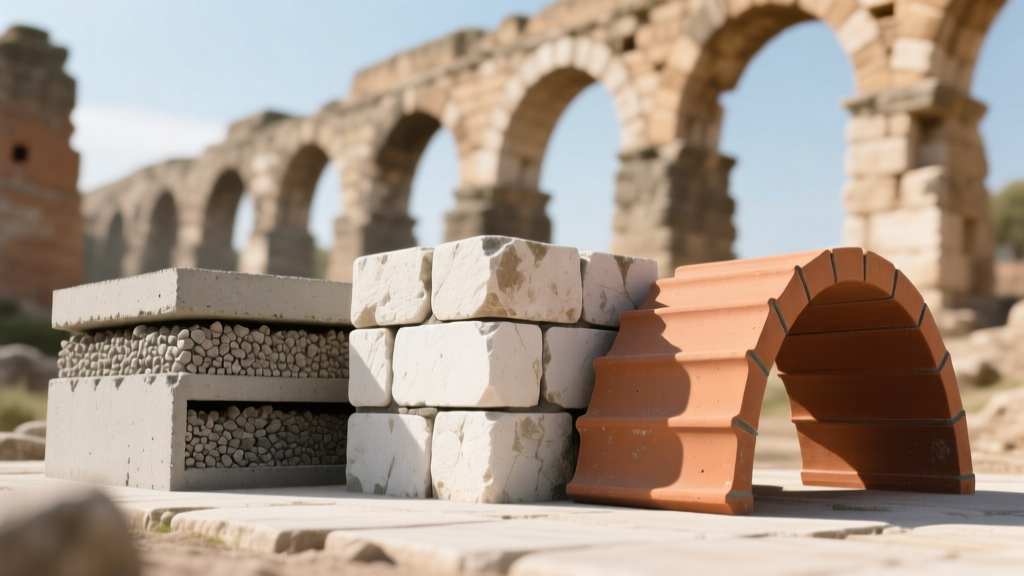
The Core Matrix: Roman Aqueduct Materials Compared
When analyzing what materials did ancient romans use to build aqueducts, modern structural engineers are often less interested in the monumental scale and more fascinated by the precise material science. The Roman hydraulic network, which delivered over one million cubic meters of water daily to the capital, relied on a highly specialized palette of materials. Each was selected for specific structural, hydraulic, or economic properties. Below is a comparative matrix of the primary materials utilized in aqueduct construction.
| Material | Primary Application | Compressive Strength | Hydraulic Roughness (Manning's n) | Expected Lifespan |
|---|---|---|---|---|
| Opus Caementicium (Roman Concrete) | Core fill, arches, vaulting | 20 - 40 MPa | N/A (Encased) | 1,000+ years |
| Travertine Ashlar | High-load piers, foundations | 90 - 110 MPa | N/A (External) | 2,000+ years |
| Tuff (Tufo) Blocks | Lightweight arches, conduit walls | 30 - 50 MPa | N/A (External) | 500 - 1,000 years |
| Opus Signinum (Cocciopesto) | Waterproof channel lining | 15 - 25 MPa | 0.012 - 0.015 | 800+ years |
| Lead (Plumbum) | Pressurized siphons (fistulae) | Very Low (Tensile used) | 0.010 | 200 - 400 years |
Structural Shell: Opus Caementicium vs. Ashlar Masonry
The structural integrity of an aqueduct relied on the interplay between cut stone and poured concrete. Understanding the trade-offs between these two materials reveals the sophistication of Roman engineering.
Opus Quadratum (Ashlar Masonry)
For the massive piers supporting the arcade sections (such as the Aqua Claudia), engineers favored opus quadratum—precisely cut, dry-laid ashlar blocks. The preferred stone was travertine quarried near Tivoli. Travertine is a dense, banded calcium carbonate rock with a compressive strength exceeding 100 MPa, making it virtually immune to the crushing loads of towering piers.
Because the blocks were laid dry without mortar, lateral stability was achieved using iron cramps (dowels) set into carved recesses. Crucially, these iron cramps were sealed with molten lead. This was not merely for adhesion; the lead acted as a sacrificial anode and a physical moisture barrier, preventing the iron from oxidizing, expanding, and spalling the surrounding stone—a failure mode that plagues poorly restored modern masonry.
Opus Caementicium (Roman Concrete)
While travertine was structurally superior, it was incredibly expensive and slow to quarry. For the vast majority of the aqueduct's core, substructure, and arch vaulting, Romans utilized opus caementicium. This was not a uniform slurry but a highly engineered composite consisting of three distinct components:
- Calx (Lime): Burnt from limestone and slaked to form the binder.
- Pulvis Puteolanus (Pozzolana): Volcanic ash sourced primarily from the Bay of Naples, rich in silica and alumina.
- Caementa (Aggregate): Fist-sized chunks of local tuff, basalt, or recycled brick.
Recent metallurgical analyses of Roman concrete have revealed the presence of 'lime clasts'—millimeter-sized white inclusions previously dismissed as poor mixing. These clasts indicate that Romans used a 'hot mixing' technique, adding quicklime directly to the pozzolana and water. This exothermic reaction creates a highly brittle but reactive calcium carbonate matrix that allows the concrete to self-heal micro-cracks when exposed to water, a vital trait for hydraulic structures.
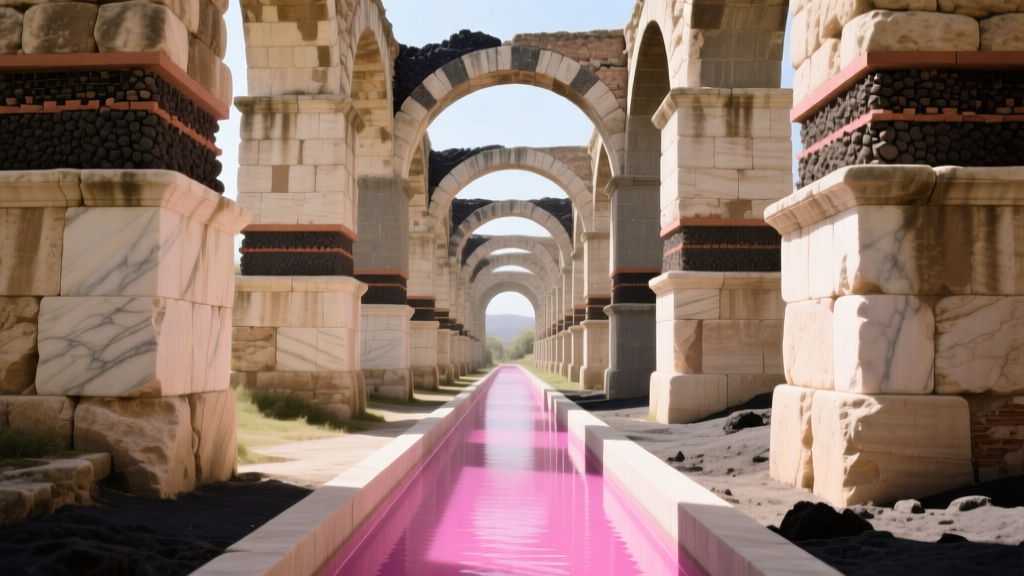
The Specus: Waterproofing and Flow Dynamics
The specus (water channel) required materials that could withstand constant hydraulic pressure, mineral scaling, and biological growth. The Romans employed three primary lining materials, each with distinct hydraulic and economic profiles.
Opus Signinum (The Impermeable Membrane)
The standard lining for the open-channel sections of an aqueduct was opus signinum, also known as cocciopesto. This material was created by mixing lime mortar with finely crushed terracotta tiles and pottery shards. The reactive silica in the fired clay interacted with the lime to create a highly impermeable, slightly flexible membrane. Its characteristic pinkish-red hue is a hallmark of Roman hydraulic engineering. Applied in multiple layers and burnished smooth, opus signinum achieved a Manning's roughness coefficient (n) of roughly 0.013, comparable to modern smooth asphalt or finished concrete, ensuring efficient water velocity and minimizing calcium carbonate buildup.
Terracotta Pipes (Tubuli)
For underground sections and lower-pressure distribution, terracotta pipes (tubuli) were the material of choice. These were manufactured with standardized tongue-and-groove joints, which were then sealed with a mixture of pitch and lime mortar. Terracotta was cheap, resistant to corrosion, and did not impart any metallic taste to the water. However, its low tensile strength restricted its use to low-pressure, gravity-fed applications.
Lead Pipes (Fistulae)
When aqueducts encountered deep valleys that could not be bridged by arcades, engineers employed inverted siphons. These required pipes capable of withstanding immense hydrostatic pressure. Lead (plumbum) was the only material malleable enough to be cast into flat sheets, rolled into cylinders, and soldered along the seam. According to Frontinus, the curator aquarum of Rome, lead pipes were standardized into 25 distinct sizes, with the base unit being the quinaria (roughly 22 mm in diameter). While hydraulically superior due to its ultra-smooth interior, lead was astronomically expensive and posed severe toxicity risks, leading to its gradual replacement by terracotta and stone conduits in later provincial constructions.
'Water from lead pipes is harmful because lead yields white lead, and this is said to be hurtful to the human system.'
Failure Modes and Material Limitations
Despite their legendary durability, Roman aqueduct materials were subject to specific environmental and mechanical failure modes. Understanding these limitations provides critical context for modern restoration and historical analysis.
Frost Wedging in Porous Aggregates
While the aqueducts of Rome and North Africa remain remarkably intact, structures in northern provinces (such as Gaul and Germania) suffered severe degradation. The local volcanic tuff used as aggregate (caementa) is highly porous. In freezing climates, water infiltrated the micro-pores of the tuff, expanded upon freezing, and caused the concrete core to spall and fracture from the inside out. Roman engineers eventually learned to substitute tuff with denser, non-porous river cobble or basalt in colder regions to mitigate this failure mode.
Calcium Carbonate Sintering (Sinter Buildup)
The most persistent operational threat to the specus was not structural failure, but hydraulic occlusion. Hard water sources, particularly those from limestone aquifers, deposited thick layers of calcium carbonate (sinter) on the opus signinum lining. In some sections of the Aqua Augusta, sinter deposits grew to over 30 centimeters thick, effectively halving the channel's cross-sectional area and drastically reducing flow capacity. This required constant, labor-intensive mechanical chipping by maintenance crews known as aquarii.
Modern Engineering Takeaways
The material science behind Roman aqueducts offers profound lessons for contemporary civil engineering. The modern reliance on Portland cement—which degrades within 50 to 100 years in marine or hydraulic environments—stands in stark contrast to the millennia-long durability of pozzolana-lime composites. As the construction industry in 2026 increasingly prioritizes lifecycle sustainability and carbon reduction, material scientists are actively reverse-engineering Roman hot-mixed concretes to develop self-healing, low-carbon alternatives for modern water infrastructure. Furthermore, the Roman practice of matching material compressive strength to specific structural nodes—using high-grade travertine only where loads demanded it, and cheaper tuff elsewhere—remains a masterclass in value-engineering and resource optimization.
Authoritative References
- World History Encyclopedia: Roman Aqueducts - Comprehensive overview of hydraulic engineering and structural layouts.
- Roman Aqueducts Information: Romanaqueducts.info - Technical analyses of specus dimensions, sinter buildup, and material degradation.
- Encyclopedia Britannica: Roman Architecture and Engineering - Detailed breakdowns of opus caementicium and ashlar masonry techniques.
Written by
James ThorntonJames Thornton is a construction industry veteran with 25 years of hands-on experience in wood framing, lumber grading, and residential building codes. He started as a framing carpenter in rural Oregon, earned his ICC Residential Building Inspector certification, and eventually became a senior plan reviewer for the City of Portland Bureau of Development Services. James holds a B.S. in Wood Science & Technology from Oregon State University and is a certified lumber grader through the West Coast Lumber Inspection Bureau (WCLIB). He has inspected over 3,000 residential construction sites and authored the city's internal guide on advanced framing techniques (2x6 at 24" O.C.). James lives in Bend, OR, where he builds custom timber-frame cabins and competes in lumberjack sports.
More from James Thornton
View all
Insulation
Best Home Insulation Materials: Complete 2026 Guide
Compare top home insulation materials for 2026. Find R-values, installed costs per square foot, and best uses for fiberglass, spray foam, and mineral wool.
Aug 4, 2026

Sustainable Building
Certify Your Green Building Material for LEED and WELL
Step-by-step guide to certifying a green building material for LEED v5 and WELL v2. Master EPDs, HPDs, and VOC limits for 2026 project specifications.
Aug 4, 2026

Stone & Masonry
Veneer Stacked Stone Panels: Interior Design & Style Showcase
Discover how veneer stacked stone panels transform interiors. Explore modern design profiles, material pairings, and technical installation specs.
Aug 4, 2026