Choosing Brick Colors: Scenario Matching for Exteriors & Interiors
Learn how to match brick colors to architectural styles, climate zones, and interior spaces with our scenario-based specification guide for masonry.
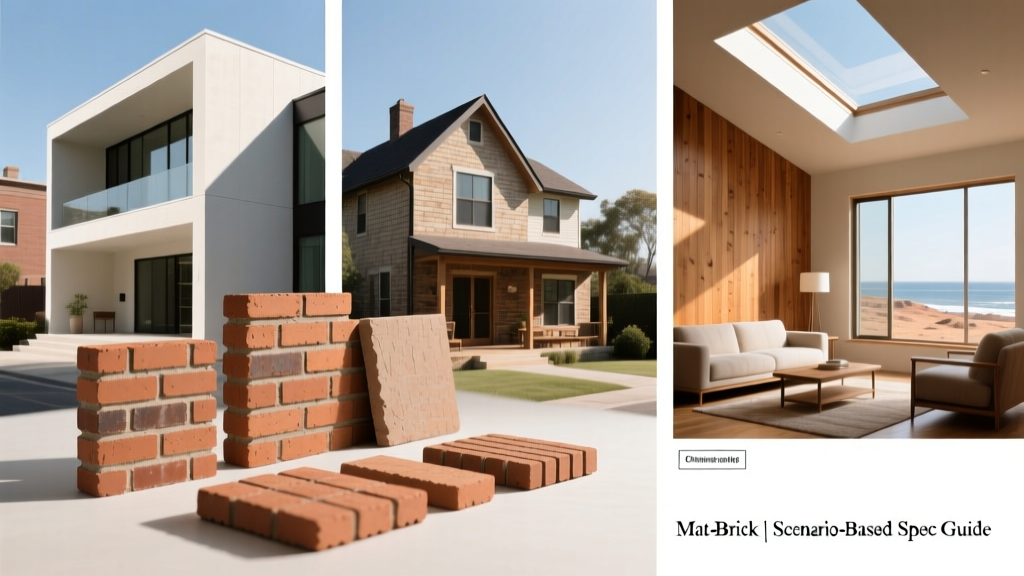
Thermal Performance & Climate Zone Matching
Brick color selection is frequently reduced to a purely aesthetic exercise, but in structural and veneer applications, it directly dictates thermal performance, moisture masking, and architectural authenticity. The color of the clay body and its surface treatment determine the masonry's Solar Reflectance Index (SRI) and albedo, which governs how much solar radiation the wall absorbs. When matching brick colors to specific scenarios, you must weigh solar reflectance against regional climate zones.
According to the U.S. Department of Energy's passive solar guidelines, high-mass materials like brick absorb and store heat. In cooling-dominated climates, dark brick colors can inadvertently increase HVAC loads by absorbing up to 90% of incident solar radiation. Conversely, in heating-dominated zones, dark brick colors act as a passive thermal battery, reducing winter heating costs.
| IECC Climate Zone | Primary Thermal Goal | Recommended Albedo | Ideal Brick Color Families | Thermal Impact |
|---|---|---|---|---|
| Zones 1-3 (Hot/Humid) | Heat Rejection | 0.40 - 0.60 | Whites, Buffs, Light Grays | Reduces cooling load by reflecting solar gain |
| Zones 4 (Mixed) | Balanced Performance | 0.25 - 0.40 | Tans, Muted Reds, Beiges | Moderate absorption for seasonal shifting |
| Zones 5-8 (Cold) | Heat Absorption | 0.05 - 0.20 | Charcoals, Deep Reds, Browns | Maximizes passive solar heating in winter |
While white and buff bricks excel in hot climates, they are highly susceptible to visible efflorescence (water-soluble salt deposits). If specifying light-colored brick in areas with high freeze-thaw cycles or heavy driven rain, mandate a low-alkali Portland cement in the mortar and ensure cavity wall drainage planes meet ASTM C67 standards for efflorescence testing.
Architectural Scenario Matrix
Matching brick colors to architectural styles requires understanding historical manufacturing processes and regional clay deposits. Modern extruded bricks can mimic historical variations, but specifying the wrong color profile breaks architectural continuity.
- Colonial & Federal Revival: Require uniform, high-iron oxide reds or deep maroons. Avoid tumbled or heavily textured faces. Specification Match: Acme Brick's "Oxford Red" or Boral's "Savannah" provide the consistent, sharp-edged profile and deep red hue characteristic of 18th-century East Coast masonry.
- Modern & Minimalist: Demand monochromatic, low-variance palettes. Charcoals, stark whites, and slurried (painted) finishes dominate. Specification Match: Glen-Gery's "Carbon" or "Titanium" lines offer the tight color tolerances and smooth wire-cut faces required for flush mortar joints and contemporary geometry.
- Tudor & Craftsman Revival: Rely on high-variation, multi-color blends with heavy clinker (over-fired, warped bricks). Specification Match: Look for "Handmade" or "Waterstruck" series from manufacturers like Pine Hall Brick, which introduce deliberate color flashes (black, purple, and deep orange) within a single pallet to replicate early 20th-century kiln inconsistencies.
- Industrial & Adaptive Reuse: Utilize muted oranges, salvage-blends, and wire-cut blacks. The goal is to mimic aged, soot-stained urban factories. Specification Match: Specify bricks with a high absorption rate and apply a penetrating siloxane sealer post-installation to lock in the matte, weathered appearance without adding artificial gloss.
The Mortar Multiplier Effect
A critical failure point in brick color specification is ignoring the mortar joint. Mortar constitutes approximately 20% of a standard brick wall's visible surface area. The Brick Industry Association (BIA) Technical Notes emphasize that mortar color and joint profile fundamentally alter the perceived color of the brick.
The 20% Rule of Mortar Interaction: A dark gray mortar (using standard Type N/S Portland cement) will visually cool down a warm red brick, pulling the overall wall tone toward brown. Conversely, a bright white mortar (using white cement and light sand) creates high contrast, making red bricks appear significantly brighter and more saturated. Always specify mortar using a custom blend like SPEC MIX Color Mortar, and require a 4x4 foot mock-up panel on-site before full production begins.
For monochromatic modern designs, specify a "color-matched" mortar where the pigment is blended to exactly match the brick body, combined with a flush or slightly recessed joint. This eliminates the grid pattern, making the wall read as a single, continuous mass of color.
Interior vs. Exterior Application Constraints
The environmental context dictates not just the color choice, but the chemical and physical treatment of the brick surface. Interior and exterior scenarios impose entirely different constraints on brick performance.
Exterior: UV Stability and Fading
For exterior applications, the color must be integral to the clay body or achieved through high-temperature kiln firing. Never specify surface-coated or painted bricks for exterior structural or veneer applications unless part of a specific historical restoration; UV degradation and moisture trapping behind the coating will cause spalling and peeling within 5 to 7 years. True brick colors are derived from metallic oxides: iron for reds, manganese for browns and blacks, and lime for yellows and whites. These inorganic pigments are completely UV-stable and will not fade over the 100-year lifespan of the masonry.
Interior: Lighting Temperature and Sealing
Interior brick accent walls are entirely governed by artificial lighting color temperatures, measured in Kelvin (K). A warm terracotta brick installed in a room lit by 4000K (cool white) LED fixtures will appear muddy and desaturated. The same brick under 2700K (warm white) lighting will amplify its red and orange undertones, creating a highly saturated, vibrant wall.
Furthermore, interior brick must be sealed to prevent dusting (the shedding of fine clay particles). Avoid high-gloss acrylic sealers, which create a plastic-like sheen that ruins the natural texture of the brick. Instead, specify a penetrating, matte-finish silane/siloxane sealer. This preserves the exact color and texture of the raw brick while locking down the surface particulates.
Sourcing & Specification Protocol
When finalizing brick colors for a project, never rely on digital renderings or small, isolated sample chips. Clay is a natural material, and color variations between production runs are common. Follow this strict sourcing protocol:
- Request Range Samples: Ask the manufacturer for a "range panel" that shows the lightest, darkest, and median colors currently in production for that specific SKU.
- View in Context: Evaluate the physical samples outdoors, in direct sunlight, and in the shade. Do not evaluate brick colors under fluorescent warehouse lighting.
- Check Lead Times: Custom color blends or specific kiln runs (especially for handmade or tumbled bricks) often carry 12 to 16-week lead times. Factor this into the critical path of the masonry schedule.
- Specify Blending: Include a clause in the masonry contract requiring the contractor to "blend from a minimum of three pallets simultaneously" during laying. This prevents large, unsightly blocks of uniform color and ensures the natural variation is distributed evenly across the facade.
By treating brick color as a technical specification rather than a mere decorative finish, architects and builders can optimize thermal performance, ensure architectural authenticity, and guarantee long-term durability across any environmental scenario.