Is the Delivery Location Brick or Siding? Hidden Freight Costs
Discover how answering 'is the delivery location brick or siding' impacts freight class, last-mile surcharges, and staging costs for your build.
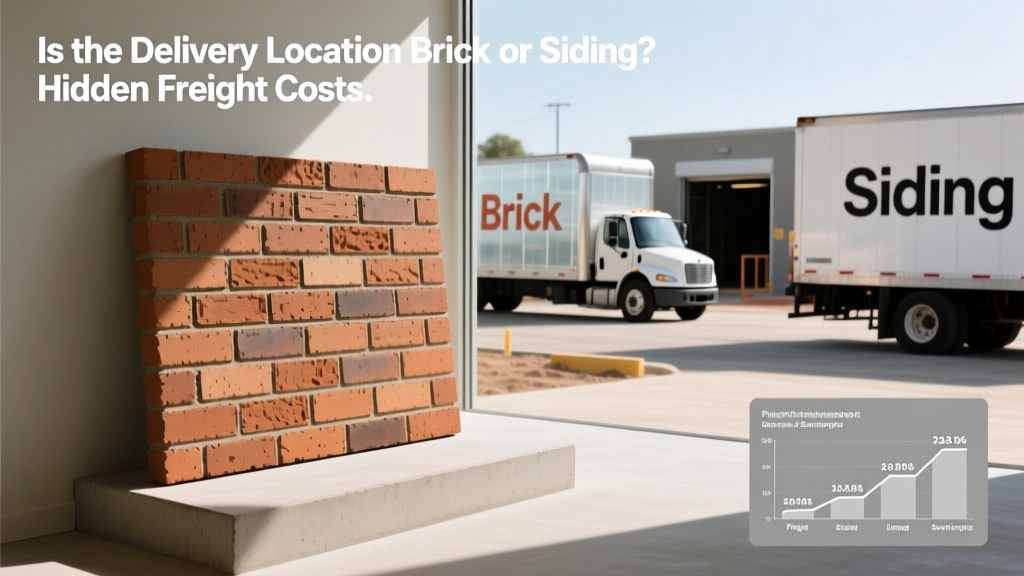
The Logistics Divide: Why Material Type Dictates Freight
When a freight dispatcher, general contractor, or site superintendent asks, is the delivery location brick or siding, they are not making small talk. This specific question determines the National Motor Freight Classification (NMFC), the required offloading equipment, and the last-mile surcharges that will ultimately impact your construction budget. While both materials serve as exterior cladding, their physical properties create vastly different logistical profiles.
Brick is a high-density, low-volume commodity. Siding—whether vinyl, fiber cement, or engineered wood—is a low-density, high-volume product. Misclassifying your delivery location or failing to prepare the site for the specific material type can result in detention fees, ruined materials, and exorbitant LTL (Less-Than-Truckload) replacement costs. Below is a comprehensive cost breakdown of how brick and siding deliveries differ from the loading dock to the final staging area.
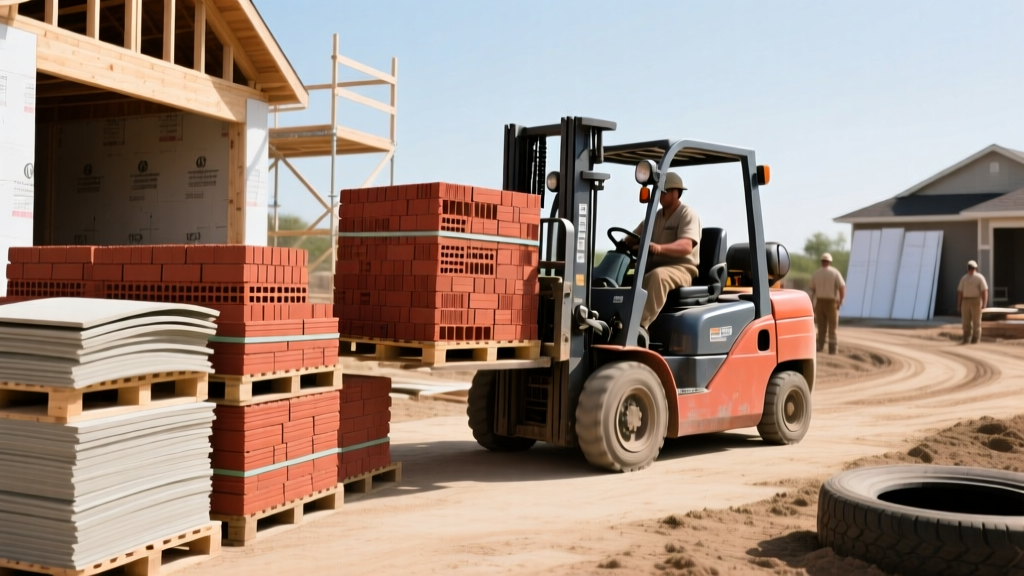
Freight Classifications and Base LTL Rates
Carriers price freight based on density, stowability, handling, and liability. Brick and siding sit on opposite ends of the NMFC spectrum, which directly affects your base shipping rate per hundredweight (cwt).
| Material Type | Typical NMFC Code | Freight Class | Avg Pallet/Bundle Weight | Est. Base LTL Rate (per cwt) |
|---|---|---|---|---|
| Clay Brick (Standard Modular) | 32150 | Class 50 | 2,800 - 3,200 lbs | $45 - $65 |
| Concrete Masonry Veneer | 32150 | Class 50 | 2,500 - 3,000 lbs | $45 - $65 |
| Fiber Cement Siding (Palletized) | 165530 | Class 85 | 1,800 - 2,200 lbs | $85 - $115 |
| Vinyl Siding (Bundled/Crated) | 165530 | Class 100 | 800 - 1,200 lbs | $110 - $145 |
Because brick is incredibly dense and durable, it qualifies for the lowest freight classes (Class 50), making the base line-haul cost relatively cheap per pound. Siding, however, takes up significant trailer space (dimensional weight) and is highly susceptible to impact damage and moisture, pushing it into Class 85 or 100. If your supplier ships siding on a pallet that exceeds standard height limits (over 84 inches), carriers will automatically bump the freight to Class 125 or apply an oversize surcharge, instantly adding 15% to 20% to the invoice.
Site Access and 'Last Mile' Surcharges
The physical delivery location is where the most severe hidden costs emerge. The answer to is the delivery location brick or siding dictates the type of truck dispatched and the offloading method required.
The Brick Delivery: Flatbeds and Forklifts
Brick is almost exclusively shipped on open-air flatbed trailers to accommodate crane loading at the plant and forklift offloading at the site. If your delivery location lacks a heavy-duty forklift (minimum 5,000 lb capacity), you will face severe penalties.
The Siding Delivery: Box Trucks and Hand-Bombing
Siding is frequently delivered via enclosed box trucks or curtain-side vans to protect it from weather. The challenge here is length and manual labor. Fiber cement and vinyl siding are typically sold in 12-foot to 16-foot lengths. Offloading requires two to three laborers to 'hand-bomb' the bundles off the truck. Carriers typically allow 1.5 to 2 hours of free unloading time. If your crew is not ready, or if the delivery location requires navigating narrow driveways, you will incur detention fees averaging $75 to $125 per hour.
Staging, Handling, and Secondary Movement Costs
Once the material hits the ground, the cost of moving it to the active work zone diverges sharply based on the material.
Brick Staging Requirements
According to the Brick Industry Association (BIA), masonry units must be stored off the ground to prevent moisture absorption and mud contamination. At the delivery location, you must budget for:
- Dunnage and Mats: Pallets must sit on crushed stone or plywood mats ($150 - $300 for site prep).
- Hoisting: For multi-story builds, brick requires a material hoist or crane. Renting a portable material hoist costs roughly $800 to $1,200 per week.
- Weather Protection: Brick must be covered with breathable tarps to prevent efflorescence, requiring $50 to $100 in heavy-duty polyethylene covers and tie-downs.
Siding Staging Requirements
Siding is highly vulnerable to warping, cracking, and moisture degradation. The Federal Motor Carrier Safety Administration (FMCSA) and manufacturer guidelines strictly dictate that siding cannot be stored directly on the ground or exposed to the elements. Budget for:
- Elevated Storage: Siding bundles must be placed on 2x4 sleepers or scaffolding planks to allow air circulation.
- Climate Control/Enclosure: Fiber cement and wood-composite siding require dry, covered staging. Building a temporary weather-proof storage tent or renting a portable storage pod (e.g., PODS or similar) adds $150 to $400 to the project.
- Double Handling: Because siding cannot be staged in mud or high-traffic zones, it is often dropped at the driveway and must be manually carried to the house, increasing labor costs by 4 to 8 hours per truckload.
Shortages, Breakage, and Replacement Logistics
No exterior project finishes with exact material counts. How you handle shortages depends entirely on whether the delivery location was stocked with brick or siding.
| Cost Factor | Brick Masonry | Exterior Siding |
|---|---|---|
| Standard Waste Factor | 5% - 7% | 10% - 15% |
| Breakage Type | Chipping, corner spalling during offload | Snapping, edge-cracking during transport |
| Replacement Freight | High. LTL minimums for heavy pallets are brutal ($250+ base). | Moderate. Can be bundled, but 16ft lengths trigger oversize LTL fees. |
| Color/Lot Matching | Critical. Different kiln runs vary wildly. Must order from original lot. | Important. Dye lots vary. Fading makes mid-run additions visible. |
The Replacement Trap: If you run short on brick, ordering a single pallet via LTL freight will cost nearly as much in shipping as the brick itself due to minimum freight charges and residential delivery surcharges. Conversely, if you run short on 16-foot fiber cement siding, standard LTL carriers often refuse the load because it exceeds their 12-foot maximum length for standard pricing, forcing you to use specialized building-material carriers at a premium rate.
Decision Framework: Optimizing Your Delivery Budget
To prevent logistical cost overruns, project managers should implement the following checklist before confirming the delivery location with suppliers:
- Audit the Drop Zone: For brick, ensure the drop zone can support 4,000 lbs of point-load weight without sinking. For siding, ensure the drop zone is within 50 feet of a dry, elevated storage area.
- Confirm Offload Equipment: Never assume a delivery truck has a forklift (a 'moffett'). If the site lacks a forklift, order brick in smaller, break-down pallets (adding 10% to material cost but saving $400 in lumper fees) or ensure a 3-man crew is ready for siding.
- Over-order Strategically: Because replacement freight is disproportionately expensive for both materials, it is mathematically cheaper to over-order by an additional 2% and absorb the return/restocking fee (or keep it for future repairs) than to pay for an emergency LTL shortage shipment.
- Consolidate Shipments: If using a distributor that handles both masonry and cladding, force a consolidated FTL (Full Truckload) delivery. FTL rates bypass NMFC class penalties entirely, pricing the shipment purely on mileage and fuel surcharges.
Ultimately, whether the delivery location is receiving brick or siding dictates the flow of capital on your job site. By treating freight classification, offloading physics, and staging requirements as line-item budget categories rather than afterthoughts, you protect your margins from the hidden costs of material logistics.
Written by
James ThorntonJames Thornton is a construction industry veteran with 25 years of hands-on experience in wood framing, lumber grading, and residential building codes. He started as a framing carpenter in rural Oregon, earned his ICC Residential Building Inspector certification, and eventually became a senior plan reviewer for the City of Portland Bureau of Development Services. James holds a B.S. in Wood Science & Technology from Oregon State University and is a certified lumber grader through the West Coast Lumber Inspection Bureau (WCLIB). He has inspected over 3,000 residential construction sites and authored the city's internal guide on advanced framing techniques (2x6 at 24" O.C.). James lives in Bend, OR, where he builds custom timber-frame cabins and competes in lumberjack sports.
More from James Thornton
View all
Insulation
Best Home Insulation Materials: Complete 2026 Guide
Compare top home insulation materials for 2026. Find R-values, installed costs per square foot, and best uses for fiberglass, spray foam, and mineral wool.
Aug 4, 2026

Sustainable Building
Certify Your Green Building Material for LEED and WELL
Step-by-step guide to certifying a green building material for LEED v5 and WELL v2. Master EPDs, HPDs, and VOC limits for 2026 project specifications.
Aug 4, 2026

Stone & Masonry
Veneer Stacked Stone Panels: Interior Design & Style Showcase
Discover how veneer stacked stone panels transform interiors. Explore modern design profiles, material pairings, and technical installation specs.
Aug 4, 2026