Masonry Nails Performance Specs: Shear Strength & ASTM Ratings
Compare masonry nail performance ratings, ASTM specifications, shear strength limits, and shank types for secure brick and concrete fastening.
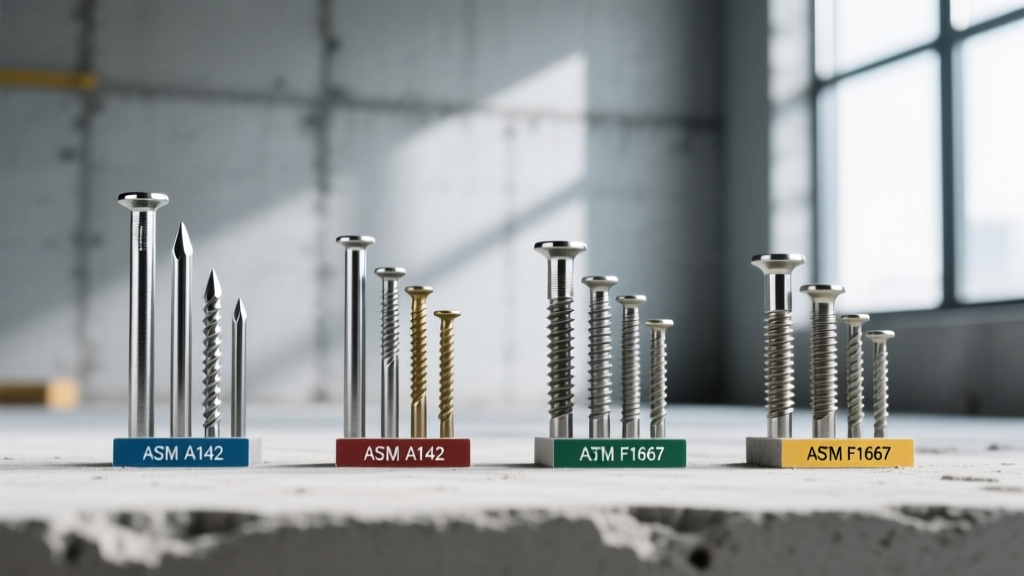
Metallurgical Specifications: Hardness and Carbon Content
Masonry nails are engineered to penetrate high-compressive-strength substrates like fired clay brick, concrete masonry units (CMU), and Portland cement mortar joints without buckling. Unlike standard framing nails governed by general fastener specs, masonry nails must adhere to strict metallurgical profiles to survive the immense friction and impact forces of being driven into masonry.
The core specification for these fasteners falls under ASTM F1667 (Standard Specification for Driven Fasteners: Nails, Spikes, and Staples). To achieve the necessary penetration, masonry nails are manufactured from high-carbon steel wire (typically 0.60% to 0.80% carbon content) and subjected to a quenching and tempering heat treatment.
Rockwell Hardness C-Scale (HRC) Targets
- Optimal Range (48-52 HRC): Provides the ideal balance of edge retention and impact toughness. The nail will not bend upon striking the brick aggregate, nor will it shatter under the hammer blow.
- Under-Tempered (<45 HRC): The nail will bend or 'fish-hook' when hitting hard clinker inclusions within the clay brick.
- Over-Tempered (>56 HRC): The steel becomes excessively brittle. The nail head may snap off, or the shank may shatter into dangerous shrapnel upon impact, a common failure mode in low-quality imported fasteners lacking strict QC.
Load Capacities: Shear vs. Tensile Performance
A critical misunderstanding in brick construction is treating masonry nails as structural tension anchors. Masonry nails derive their holding power entirely from the radial compression of the surrounding mortar or brick matrix against the shank. Consequently, their shear strength vastly exceeds their tensile (pull-out) strength.
The compressive strength of the mortar joint (f'm) directly dictates holding power. Type S mortar (minimum 1,800 psi) yields up to 25% higher withdrawal resistance than Type N mortar (minimum 750 psi). According to structural guidelines published by The Masonry Society, relying on nails for dynamic tensile loads in brick veneer is a code violation; they are strictly rated for static, light-duty shear applications.
Performance Matrix: 8-Gauge and 10-Gauge Masonry Nails
| Gauge (Dia.) | Length | Shank Type | Mortar Type | Avg. Shear Load (lbs) | Avg. Pull-Out (lbs) |
|---|---|---|---|---|---|
| 10 ga (0.135') | 1.5' | Fluted | Type S | 420 | 65 |
| 8 ga (0.162') | 2.0' | Fluted | Type S | 780 | 115 |
| 8 ga (0.162') | 2.0' | Fluted | Type N | 610 | 85 |
| 8 ga (0.162') | 3.0' | Square | Type S | 950 | 160 |
Note: Data assumes a minimum embedment depth of 1.5 inches into the masonry substrate, exclusive of the attached fixture thickness.
Never drive a masonry nail directly into the fired clay brick unit itself. The radial expansion of the steel shank displaces the brittle clay, causing micro-fractures that lead to severe spalling and moisture intrusion. Always drive masonry nails into the mortar joint. Maintain a minimum edge distance of 1.5 inches from the face of the brick to prevent the mortar joint from blowing out. For hollow CMU, nails must only be driven into the solid concrete webbing, never the hollow face shell.
Shank Geometries and Pull-Out Resistance
The shank profile dictates how the nail displaces the Portland cement matrix. Selecting the correct geometry is vital for long-term vibration resistance.
1. Fluted Shank
Fluted nails feature extruded longitudinal fins running down the shank. As the nail is driven, these fins cut into the mortar, creating a mechanical interlock. Fluted shanks offer the highest withdrawal resistance and are the industry standard for permanently attaching wood furring strips to brick walls. However, the flutes increase driving friction, requiring more hammer strikes and increasing the risk of masonry spalling if the mortar is fully cured and exceptionally hard.
2. Square Shank
Square shanks displace more material than round shanks but less than fluted profiles. The sharp corners of the square profile bite into the aggregate of the mortar joint. Square masonry nails are preferred when attaching thicker wood members (like 2x4 sleepers) where higher shear strength is needed, and the slight reduction in pull-out resistance compared to fluted nails is acceptable.
3. Round / Smooth Shank
Smooth shank masonry nails rely purely on friction. They offer the lowest pull-out resistance and are highly susceptible to backing out under thermal expansion/contraction cycles. Their primary use case is for temporary bracing or securing lightweight wire mesh during the initial stages of brick laying, where easy removal is desired.
Corrosion Ratings and Exterior Masonry
Corrosion in masonry fasteners is not just a structural issue; it is a cosmetic and destructive one. When steel oxidizes, the resulting iron oxide (rust) occupies 2 to 6 times the volume of the base metal. This phenomenon, known as rust jacking, generates immense internal pressure that will spall the surrounding brick or mortar, leaving unsightly rust stains on the masonry facade.
For any exterior brick application, or interior applications subject to high humidity, fasteners must meet Brick Industry Association (BIA) guidelines for corrosion resistance.
- Electro-Galvanized (Zinc Plated): Coating thickness is typically less than 0.5 mils. Verdict: Interior use only. Will rust-jack in exterior mortar within 2-4 years.
- Hot-Dipped Galvanized (HDG): Governed by ASTM A153 (Class C for nails). Coating thickness is 1.5 to 3.0 mils. Verdict: Mandatory for all exterior brick veneer and cavity wall applications.
- Stainless Steel (Type 304 or 316): While stainless steel masonry nails exist, they are rarely hardened to the HRC 48-52 spec because austenitic stainless cannot be heat-treated. They tend to bend during installation. If stainless steel is required by code for coastal environments, mechanical screw anchors are a vastly superior alternative to masonry nails.
Decision Framework: When to Use Masonry Nails vs. Screw Anchors
While masonry nails are cost-effective and fast to install, modern construction frequently defaults to mechanical anchors. Use this framework to specify the correct fastener for your brick assembly:
| Application Scenario | Recommended Fastener | Why? |
|---|---|---|
| Attaching 1x3 wood furring to interior brick | 2.5' Fluted HDG Masonry Nail | High shear, low cost, rapid installation. Tensile load is negligible. |
| Securing exterior brick veneer ties | Mechanical Screw Anchor (Tapcon) | Nails lack the tensile strength to resist wind uplift on veneer ties. |
| Mounting heavy cabinetry to CMU/Brick | Sleeve Anchor or Wedge Anchor | Masonry nails will shear under the dynamic load and leverage of heavy cabinets. |
| Temporary formwork bracing on brick | 3' Smooth Shank Masonry Nail | Easy to drive and pry out without destroying the mortar joint. |
Technical FAQ
Can I use a powder-actuated tool to drive masonry nails into brick?
No. Powder-actuated tools (PATs) are calibrated for the dense, uniform matrix of poured concrete or structural steel. Fired clay brick is highly porous and brittle. The explosive velocity of a PAT load will shatter the brick unit, destroy the surrounding mortar joints, and leave the fastener with zero holding power. Always drive masonry nails into brick mortar joints using a standard 16oz to 20oz steel masonry hammer.
What is the minimum embedment depth for an 8-gauge masonry nail?
The industry rule of thumb for driven masonry fasteners is an embedment depth of 10 to 12 times the shank diameter. For an 8-gauge nail (0.162 inches), the absolute minimum embedment into the mortar is 1.62 inches. If you are attaching a 0.5-inch thick wood fixture, you must use a nail that is at least 2.25 inches long to achieve the required structural embedment.
Why did my masonry nail snap halfway into the joint?
Mid-shank snapping is almost always caused by one of two factors: 1) The nail was manufactured with an HRC hardness above 55, making it too brittle for impact, or 2) You are attempting to drive the nail into a high-psi engineering brick or a fully cured Type M mortar joint (2,500+ psi) that exceeds the displacement limits of the nail's geometry. In the latter case, pre-drilling a pilot hole slightly smaller than the shank diameter is required to prevent catastrophic steel failure.