Calacatta Viola Marble: Technical Specs, Hardness, and Durability
Explore the technical specifications, Mohs hardness, and durability ratings of Calacatta Viola marble for high-end interior applications.
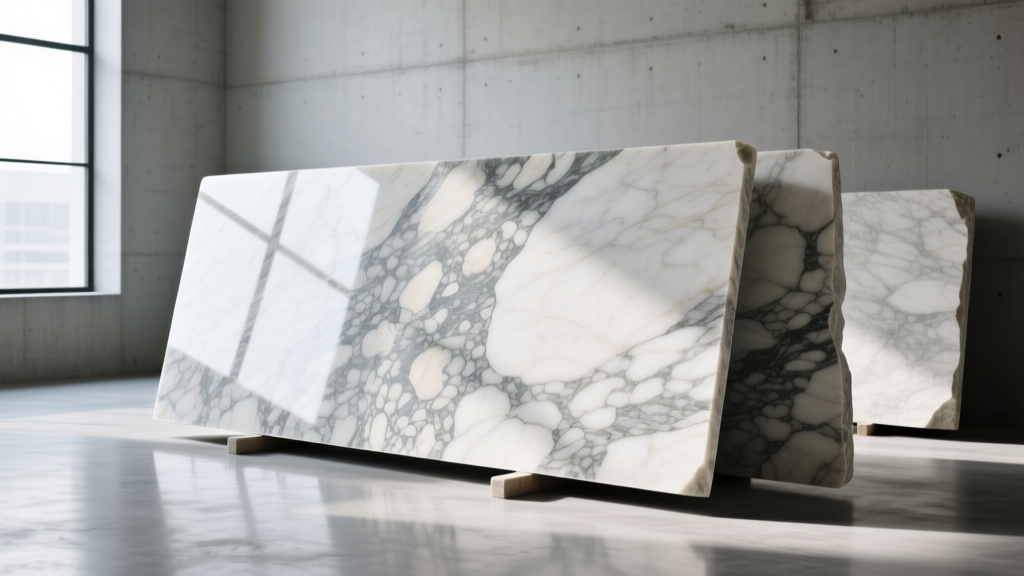
Executive Specification Summary
Material Classification: Calcite-based metamorphic rock (Marble)
Primary Origin: Carrara basin, Tuscany, Italy
Mohs Hardness: 3.0 - 4.0
Water Absorption: 0.12% - 0.25% (ASTM C97)
Best Applications: Interior feature walls, low-traffic flooring, bathroom vanities, kitchen islands (with strict maintenance protocols).
Mineralogical Composition and Physical Properties
Calacatta Viola marble is geologically classified as a true marble, meaning it is a metamorphic rock composed predominantly of recrystallized carbonate minerals, specifically calcite (calcium carbonate). The distinctive deep purple, burgundy, and occasional gold veining are caused by trace mineral impurities, primarily iron oxides (hematite and limonite) and manganese, introduced during the metamorphic recrystallization process under extreme heat and pressure.
Understanding the baseline physical properties is critical for structural planning and environmental suitability. The following data reflects standardized testing metrics for premium-grade Calacatta Viola blocks extracted from the Carrara region.
| Property | Test Method | Calacatta Viola Metric | Industry Standard Requirement |
|---|---|---|---|
| Density | ASTM C97 | 2,710 kg/m³ | Min 2,300 kg/m³ |
| Water Absorption | ASTM C97 | 0.18% by weight | Max 0.20% (Exterior) |
| Compressive Strength | ASTM C170 | 138 MPa (20,000 psi) | Min 69 MPa |
| Flexural Strength | ASTM C880 | 14.5 MPa (2,100 psi) | Min 6.9 MPa |
| Abrasion Resistance | ASTM C241 | 28 Ha (Hardness Index) | Min 10 Ha |
Mechanical Limits and Load-Bearing Specifications
The flexural strength of 14.5 MPa dictates the structural limitations for horizontal applications, particularly kitchen countertops and island overhangs. Unlike granite or quartzite, which boast flexural strengths exceeding 25 MPa, Calacatta Viola requires rigid substructure support.
Overhang and Support Engineering
- Unsupported Overhang Limit: Maximum 10 inches for 2cm thickness; maximum 14 inches for 3cm thickness.
- Cantilevered Seating: Any island overhang exceeding 12 inches must be reinforced with steel corbels, structural plywood sub-tops (minimum 3/4-inch), or concealed aluminum support brackets spaced no more than 24 inches apart.
- Seam Placement: Seams should never be placed over dishwashers or under heavy point-loads. Fabricators must use color-matched, high-modulus epoxy (such as Tenax Knife Grade) rather than standard polyester resin to maintain structural integrity at the joint.
Acid Sensitivity and Etching Vulnerability
The most significant performance limitation of Calacatta Viola marble is its chemical reactivity. Because it is composed of calcium carbonate, it reacts immediately with acidic substances. This is not a defect; it is an inherent mineralogical property.
When an acid (pH < 7) contacts the surface, it dissolves the calcite crystals, leaving a dull, matte depression known as an etch mark. Common household triggers include:
- Lemon Juice (pH 2.0): Causes immediate, severe etching.
- White Wine (pH 3.0 - 3.5): Causes moderate etching within 30 seconds.
- Tomato Sauce (pH 4.3): Causes mild to moderate etching if left for > 2 minutes.
- Coffee (pH 5.0): Causes micro-etching over prolonged exposure.
Finish Selection Matrix: Mitigating Etch Visibility
While you cannot prevent calcite from etching, you can manipulate the surface finish to dictate how visible the etch marks become. The following matrix guides finish selection based on application and maintenance tolerance.
| Finish Type | Gloss Level | Etch Visibility | Stain Resistance | Recommended Application |
|---|---|---|---|---|
| Polished | 90+ GU | High (Etches disrupt light reflection) | High (Pores are mechanically closed) | Feature walls, low-use vanities |
| Honed | 10-40 GU | Low (Matte base hides matte etches) | Moderate (Micro-pores remain open) | Kitchen countertops, high-use islands |
| Leathered | 5-15 GU | Very Low (Textured surface masks defects) | Low (Deep texture traps liquids) | Bathroom surrounds, tactile feature walls |
Sealing Protocols and Chemical Resistance
A pervasive misconception in the stone industry is that sealers prevent etching. Impregnating sealers do not prevent etching. Etching is a chemical reaction on the surface; sealers reside below the surface. Sealers only mitigate staining by reducing the capillary action that draws pigmented liquids into the stone's micro-pores.
For Calacatta Viola, specify a fluoropolymer-based impregnating sealer (e.g., Tenax Ager or Miracle Sealants 511 Porous Plus). Fluoropolymers provide both hydrophobic (water-repelling) and oleophobic (oil-repelling) protection, which is critical for kitchen environments where cooking oils are present.
2026 Market Pricing and Block Yield Economics
Calacatta Viola remains one of the most expensive natural stones on the global market due to its limited quarry yield and high extraction costs. The dramatic, thick veining required for premium bookmatching is present in only 15-20% of extracted blocks.
- Raw Slab Cost (2cm/3cm): $140 to $280 per square foot, depending on the intensity of the violet pigmentation and background clarity.
- Fabrication and Installation: $90 to $160 per square foot. This includes CNC edge profiling, structural epoxy seaming, and custom templating.
- Total Installed Cost: Expect to budget between $230 and $440 per square foot for a completed kitchen island or vanity installation.
- Bookmatching Premium: Projects requiring four-way bookmatching (often used for shower surrounds or grand foyer floors) incur a 30-50% material waste factor, effectively driving the usable square-foot cost above $350.
Fabrication Tolerances and Edge Profiling
Due to the stark contrast between the white calcite background and the dark burgundy veining, edge profiling on Calacatta Viola requires extreme precision. When fabricating a mitered edge (e.g., a 2-inch drop apron), the vein pattern must flow continuously across the 45-degree joint.
Fabricators must use digital templating and 5-axis CNC waterjet saws to achieve seam tolerances of less than 0.5mm. Standard bridge saws often result in chipping along the dark iron-oxide veins, which are structurally harder and more brittle than the surrounding white calcite matrix. Always specify a honed or micro-beveled edge profile over a sharp eased or bullnose edge; sharp 90-degree corners on calcite marbles are highly prone to micro-chipping during daily use.
For comprehensive maintenance guidelines and long-term care protocols, refer to the official Natural Stone Institute Care Guide to ensure the longevity of your investment.