Carrara Marble Countertops: Durability and Lifespan Analysis
Analyze the durability and lifespan of Carrara marble countertops. Learn about etching, sealing protocols, honed vs. polished finishes, and long-term care.
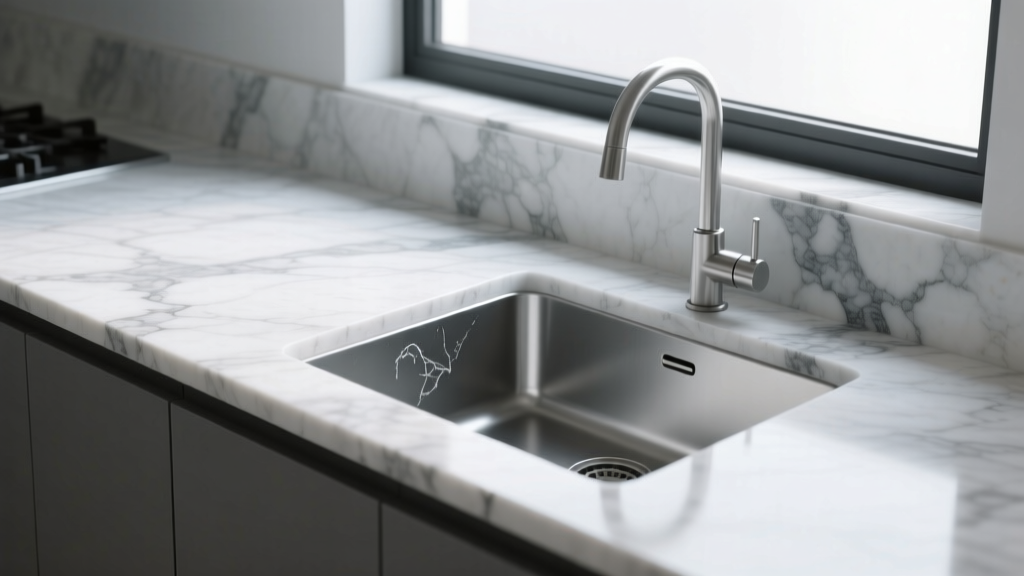
Carrara marble remains one of the most sought-after natural stones in residential and commercial construction, prized for its bright white background and delicate, feathery grey veining. However, specifying Carrara marble countertops requires a rigorous understanding of its geological limitations. Unlike engineered quartz or high-density quartzite, Carrara is a calcite-based metamorphic rock. Its durability is not defined by structural failure or impact resistance, but by its chemical reactivity and surface abrasion tolerance. This analysis breaks down the exact mineral mechanics, lifespan expectations, and maintenance economics of Carrara marble in high-use environments.
The Mineral Reality: Mohs Hardness and Porosity Metrics
To evaluate the lifespan of Carrara marble, we must first look at its mineral composition. Carrara marble is composed of 95% to 99% calcium carbonate (CaCO3). On the Mohs scale of mineral hardness, calcite registers at a 3, while the quartz impurities found in some veins can reach a 7. In practical terms, a pure Carrara surface will scratch when exposed to materials with a Mohs hardness of 4 or higher—including common kitchen culprits like steel knives (Mohs 5.5) and unglazed ceramic cookware (Mohs 6-7).
Beyond scratch resistance, porosity dictates the stone's vulnerability to deep-set stains. Carrara marble typically exhibits a water absorption rate between 0.5% and 2.0% by weight, depending on the specific quarry grade. While this is relatively low compared to sandstone or limestone, it is high enough to allow lipid-based stains (oils, butter) and dark pigments (red wine, coffee) to penetrate the capillary network if the surface is left unsealed.
Etching vs. Staining: The Chemical Breakdown
The most common point of failure for Carrara marble countertops is the conflation of staining and etching. Understanding the chemical distinction between the two is critical for setting accurate lifespan expectations.
Critical Distinction: Etching is Not Staining
Staining occurs when a pigmented liquid penetrates the stone's pores. It is a physical intrusion that can be prevented by impregnating sealers and removed with poultices.
Etching is a chemical reaction. When an acidic substance (pH below 7.0) contacts the calcium carbonate in Carrara marble, it literally dissolves the surface layer, leaving a dull, depressed mark. No penetrating sealer can prevent etching. Sealers only slow the absorption of liquids; they do not alter the surface chemistry of the calcite.
Common household items pose severe etching risks. Lemon juice (pH ~2.0), white vinegar (pH ~2.5), and tomato sauce (pH ~4.0) will begin dissolving the polished surface of Carrara marble within seconds of contact. According to the Natural Stone Institute, preventing etching requires strict behavioral controls in the kitchen, such as using cutting boards for all acidic food preparation and immediately wiping up spills.
Honed vs. Polished: A Durability Matrix
The factory finish applied to Carrara marble drastically alters its perceived durability and long-term maintenance cycle. While a polished finish offers a higher degree of stain resistance (due to the closed surface pores), it is highly susceptible to visible etching. A honed finish is generally recommended for kitchen environments.
| Performance Metric | Polished Carrara | Honed Carrara |
|---|---|---|
| Etch Visibility | High (dull spots contrast sharply with glossy reflection) | Low (matte surface camouflages micro-etching) |
| Stain Resistance | Higher (mechanical polishing closes surface capillaries) | Lower (open pores require more frequent sealing) |
| Scratch Concealment | Poor (scratches disrupt light refraction) | Good (diffuse light scattering hides micro-abrasions) |
| DIY Repairability | Very Difficult (requires specialized polishing powders) | Moderate (can be sanded with wet-dry sandpaper) |
Grade Density: Bianco C vs. Bianco CD
Not all Carrara marble is identical. The commercial grading system directly impacts the stone's porosity and, consequently, its lifespan in a wet environment. When sourcing slabs, specifying the correct grade is a vital durability control measure.
- Bianco Carrara C (Premium): Features a brighter white background with tight, thin grey veining. This grade is denser, with a lower absorption rate (closer to 0.5%). It holds up better in high-moisture areas and requires less aggressive sealing protocols.
- Bianco Carrara CD (Commercial): Exhibits a slightly greyer background with broader, more pronounced veining. The wider veins often represent areas of higher porosity and structural weakness. CD grade is more prone to deep staining and may require bi-annual sealing in heavy-use kitchens.
Sealing Protocols: Extending the Functional Lifespan
Because penetrating sealers cannot stop etching, their sole purpose is to buy time against staining. Modern fluoropolymer and siloxane-based impregnators are the industry standard for calcite-based stones. Products like Miracle Sealants 511 Impregnator or Tenax Ager penetrate the capillary network and create a hydrophobic barrier without altering the stone's vapor transmission.
The 2026 Water Drop Testing Standard
Do not rely on a fixed calendar schedule for resealing. Instead, perform the water drop test. Place a 3-inch diameter puddle of water on the countertop in high-use zones (near the sink and prep areas). If the stone darkens within 3 to 5 minutes, the sealer has degraded and immediate reapplication is required. If the water beads or the stone remains unchanged for 15 minutes, the hydrophobic barrier is intact.
For honed Carrara CD grade in a busy kitchen, expect to perform this test and potentially reseal every 12 to 18 months. For polished Bianco C grade in a low-use bar area, the sealer may last 3 to 5 years. For advanced chemical protection, some fabricators now offer factory-applied nano-coatings (like those detailed by MB Stone Care), which provide a temporary physical barrier against mild acids, though these require professional reapplication every 2 to 3 years.
Long-Term Lifespan and Patina Development
Structurally, a properly supported 2cm or 3cm Carrara marble countertop will easily outlast the building it resides in; a 100-year lifespan is standard. However, the aesthetic lifespan is highly subjective. In European design traditions, the accumulation of micro-etches, minor scratches, and slight color shifts is referred to as a 'patina'—a record of the home's culinary history that adds character and warmth to the stone.
In North American markets, where pristine, uniform surfaces are often expected, this patina is frequently viewed as damage. Homeowners who cannot tolerate the inevitable dulling of the surface near the sink and cooktop should reconsider Carrara marble in favor of non-reactive alternatives like quartzite or engineered quartz.
Restoration Economics: When to Refinish
When a Carrara marble countertop becomes heavily etched, deeply stained, or structurally compromised by lippage (uneven tile/slab edges), professional restoration is highly cost-effective compared to replacement. The restoration process involves mechanical honing using diamond-impregnated pads.
A professional restorer will typically sequence through 400-grit, 800-grit, and 1500-grit diamond pads to remove the damaged surface layer (usually 1mm to 2mm of depth), followed by a tin oxide or aluminum oxide polishing powder to restore the factory gloss.
Current Cost Metrics (2026 Estimates):
- Professional Honing/Polishing: $4.00 to $8.00 per square foot.
- Deep Stain Poultice Treatment: $150 to $250 per localized incident.
- Full Slab Replacement: $80 to $150+ per square foot (installed).
Given the massive cost differential, refinishing a Carrara countertop every 10 to 15 years is a highly economical strategy for preserving the asset over its multi-decade lifespan.
Summary Decision Framework
Specify Carrara marble countertops if the client values authentic, natural veining, accepts the development of a lived-in patina, and is committed to strict acidic-spill management. Mandate a honed finish for kitchen environments to camouflage inevitable micro-etching, and specify Bianco C grade to minimize porosity risks. If the client demands a permanently pristine, high-gloss surface with zero chemical maintenance, reject Carrara marble and pivot the specification toward a calcite-free quartzite or a high-end sintered stone.