Best Marble Floor Tile Brands & Collections for 2026
Explore top marble floor tile brands for 2026. We deep-dive into Antolini, Walker Zanger, and MSI product lines, pricing, and installation specs.
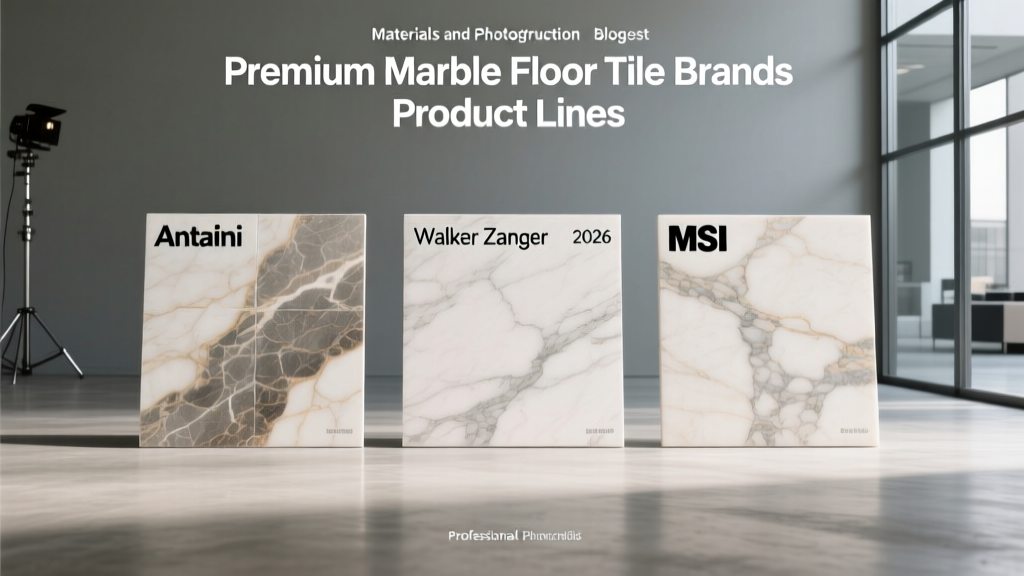
The Shift in Marble Floor Specifications
Specifying a marble floor in 2026 requires navigating a landscape that has evolved far beyond basic Carrara squares. Today's leading manufacturers are addressing the historical vulnerabilities of natural stone—namely etching, staining, and slip hazards—through proprietary treatments, advanced quarrying techniques, and large-format rectification. For architects, designers, and high-end residential builders, selecting the right brand is no longer just about aesthetic matching; it is about securing a product line backed by rigorous technical testing and specific installation mandates.
This deep-dive examines three dominant brands in the natural marble flooring sector, analyzing their flagship collections, proprietary technologies, and the exact technical specifications required to ensure long-term performance without failure.
Antolini: The Azerocare Breakthrough
Antolini has fundamentally altered the specification landscape for natural stone floors with its patented Azerocare technology. Historically, specifying polished marble in high-traffic entryways, kitchens, or dining areas was a liability due to the stone's calcium carbonate composition, which reacts instantly to acidic spills (wine, citrus, vinegar) causing permanent etching.
Azerocare is not a surface topical sealant that wears away over time. It is a proprietary molecular treatment applied at the factory level that fills the microscopic pores of the marble with organic compounds. This process renders the stone completely resistant to organic stains and acid etching without altering the natural color, luminosity, or tactile feel of the marble.
Flagship Collection: The Onyx and Marble Fusion series. Antolini excels in exotic, highly veined marbles and onyx-marble hybrids. Their bookmatched 24x48 inch floor tiles are cut from sequential blocks, ensuring continuous veining across expansive floor plans. Pricing for Azerocare-treated large-format tiles typically ranges from $45 to $85 per square foot, positioning it strictly in the ultra-luxury tier.
Walker Zanger: Waterjet and Bookmatched Mastery
Walker Zanger targets the high-end residential and boutique hospitality market, focusing on intricate waterjet patterns, mosaics, and meticulously graded bookmatched slabs cut into floor tiles. Their approach to marble flooring emphasizes heritage aesthetics combined with modern dimensional precision.
Flagship Collection: The Museum Collection. This line features premium-grade Calacatta, Statuario, and Bardiglio marbles sourced from specific, historically significant veins in Tuscany. Walker Zanger provides these in large-format tiles (up to 36x36 inches) with rectified edges, allowing for minimal 1/16-inch grout joints.
A critical advantage of Walker Zanger's product line is their in-house waterjet capability. For grand foyers and formal dining rooms, they offer pre-assembled, mesh-backed marble medallions and border systems that integrate seamlessly with their field tiles. This eliminates the need for third-party fabrication and ensures the color lot of the medallion perfectly matches the surrounding field tile.
- Thickness Tolerance: Maintained within ±1/32 inch across large formats, critical for preventing lippage in large-format installations.
- Finish Options: Offers a proprietary 'Velvet' honed finish that provides a soft, matte sheen while achieving a Dynamic Coefficient of Friction (DCOF) of 0.55, well above the safety threshold for wet areas.
- Pricing: $28 to $55 per square foot for standard field tiles; custom waterjet medallions range from $120 to $250 per square foot.
MSI (M S International): Scaling Accessible Luxury
While Antolini and Walker Zanger dominate the ultra-luxury tier, MSI provides the most robust portfolio of accessible, commercial-grade, and upper-mid-market natural marble flooring. MSI's strength lies in its massive global supply chain, allowing them to offer consistent, large-volume natural stone collections that are readily available through regional distributors.
Flagship Collection: The Mont Blanc and Emperador natural stone lines. MSI focuses heavily on standardized formats (12x12, 12x24, and 24x24) that align with standard commercial grid layouts. Their Mont Blanc collection features a bright white background with subtle gray veining, serving as a highly consistent, commercially viable alternative to premium Italian Calacatta.
MSI's natural marble tiles are typically sold in standard polished or honed finishes. Because they do not utilize proprietary molecular stain-blocking treatments like Azerocare, MSI marble floors require the application of high-quality penetrating sealers (such as impregnating siloxane-based sealers) immediately post-installation and annually thereafter.
Brand & Collection Comparison Matrix
| Brand | Flagship Line | Best Application | Proprietary Tech | Price Range (SQFT) |
|---|---|---|---|---|
| Antolini | Onyx & Marble Fusion | Luxury residential, dining areas | Azerocare (Etch/Stain proof) | $45 - $85 |
| Walker Zanger | Museum Collection | Foyers, formal spaces, hospitality | Velvet Honed Finish, Waterjet | $28 - $55 |
| MSI | Mont Blanc / Emperador | Commercial grids, mid-market homes | Standard Rectification | $12 - $22 |
Critical Installation Mandates for Marble Floors
The most expensive marble floor tile will fail catastrophically if installed using generic ceramic tile protocols. Natural marble is highly sensitive to moisture, alkalinity, and mechanical stress. Adherence to the guidelines established by the Tile Council of North America (TCNA) and the Natural Stone Institute is non-negotiable.
The White Thinset Rule and ANSI Standards
Never use gray thinset mortar beneath light-colored marble (Carrara, Calacatta, Statuario, Thassos). Gray mortar contains iron and other metallic oxides that can oxidize when exposed to moisture, bleeding through the translucent crystalline structure of white marble and causing permanent yellow or rust-colored shadowing. You must specify a high-quality, white, polymer-modified thinset mortar.
For large-format marble tiles (any edge longer than 15 inches), the mortar must meet ANSI A118.15 (Improved Modified Dry-Set Cement Mortar). This standard ensures higher bond strength and non-sag properties, which are critical for preventing voids beneath heavy stone. The TCNA mandates a minimum 95% mortar coverage for natural stone in wet areas and 80% in dry areas to prevent point-load cracking.
DCOF Ratings and Slip Resistance
Polished marble is inherently slippery when wet. Under the ANSI A326.3 standard for measuring the Dynamic Coefficient of Friction (DCOF), many polished marbles score below 0.42 when wet, classifying them as a slip hazard. If the marble floor is specified for a bathroom, mudroom, or commercial entryway, you must select a honed, flamed, or bush-hammered finish that achieves a DCOF of 0.50 or higher. Always request the manufacturer's specific DCOF test report for the exact finish being ordered, as DCOF varies wildly even between different batches of honed stone.
Cost Analysis: Material and Grade Tiers
Budgeting for a marble floor requires looking beyond the per-square-foot material cost. The total installed cost is heavily influenced by the stone's grade, the required site preparation, and the complexity of the layout.
- Material Costs: Commercial grade marble starts around $8 - $12 per square foot. Premium, first-choice Italian marbles range from $20 to $45 per square foot. Exotic, bookmatched, or Azerocare-treated stones command $50 to $100+ per square foot.
- Installation Labor: Natural stone installation labor is typically 30% to 50% higher than standard porcelain. Expect to pay $12 to $25 per square foot for labor, depending on regional markets and format size.
- Consumables and Prep: Factor in $3 to $5 per square foot for white ANSI A118.15 thinset, premium grout, penetrating sealers, and uncoupling membranes (like Schluter-DITRA) which are highly recommended over wood subfloors to prevent deflection-induced cracking.
Final Sourcing and Verification Checklist
Before finalizing your marble floor specification and issuing the purchase order, run through this verification protocol to prevent costly on-site failures:
- Verify the Lot Number: Ensure all field tiles, borders, and trim pieces are pulled from the exact same quarry block and production lot. Natural stone color shifts dramatically between lots.
- Dry-Lay Requirement: Mandate in your contract that the installer must dry-lay and blend a minimum of 10% of the total square footage on-site before setting, ensuring an even distribution of veining and color variation.
- Confirm the Sealer Compatibility: If using a resin-filled marble (common in lower grades to stabilize natural fissures), verify that your chosen penetrating sealer is compatible with the factory resin. Some solvent-based sealers will soften or cloud epoxy resins.
- Subfloor Deflection Check: Verify the structural subfloor meets the L/720 deflection criteria for natural stone. Standard L/360 framing used for ceramic tile will result in cracked marble grout joints and fractured tiles over time.