Cobblestone Driveway Cost Calculator & Pricing Guide 2026
Calculate exact cobblestone driveway costs for 2026. Includes material pricing, quantity formulas, base prep requirements, and labor estimates.
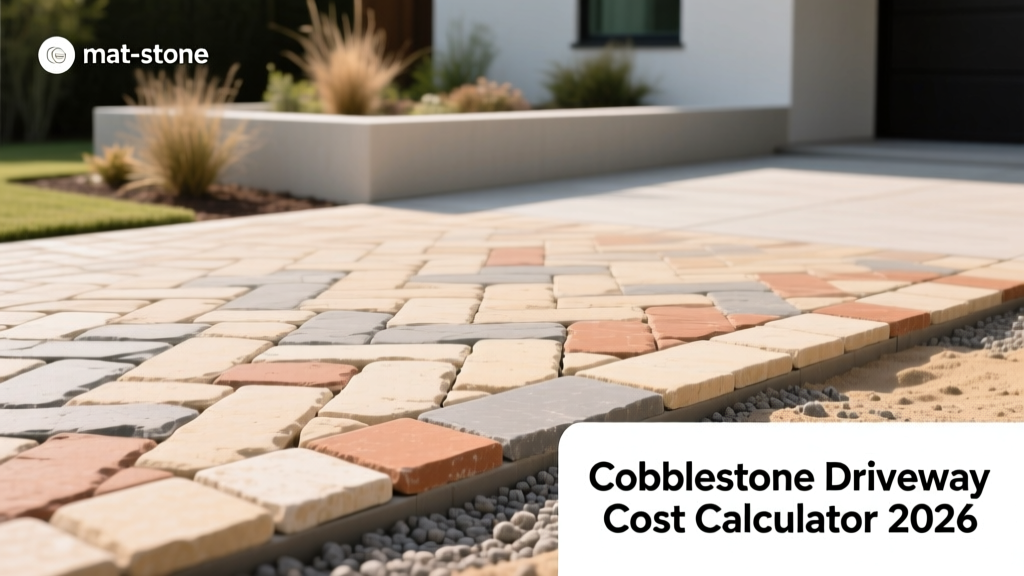
2026 Cobblestone Pricing Matrix: Material, Labor, and Base
True cobblestone—defined as naturally rounded or machine-tumbled granite and basalt blocks, not stamped concrete or porcelain pavers—commands a premium due to material density and specialized masonry labor. The following matrix breaks down the 2026 national average costs per square foot for a vehicular-rated cobblestone driveway installation.
| Cost Component | Low End (Domestic Tumbled) | High End (Reclaimed European) | Notes & Variables |
|---|---|---|---|
| Cobblestone Material | $14.00 / sq ft | $38.00 / sq ft | Domestic 4x4x4 granite vs. imported reclaimed porphyry/basalt. |
| Base & Bedding Materials | $6.50 / sq ft | $9.00 / sq ft | Includes geotextile fabric, ASTM D2940 aggregate, and coarse sand. |
| Edge Restraint (Haunch) | $18.00 / linear ft | $28.00 / linear ft | Reinforced concrete curb required to prevent lateral vehicular creep. |
| Specialized Labor | $22.00 / sq ft | $45.00 / sq ft | Hand-laying and cutting irregular cobbles requires certified masons. |
| Total Installed Cost | $42.50 / sq ft | $92.00 / sq ft | Average 600 sq ft driveway: $25,500 to $55,200 total. |
Step-by-Step Quantity Calculator Formulas
Estimating cobblestone requires accounting for irregular shapes, cutting waste, and the volumetric depth of the sub-base. Use these exact formulas to generate your material list.
- Calculate Surface Stone & Waste Factor:
Measure Length × Width = Total Square Footage. Because cobblestones are irregular and require cutting along borders, add a strict 15% waste factor. Formula: Total Sq Ft × 1.15 = Order Quantity. - Calculate Sub-Base Aggregate Tonnage:
A vehicular driveway requires a minimum 8-inch compacted crushed stone base (typically 3/4-inch minus). Formula: (Total Sq Ft × 0.66) ÷ 27 = Cubic Yards. Multiply Cubic Yards by 1.35 (the standard density conversion for crushed granite/limestone) to get the required tonnage. - Calculate Bedding Sand Volume:
The setting bed requires 1.5 inches of coarse, sharp concrete sand (never use masonry or play sand, which retains moisture and causes frost heave). Formula: (Total Sq Ft × 0.125) ÷ 27 = Cubic Yards of bedding sand. - Calculate Jointing Sand:
For 4x4x4 inch cobbles, joints average 0.5 inches wide. You will need approximately 1 bag (50 lbs) of high-performance polymeric sand per 40 square feet of surface area.
Sub-Base Engineering: Preventing Frost Heave and Edge Creep
The most common failure mode in cobblestone driveways is not the stone itself, but the sub-base. According to structural guidelines published by the Interlocking Concrete Pavement Institute (ICPI), which governs flexible segmental paving standards, a poorly engineered base will result in differential settling and frost heave.
The 4-Layer Base Specification
- Layer 1 (Subgrade): Native soil excavated to 12 inches below finish grade. Must be compacted to 98% Standard Proctor density.
- Layer 2 (Geotextile Fabric): A non-woven separation fabric (minimum 4 oz/sq yd) laid directly over the subgrade. This prevents clay migration into the aggregate base, which is the primary cause of base softening.
- Layer 3 (Aggregate Base): 8 inches of ASTM D2940 graded aggregate, compacted in two 4-inch lifts using a 3-ton vibratory roller.
- Layer 4 (Bedding): 1.5 inches of ASTM C33 coarse concrete sand, screeded to a precise grade. Do not compact the bedding sand before laying stone.
Edge Restraint: The Concrete Haunch
Cobblestones subjected to vehicular turning forces will spread laterally if not contained. Plastic paver restraints are insufficient for natural stone driveways. You must pour a continuous concrete haunch (curb) at the perimeter. The haunch must be 8 inches wide and 12 inches deep, poured against the outer row of cobbles, with the top of the concrete sitting 1 inch below the sand bedding layer to remain invisible.
Decision Matrix: Flexible Sand-Set vs. Rigid Mortar-Set
Choosing the wrong installation method for your specific climate and soil type will lead to catastrophic failure. Use this matrix to determine the correct setting method.
| Feature | Flexible Sand-Set (Recommended) | Rigid Mortar-Set |
|---|---|---|
| Best Climate | Freeze-thaw regions (North/Midwest) | Warm, stable climates (South/Southwest) |
| Drainage | Permeable; water drains through joints | Impermeable; requires surface sloping (2% min) |
| Frost Heave Risk | Low (system flexes with ground movement) | High (mortar cracks, water enters, freezes) |
| Maintenance | Re-sand joints every 5-8 years | Re-point mortar every 10-15 years |
| Labor Cost Impact | Standard masonry rates | +25% premium for mortar mixing and setting |
Frequently Asked Cost & Installation Questions
Can I install cobblestone over an existing concrete driveway?
Yes, but only using a rigid mortar-set method. You must first verify the existing concrete slab is structurally sound, free of heaving, and sloped correctly for drainage. You will need to scarify (grind) the concrete surface to ensure a mechanical bond with the mortar bed. However, this adds $4.50 to $7.00 per square foot in surface preparation costs and raises the final driveway height by 4 to 5 inches, which may interfere with garage door thresholds and municipal sidewalk grades.
What is the difference between Belgian Block and Cobblestone?
In modern landscaping terminology, "Belgian Block" refers to quarried granite cut into rectangular, cubic shapes (typically 4x4x4 or 5x5x5 inches). True "cobblestone" refers to naturally rounded, water-tumbled stones. Belgian block is significantly easier to install, yields a tighter joint pattern, and results in a smoother driving surface, which is why it dominates the 2026 residential driveway market. True rounded cobblestone is mostly reserved for historical restorations or decorative pedestrian aprons.
How do I remove oil stains from granite cobblestones?
Granite is dense but porous. For fresh oil stains, apply a poultice made of diatomaceous earth and acetone, cover with plastic wrap, and let it draw the oil out over 48 hours. Avoid using high-pressure power washers (over 1,500 PSI) on sand-set cobblestones, as the concentrated stream will excavate the jointing sand and destabilize the interlocking friction that holds the stones in place.