Completely Decomposed Granite: 2026 Performance Specs & Load Ratings
Explore 2026 performance specifications, CBR ratings, compaction densities, and sieve analysis for completely decomposed granite in construction.
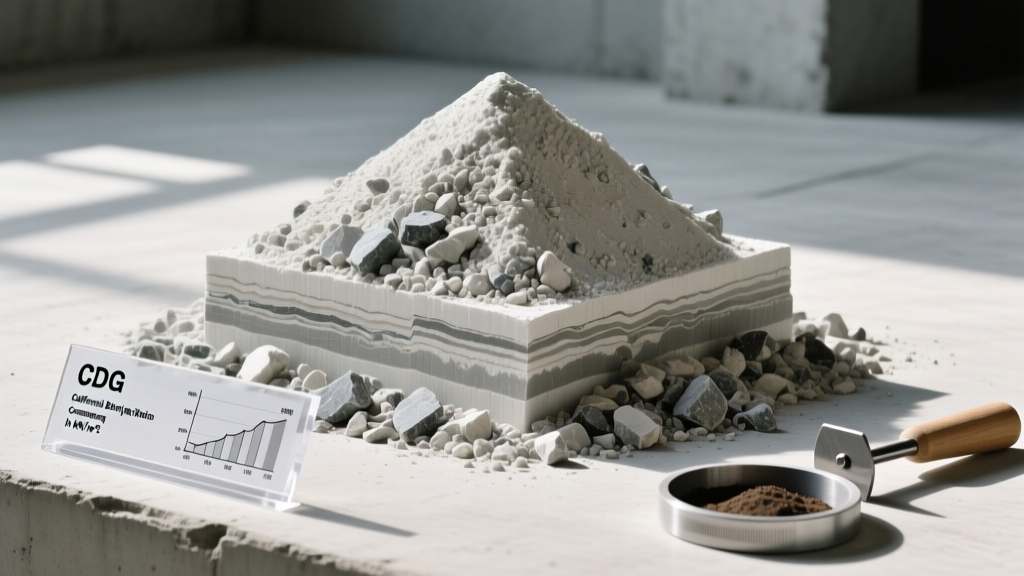
Geotechnical Profile and Mineralogical Composition
Completely decomposed granite (CDG), frequently classified in geotechnical engineering as saprolite, represents the final stage of in-situ rock weathering before the material transitions into residual soil. Unlike highly decomposed granite (HDG), CDG has lost almost all of its original unconfined compressive strength and can be easily crumbled by hand or under light mechanical pressure. However, it retains the relict structural fabric and joint patterns of the parent igneous rock, a characteristic that heavily dictates its anisotropic engineering behavior.
The mineralogical shift in CDG is defined by the extensive hydrolysis of feldspars into clay minerals, predominantly kaolinite and illite, while quartz grains remain largely unaltered. This creates a dual-porosity system: the macro-pores exist between the intact quartz sand particles, while micro-pores reside within the clay aggregates. This unique microstructure makes CDG highly sensitive to moisture variations, resulting in distinct collapse potential and strain-softening behaviors under shear stress. For material classification, CDG typically falls under the Unified Soil Classification System (USCS) as silty sand (SM), clayey sand (SC), or occasionally sandy silt (ML), aligning with frameworks outlined by the USDA NRCS soil classification guidelines.
- Specific Gravity (Gs): 2.60 – 2.68
- Liquid Limit (LL): 25% – 45%
- Plastic Limit (PL): 18% – 25%
- Plasticity Index (PI): 5 – 20 (Generally low to medium plasticity)
- Linear Shrinkage: 2% – 6%
Particle Size Distribution and Sieve Analysis
The gradation of CDG is highly variable depending on the parent rock's grain size and the specific microclimate of the weathering profile. However, for construction applications such as subbase fills and pathway aggregates, the material must meet specific gradation bands to ensure adequate interlock and drainage. Testing protocols for these distributions follow guidelines established by ASTM International testing standards, specifically D422 for particle-size analysis.
| Sieve Size | Typical % Passing (Unprocessed) | Spec % Passing (Processed Base) |
|---|---|---|
| 3-inch (75 mm) | 100% | 100% |
| No. 4 (4.75 mm) | 75% – 95% | 85% – 100% |
| No. 40 (0.425 mm) | 40% – 65% | 45% – 70% |
| No. 200 (0.075 mm) | 15% – 35% | 10% – 25% |
Materials with greater than 35% passing the No. 200 sieve are generally rejected for structural fill applications without stabilization, as the high fines content severely restricts permeability and increases frost-heave susceptibility in colder climates.
Compaction Metrics and Moisture-Density Relationships
Achieving target density in CDG is notoriously challenging due to its moisture sensitivity. The clay aggregates within the matrix act as moisture sponges, leading to significant discrepancies between field moisture content and laboratory optimums.
Standard vs. Modified Proctor Densities
For light-duty applications like pedestrian pathways or landscaping, Standard Proctor (ASTM D698) specifications are sufficient. For structural subgrades, pavement bases, or heavy load-bearing fills, Modified Proctor (ASTM D1557) is mandated.
- Standard Proctor Maximum Dry Density (MDD): 105 – 115 pcf (1,680 – 1,840 kg/m³)
- Standard Proctor Optimum Moisture Content (OMC): 12% – 18%
- Modified Proctor MDD: 112 – 122 pcf (1,790 – 1,950 kg/m³)
- Modified Proctor OMC: 9% – 14%
Bearing Capacity, Shear Strength, and CBR Ratings
The load-bearing performance of CDG is highly dependent on its compaction state and moisture condition. The California Bearing Ratio (CBR) is the primary metric used by civil engineers to design pavement thickness over CDG subgrades, referencing methodologies found in the Caltrans Standard Specifications for aggregate bases.
- Unsoaked CBR: 25% – 45% (When compacted to 95% Modified Proctor at OMC)
- Soaked CBR (4-day soak): 8% – 18% (Demonstrating a severe penalty upon saturation)
- Effective Friction Angle (φ'): 28° – 36° (Drained conditions)
- Effective Cohesion (c'): 0 – 10 kPa (Often assumed as zero for conservative design)
The drastic drop between unsoaked and soaked CBR values highlights the material's vulnerability to water ingress. In high-water-table environments, relying on unsoaked CBR values will result in catastrophic subgrade failure and surface rutting.
Permeability, Erodibility, and Piping Risk
The coefficient of permeability ($k$) for compacted CDG typically ranges from $10^{-4}$ to $10^{-6}$ cm/s. While this is relatively low compared to clean sands, it is high enough to allow internal seepage. The primary failure mode in hydraulic structures or retaining wall backfills is internal erosion (piping).
Because CDG contains a mix of coarse quartz grains and fine kaolinite clays, it is susceptible to suffusion—where the fine clay particles are washed out through the voids of the coarser sand skeleton under hydraulic gradients. To mitigate this, engineers must specify strict filter criteria (e.g., Terzaghi's filter rules) when placing CDG adjacent to open-graded drainage aggregates, or utilize non-woven geotextile separation fabrics with an Apparent Opening Size (AOS) of 70 to 100 US Sieve.
Field Application and Stabilization Decision Matrix
Determining whether CDG can be used in its natural state or requires chemical stabilization depends on the structural demands of the project. Below is a decision framework for 2026 construction specifications.
| Application | Required Soaked CBR | Natural CDG Viable? | Recommended Stabilization |
|---|---|---|---|
| Pedestrian Pathways / Landscaping | 5% – 10% | Yes (Unsoaked adequate) | None; surface sealant optional |
| Light-Duty Parking Subbase | 10% – 15% | Marginal | Mechanical (Geogrid) or 2% Cement |
| Highway Pavement Subgrade | > 20% | No | 4-6% Portland Cement (CTB) |
| Retaining Wall Backfill | N/A (Friction focus) | No (Piping risk) | Replace with clean crushed rock |
Chemical Stabilization Protocols
When natural CDG fails to meet load-bearing specifications, chemical stabilization is required. It is a common industry error to attempt stabilization with hydrated lime. Because CDG clays (kaolinite) have low cation exchange capacity and lack reactive silica, lime yields negligible strength gains.
The correct protocol is the creation of a Cement-Treated Base (CTB). By blending 4% to 6% Type I/II Portland cement by dry weight of the CDG, and compacting the mixture at a slightly reduced moisture content (typically 1-2% below the OMC of the untreated soil), the soaked CBR can be reliably elevated above 40%, with unconfined compressive strength (UCS) exceeding 300 psi at 7 days. This effectively locks the relict fabric and clay matrix into a rigid, moisture-resistant slab.