Flagstone Walkway Specs: ASTM Ratings, Slip Resistance & Load Data
Engineer your flagstone walkway with exact ASTM specs, compressive strength ratings, slip resistance data, and base thickness requirements.
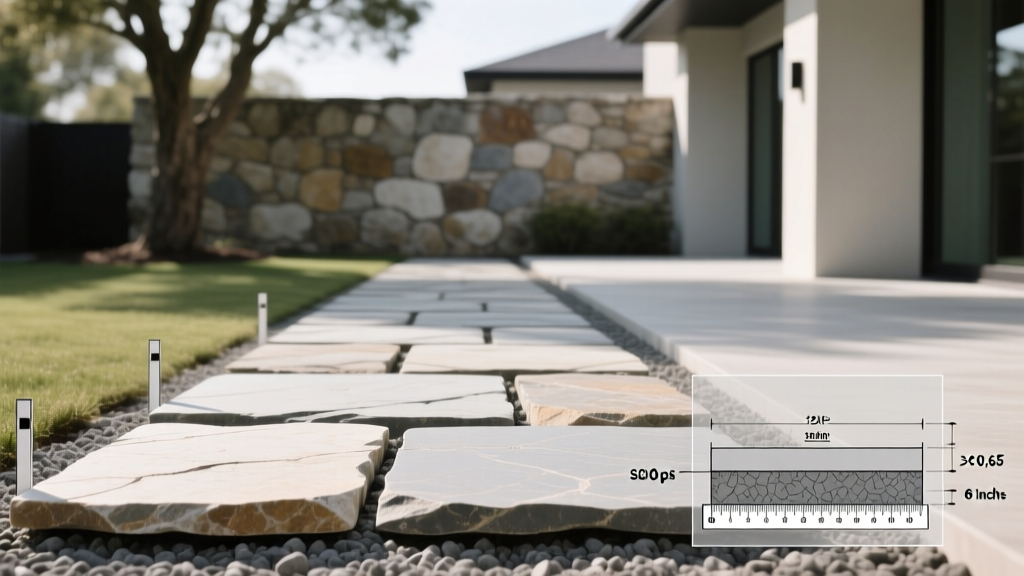
Flagstone is not a single geological material; it is a commercial term for flat, sedimentary, or metamorphic rock split into natural layers. When engineering a flagstone walkway, selecting stone based solely on color or aesthetic appeal inevitably leads to catastrophic spalling, frost heave, and severe slip hazards. A structurally sound installation requires strict adherence to material performance ratings, dynamic friction coefficients, and precise subgrade matrices. This guide details the exact ASTM specifications, structural load limits, and base engineering requirements necessary for a permanent, code-compliant pedestrian installation.
Geological Classification & ASTM Material Standards
The term 'flagstone' encompasses three primary rock types, each governed by distinct ASTM International standards for exterior dimension stone. Understanding these classifications is the first step in determining the stone's viability for your specific climate and load requirements.
- Sandstone (ASTM C568): A sedimentary rock composed of quartz grains. Highly porous and susceptible to freeze-thaw damage if not properly sealed or graded.
- Slate (ASTM C629): A fine-grained metamorphic rock with excellent foliation (splitting planes). Highly durable but prone to delamination if low-grade material is used.
- Quartzite (ASTM C616): A metamorphic rock formed from sandstone under extreme heat and pressure. Exceptionally dense, non-porous, and the most durable option for high-traffic exterior zones.
Compressive Strength & Flexural Yield Matrix
Pedestrian walkways do not bear vehicular loads, but they must withstand concentrated point loads (e.g., high heels, heavy hand trucks, or patio furniture) without snapping. Flexural strength (modulus of rupture) is the critical metric for flagstone, as it dictates the stone's ability to span minor voids in the bedding layer without cracking.
| Stone Type | ASTM Standard | Min Compressive Strength (psi) | Min Flexural Strength (psi) | Required Min Thickness (Sand-Set) |
|---|---|---|---|---|
| Quartzite | C616 | 20,000 | 2,000 | 1.25 inches |
| Slate | C629 | 15,000 | 1,500 | 1.50 inches |
| Sandstone | C568 | 8,000 | 1,000 | 2.00 inches |
If your project utilizes irregular, naturally cleft sandstone under 1.5 inches thick, you must transition from a sand-set base to a fully supported mortar-set base over a reinforced concrete slab to prevent flexural failure.
Water Absorption & Freeze-Thaw Durability
Water absorption by weight is the single most important predictor of exterior stone longevity in transitional and northern climates. When water infiltrates the stone's pore structure and freezes, it expands by 9%, generating internal tensile stresses that cause the face of the stone to pop off (spalling).
Absorption Thresholds for Exterior Paving
- Optimal (< 0.25%): High-density quartzite and premium slate. Requires no chemical sealing for freeze-thaw survival.
- Marginal (0.25% - 1.0%): Dense sandstone and standard slate. Requires a penetrating silane/siloxane sealer applied every 3-5 years to maintain frost resistance.
- Unacceptable (> 1.0%): Low-grade sandstone or limestone. Do not use in regions where the temperature drops below 32°F (0°C).
Slip Resistance: DCOF Ratings for Wet Pedestrian Zones
Smooth, honed, or thermal-flamed stones become exceptionally hazardous when wet. For exterior pedestrian zones, slip resistance is measured using the Dynamic Coefficient of Friction (DCOF) per the ANSI A326.3 standard. The Tile Council of North America (TCNA) outlines that exterior walkways subject to rain, snow, or irrigation overspray must achieve a wet DCOF of 0.42 or greater.
When ordering flagstone, specify the surface finish to guarantee adequate friction:
- Natural Cleft: Yields a DCOF of 0.55 - 0.70. The natural, uneven split face provides excellent micro-traction. Recommended for all walkways.
- Thermal (Flamed): Yields a DCOF of 0.45 - 0.55. The surface is blasted with high heat to pop the quartz crystals, creating a rough, pitted texture.
- Honed/Polished: Yields a DCOF of < 0.30. Strictly prohibited for exterior walkways.
Structural Base Specifications: Sand-Set Engineering
The most common failure in flagstone walkways is not the stone itself, but the subgrade. A sand-set flagstone walkway is a flexible pavement system. It must distribute loads evenly while allowing water to permeate and drain away from the frost line. The following base matrix is engineered for regions with a frost depth of up to 36 inches.
Layer-by-Layer Base Matrix
- Subgrade Preparation: Excavate native soil to a depth of 10 inches below the finished elevation. Compact the native soil using a vibratory plate compactor to achieve a minimum 95% Proctor density.
- Geotextile Separation Fabric: Lay a non-woven geotextile fabric (minimum 4 oz/sq yd) directly over the compacted subgrade. This prevents the migration of fine clay particles up into the aggregate base, which causes localized sinking.
- Aggregate Base Course: Install 6 inches of ASTM D2940 graded aggregate (3/4-inch crushed angular stone with fines). Compact in two 3-inch lifts. The angular faces of the crushed stone lock together, preventing lateral shifting under load.
- Bedding Layer: Spread exactly 1 inch of coarse, washed concrete sand (ASTM C33). Do not use masonry sand or play sand; the fine particles will wash out and cause the flagstone to settle unevenly. Screed the sand to a precise grade, maintaining a minimum 1% slope (1/8 inch per foot) for surface drainage.
Jointing Specifications & Edge Restraint
Irregular flagstone requires wide joints, typically ranging from 0.75 inches to 2.0 inches. Traditional mortar joints will crack in a flexible sand-set system due to thermal expansion and minor subgrade deflection. Instead, utilize high-performance polymeric sand.
Modern polymeric sands contain silica sand blended with advanced polymer binders that activate with water, creating a flexible, weed-resistant joint that can withstand minor movement without cracking. For joints wider than 1.5 inches, specify a 'wide-joint' polymeric sand formula containing larger aggregate particles to prevent washout during heavy rain events before the polymers fully cure.
Edge Restraint Requirements
Without rigid edge restraint, the perimeter stones will migrate outward, causing the jointing sand to fail and the walkway to unravel. Install a poured concrete curb (minimum 6 inches wide by 8 inches deep) or a heavy-duty commercial-grade plastic paver restraint. If using plastic restraints, secure them with 10-inch galvanized steel spikes driven every 8 inches along the perimeter.
Common Failure Modes & Engineering Tolerances
Even with premium materials, improper execution leads to specific, predictable failure modes. Use this diagnostic framework to audit your installation:
- Symptom: Individual stones rock or click when stepped on.
Cause: Uneven bedding sand or stones with highly variable thicknesses were not individually adjusted.
Tolerance Fix: Each stone must be tapped into the bedding sand with a rubber mallet until it sits perfectly flush with its neighbors, with zero vertical deflection. - Symptom: Polymeric sand haze or white film on the stone surface.
Cause: Incomplete removal of sand dust from the stone surface before activating the polymers with water, or over-watering during activation.
Tolerance Fix: Use a leaf blower to remove all surface dust before watering. Apply water using a fine mist shower nozzle for exactly 3 minutes, avoiding pooling. - Symptom: Frost heave pushing stones upward in localized patches.
Cause: Water trapped in the base course due to poor drainage or lack of geotextile fabric.
Tolerance Fix: Ensure the aggregate base maintains a 2% cross-slope to shed water to adjacent French drains or daylighted outfalls.
By adhering strictly to these ASTM material ratings, DCOF friction requirements, and subgrade engineering tolerances, your flagstone walkway will perform flawlessly under heavy pedestrian traffic and severe weather conditions for decades.