Home Exterior Stone Veneer Cost Guide: 2026 Pricing & ROI
Analyze 2026 home exterior stone veneer costs, including manufactured vs. natural stone pricing, labor rates, hidden prep expenses, and long-term ROI.
The True Cost of Home Exterior Stone Veneer in 2026
Upgrading a facade with home exterior stone veneer remains one of the most impactful architectural decisions a homeowner can make, instantly elevating curb appeal and perceived property value. However, budgeting for this project requires moving beyond basic square-footage estimates. In 2026, the total installed cost for exterior stone veneer ranges from $16 to $38 per square foot, driven by material selection, regional labor rates, and critical structural preparation. Understanding the granular breakdown of these costs ensures you avoid mid-project budget overruns and select materials that align with both your aesthetic goals and financial constraints.
Material Cost Breakdown: Manufactured vs. Natural Stone
The primary cost variable is the choice between Manufactured Stone Veneer (MSV) and natural thin stone veneer. MSV, composed of Portland cement, lightweight aggregates, and iron oxide pigments, dominates the residential market due to its lower weight and consistent pricing. Natural stone, quarried and sliced into thin profiles, commands a premium for its authentic geological variations.
| Material Type | Average Material Cost (per sq ft) | Weight (lbs/sq ft) | Popular Brands / Profiles | Best Application |
|---|---|---|---|---|
| Manufactured Stone Veneer (MSV) | $6.50 - $12.00 | 10 - 12 lbs | Cultured Stone (Cobblefield), Eldorado Stone | Full facade wraps, wainscoting, gable accents |
| Natural Thin Stone Veneer | $13.00 - $24.00 | 13 - 18 lbs | Thin Cut Limestone, Natural Fieldstone | High-end custom homes, historic restorations |
| Faux/Polyurethane Stone Panels | $4.00 - $8.00 | 1 - 2 lbs | GenStone, Texture Plus | DIY accent walls, skirting, non-load-bearing columns |
When purchasing MSV, factor in a 10% to 15% waste allowance for cuts and breakage, particularly when working with complex profiles like ledger stone or dry-stack, which require precise staggering at corners and window casings.
Labor and the 5-Step Installation Process
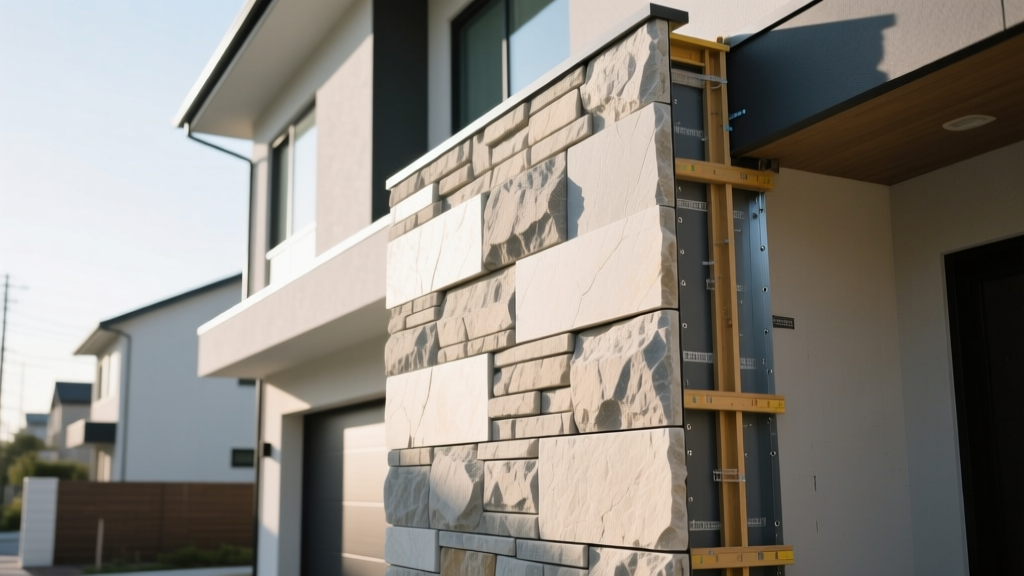
Labor accounts for 40% to 60% of the total project cost, typically ranging from $9 to $16 per square foot in 2026. Proper installation of home exterior stone veneer is not simply gluing stone to a wall; it is a multi-layered moisture management system. Masons charge a premium for the meticulous execution of the following five steps:
- Weather-Resistant Barrier (WRB): Application of two layers of Grade D building paper or a high-performance fluid-applied membrane over the exterior sheathing.
- Corrosion-Resistant Lath: Installation of 2.5 lb self-furring galvanized diamond mesh, fastened with corrosion-resistant nails or screws directly into the wall studs every 6 inches.
- Scratch Coat: Troweling a 3/8-inch to 1/2-inch layer of Type S masonry cement over the lath and scoring it horizontally to create a mechanical bond.
- Stone Setting: Buttering the back of each veneer piece with mortar and pressing it firmly into the scratch coat, maintaining consistent joint widths for traditional profiles or tight-fitting for dry-stack.
- Pointing and Tooling: Filling joints with a mortar bag and tooling the joints to compress the mortar, ensuring water sheds away from the stone face.
Warning: Hidden Structural and Prep Costs
Homeowners frequently overlook site preparation costs. Removing existing siding (vinyl, wood, or stucco) adds $1.50 to $3.50 per square foot. Additionally, because stone veneer is heavy, installing it above a garage door or spanning large window headers may require a structural engineer's assessment and the addition of steel angle iron supports (shelf angles), which can add $800 to $2,500 to the overall project budget. Scaffolding erection and dismantling for two-story applications typically adds a flat fee of $1,200 to $3,000.
ROI and Resale Value: Is the Investment Justified?
From a purely financial perspective, home exterior stone veneer consistently ranks among the highest-returning exterior renovations. According to data tracked by Remodeling Magazine's Cost vs. Value Report, manufactured stone veneer replacements routinely recoup between 90% and 102% of their initial investment at resale, depending on the regional housing market.
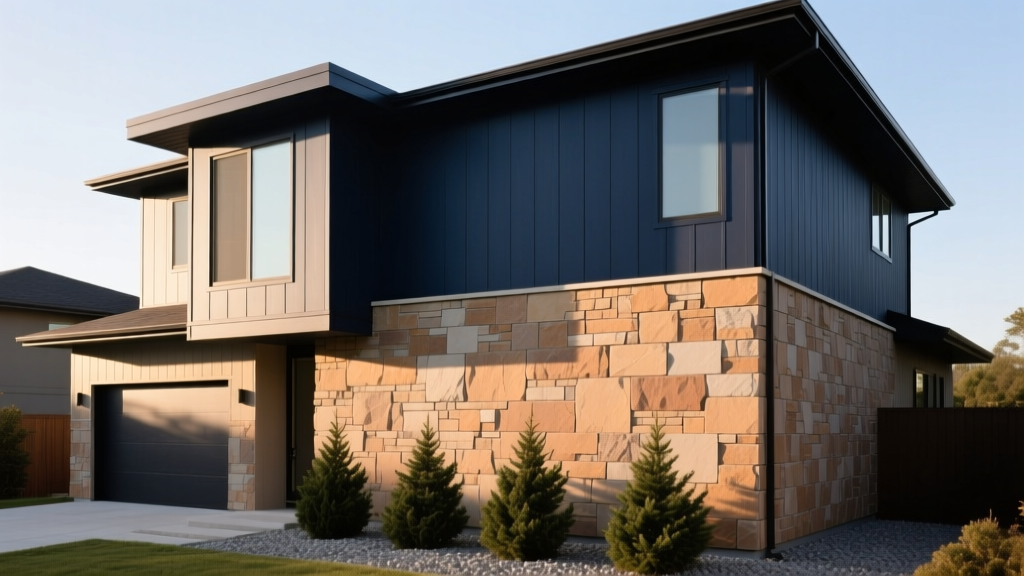
The high ROI is driven by buyer perception. A home featuring stone wainscoting or a fully wrapped stone facade is appraised and perceived as a 'premium' or 'custom' build, allowing sellers to command a higher price per square foot compared to identical homes clad in standard vinyl siding. Furthermore, unlike wood or fiber cement siding, stone veneer requires virtually zero maintenance—no painting, caulking, or power washing—making it a highly attractive selling point for prospective buyers.
Preventing Expensive Installation Failures
The most common cause of stone veneer failure is moisture intrusion leading to efflorescence, freeze-thaw spalling, or structural rot behind the wall. According to industry guidelines detailed by masonry experts at Angi, repairing moisture-damaged sheathing behind improperly installed veneer can cost upwards of $15,000. To protect your investment, ensure your contractor adheres to the following critical standards:
- Weep Screeds (ASTM C1063): A corrosion-resistant weep screed must be installed at the base of the wall, minimum 4 inches above grade or 2 inches above paved surfaces. This allows trapped moisture to escape behind the WRB. Omitting this component is the leading cause of bottom-row stone deterioration.
- Flashing Integration: All window heads, sills, and door casings must feature integrated kick-out flashing that directs water over the stone face, not behind it.
- Mortar Selection: Use Type S mortar for exterior applications. Type N is too soft for exterior freeze-thaw cycles, while Type M is too rigid and can cause the manufactured stone to crack under thermal expansion.
- Clearance to Grade: Maintain a strict 4-inch clearance between the bottom of the stone veneer and the soil line to prevent ground moisture from wicking up into the porous masonry materials via capillary action.
Regional Price Variations and Market Factors
Geography significantly impacts the final invoice. In high-cost-of-living metropolitan areas (e.g., San Francisco, New York, Boston), masonry labor rates can exceed $85 per hour, pushing installed costs toward the $35-$40 per square foot range. Conversely, in the Midwest and Southern U.S., where masonry trades are more abundant and labor rates hover around $45-$55 per hour, total installed costs often sit closer to $18-$22 per square foot.
Freight costs also play a role. Manufactured stone is heavy; shipping a full truckload (approx. 1,500 sq ft) across the country can add $1,500 to $3,000 to the material cost. Sourcing from regional manufacturers or selecting local natural stone quarries can mitigate these logistical premiums.
Final Budgeting Framework
To accurately estimate your specific project, use this comprehensive formula:
Total Cost = (Measurable Square Footage × 1.10 for waste) × (Material Cost + Labor Cost) + Scaffolding Fee + Demolition/Prep Fee + Flashing/Weep Screed Materials.
By itemizing your quote against this framework, you ensure that your contractor is not cutting corners on the vital moisture-management components that guarantee the longevity of your home exterior stone veneer.
Written by
Marcus ChenMarcus Chen is a licensed structural engineer (PE) and building materials analyst with over 12 years of experience across residential, commercial, and industrial construction. He holds a Master of Science in Civil Engineering from UC Berkeley and spent six years at Thornton Tomasetti before transitioning to independent consulting and technical writing. Marcus specializes in material selection for seismic-prone regions, concrete reinforcement strategies, and lifecycle cost analysis. His work has been cited by the American Concrete Institute (ACI) and the Structural Engineers Association of California (SEAOC). When he is not on a job site or at his desk, you will find him hiking the Sierra Nevada or restoring a 1920s craftsman bungalow in Oakland, CA.
More from Marcus Chen
View all
Construction Cost
How Much Did the Eiffel Tower Cost to Build?
How much did the Eiffel Tower cost to build in 1889? We adjust for inflation and compare its budget to modern skyscraper construction.
Aug 4, 2026

Fire Resistance
What Is a Fire Resistant Material? Testing & Certification Guide
Discover what is a fire resistant material through ASTM and UL testing. Learn how fire ratings, certifications, and assemblies work in construction.
Aug 4, 2026

Construction Cost
How Much Did the Burj Khalifa Cost to Build?
How much did the Burj Khalifa cost to build? We break down the $1.5B project and extract 5 money-saving strategies for your next build.
Jul 30, 2026