Manufactured Stone Veneer Fireplace: Complete Material Guide
Discover everything about building a manufactured stone veneer fireplace, including material costs, heat clearances, top brands, and installation tips.
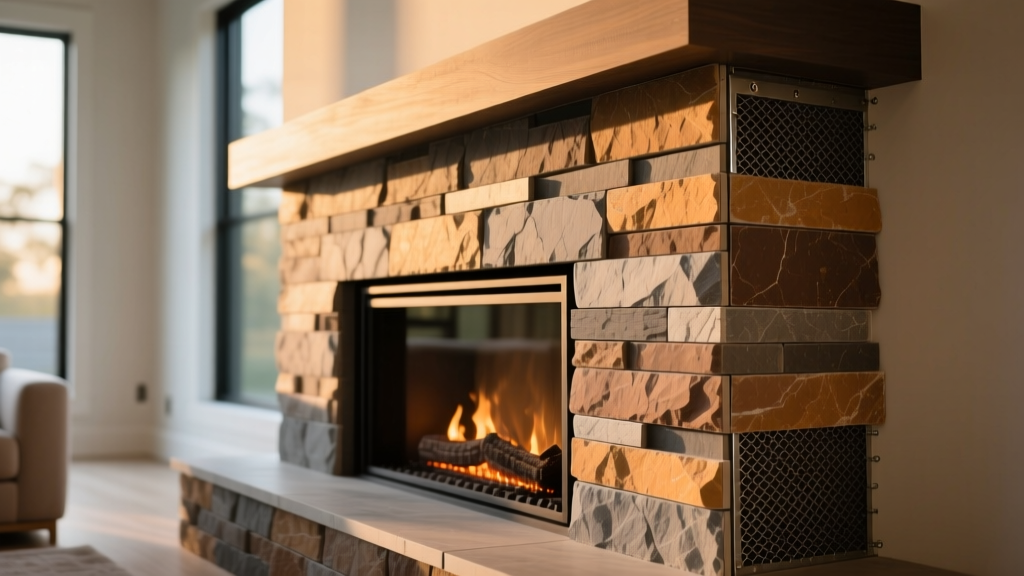
The Anatomy of Manufactured Stone Veneer (MSV)
Manufactured stone veneer (MSV) is an architectural cladding product engineered to replicate the exact texture, color, and weight of natural quarried stone. Unlike natural stone, which is cut and shaped from the earth, MSV is cast in molds taken directly from natural stone surfaces. The mixture consists of Portland cement, lightweight aggregates (like expanded shale or pumice), and iron oxide pigments.
For fireplace applications, MSV offers a distinct structural advantage: weight. Natural stone veneer typically weighs between 25 and 40 pounds per square foot, often requiring structural footing reinforcement or heavy-duty wall framing. Manufactured stone veneer weighs approximately 10 to 12 pounds per square foot. This lightweight profile allows it to be installed over standard interior wall framing and cement backer boards without requiring additional structural support, making it the premier choice for interior fireplace retrofits and remodels.
Heat Tolerance and Firebox Clearances
A common misconception is that the Portland cement and aggregates in MSV will degrade under the high heat of a fireplace. In reality, MSV is completely non-combustible and routinely passes the ASTM E136 standard test method for assessing combustibility. The material itself will not catch fire, emit toxic smoke, or melt.
However, the primary safety concern is not the stone, but the heat transfer to combustible substrates and adjacent mantels. When designing a manufactured stone veneer fireplace, you must adhere to strict clearance guidelines:
For combustible mantels and trim, the NFPA 211 Standard for Chimneys, Fireplaces, Vents, and Solid Fuel-Burning Appliances dictates that combustible material must be placed a minimum of 12 inches from the top of the masonry fireplace opening. If the mantel projects more than 1.5 inches from the wall, you must add 1 inch of vertical clearance for every 1/8 inch of projection. Always cross-reference this with your specific zero-clearance firebox insert manufacturer's manual, as some modern steel inserts require up to 18 inches of clearance or specific non-combustible heat shields.
Brand and Profile Matrix
The MSV market is dominated by a few major manufacturers, each offering distinct casting molds and color palettes. Selecting the right profile dictates the final aesthetic of your fireplace surround.
| Brand | Flagship Profile | Best Application | Approx. Cost (Materials) |
|---|---|---|---|
| Cultured Stone (Boral) | Dressed Stone Pro-Fit | Modern, clean-line fireplace surrounds with tight, mortarless-looking joints. | $9.00 - $13.00 / sq ft |
| Eldorado Stone | Rustic Ledge | Traditional, rugged floor-to-ceiling chimney chases and cabin hearths. | $7.50 - $11.50 / sq ft |
| Coronado Stone | Classic Fieldstone | Cottage-style fireplaces requiring rounded, varied-depth stones. | $6.50 - $10.00 / sq ft |
For a comprehensive look at specific application techniques and warranty requirements, consult the Cultured Stone Installation Guide or the Eldorado Stone Installation Instructions before purchasing, as improper installation will void the manufacturer's 50-year limited warranty.
Project Cost Estimator: 50 Sq. Ft. Surround
Budgeting for a manufactured stone veneer fireplace requires accounting for the stone itself, the setting materials, and the labor. Below is a realistic cost breakdown for a standard 50-square-foot interior fireplace surround (e.g., 5 feet wide by 10 feet high, minus the firebox opening) in 2026.
| Line Item | Unit Cost | Total for 50 Sq. Ft. |
|---|---|---|
| Manufactured Stone Veneer (Flat) | $8.50 / sq ft | $425.00 |
| Corner Pieces (10 Linear Ft) | $11.00 / lin ft | $110.00 |
| Cement Backer Board & Fasteners | $2.00 / sq ft | $100.00 |
| Polymer-Modified Veneer Mortar | $2.50 / sq ft | $125.00 |
| Professional Masonry Labor | $22.00 / sq ft | $1,100.00 |
| Estimated Total | $1,860.00 |
Note: Scaffolding, demolition of existing surrounds, and custom mantel fabrication are excluded from this baseline estimate.
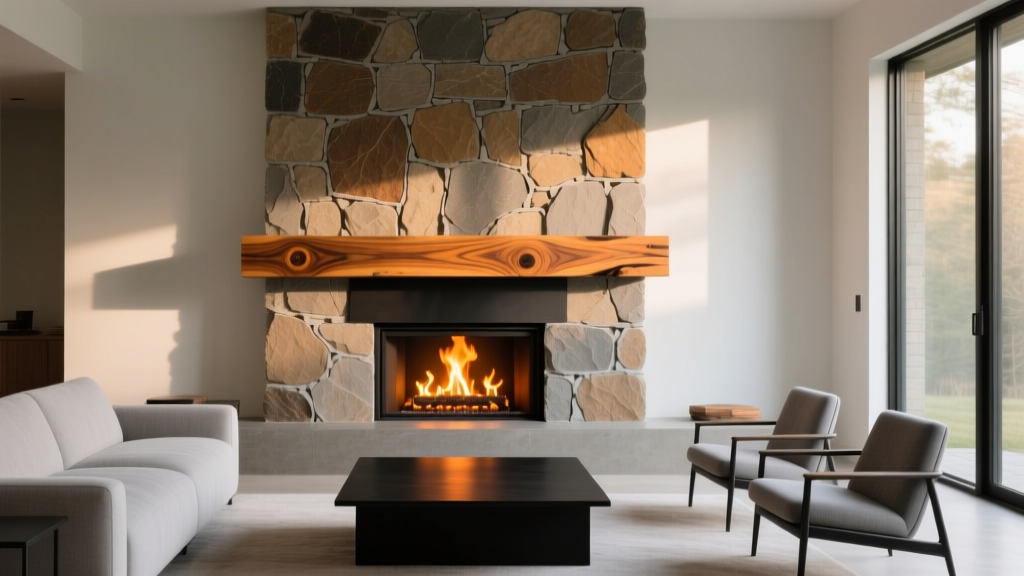
Substrate Preparation and Installation Protocol
The longevity of an MSV fireplace relies entirely on substrate preparation and mortar chemistry. Standard Type N or Type S masonry cement is no longer the industry standard for interior veneer; polymer-modified veneer mortars (such as SAKRETE Veneer Stone Mortar or PRO-SKIM) provide superior flexural strength and adhesion to non-porous backer boards.
- Substrate Framing: Ensure wall studs are spaced 16 inches on center. Remove any existing drywall in the veneer zone.
- Backer Board Application: Install 1/2-inch cement backer board using corrosion-resistant alkali-resistant (AR) glass fiber mesh tape on all seams. Fasten with galvanized or ceramic-coated backer board screws every 8 inches.
- Mortar Scratch Coat (Optional but Recommended): While some polymer mortars allow direct application to backer board, applying a 1/4-inch scratch coat of mortar and scoring it horizontally with a coarse rake provides a mechanical key. Allow this to cure for 24 to 48 hours.
- Layout and Dry-Fit: Unbox multiple pallets of stone and blend them on the floor. MSV color can vary slightly between manufacturing runs. Dry-fit the corners and hearth line first to establish your sightlines.
- Setting the Stone: Apply a 1/2-inch layer of polymer-modified mortar to the substrate. Back-butter every stone larger than 12 inches by applying a thin layer of mortar directly to the back of the veneer. Press the stone firmly into the substrate until mortar squeezes out slightly at the edges.
- Jointing: For profiles requiring mortar joints (like Fieldstone), use a 1/2-inch to 3/4-inch convex jointer tool to compress and smooth the joints once the mortar becomes thumbprint-hard (usually 30-45 minutes). Do not use a wet sponge to clean excess mortar, as this drives cement paste into the stone's pores and causes staining.
Troubleshooting: Efflorescence and Delamination
Even interior fireplace surrounds can suffer from masonry failure modes if environmental conditions are ignored during installation.
Efflorescence (White Powdery Staining)
Efflorescence occurs when water-soluble salts present in the Portland cement migrate to the surface of the stone or mortar joints and crystallize upon evaporation. While more common on exterior chimney chases, it can happen indoors if the stone was installed in a highly humid environment or if the mortar was mixed with too much water. The Fix: Do not use water or acid washes on MSV, as this will strip the iron oxide pigments. Instead, allow the stone to dry completely and brush the efflorescence away with a stiff, dry nylon bristle brush.
Delamination (Stones Popping Off)
If stones detach from the backer board, the failure is almost always at the mortar-to-substrate interface, not the mortar-to-stone interface. This is caused by 'suction'—the dry cement backer board pulling the moisture out of the mortar too quickly before it can achieve a chemical cure. The Fix: Always dampen (do not soak) highly porous substrates with a spray bottle of clean water immediately before troweling your setting mortar. Alternatively, use a primer specifically designed for masonry veneers to seal the backer board's porosity prior to installation.
Written by
James ThorntonJames Thornton is a construction industry veteran with 25 years of hands-on experience in wood framing, lumber grading, and residential building codes. He started as a framing carpenter in rural Oregon, earned his ICC Residential Building Inspector certification, and eventually became a senior plan reviewer for the City of Portland Bureau of Development Services. James holds a B.S. in Wood Science & Technology from Oregon State University and is a certified lumber grader through the West Coast Lumber Inspection Bureau (WCLIB). He has inspected over 3,000 residential construction sites and authored the city's internal guide on advanced framing techniques (2x6 at 24" O.C.). James lives in Bend, OR, where he builds custom timber-frame cabins and competes in lumberjack sports.
More from James Thornton
View all
Insulation
Best Home Insulation Materials: Complete 2026 Guide
Compare top home insulation materials for 2026. Find R-values, installed costs per square foot, and best uses for fiberglass, spray foam, and mineral wool.
Aug 4, 2026

Sustainable Building
Certify Your Green Building Material for LEED and WELL
Step-by-step guide to certifying a green building material for LEED v5 and WELL v2. Master EPDs, HPDs, and VOC limits for 2026 project specifications.
Aug 4, 2026

Stone & Masonry
Veneer Stacked Stone Panels: Interior Design & Style Showcase
Discover how veneer stacked stone panels transform interiors. Explore modern design profiles, material pairings, and technical installation specs.
Aug 4, 2026