Manufactured Stone Veneer Products Cost Analysis & 2026 Pricing
Detailed cost breakdown of manufactured stone veneer products in 2026. Compare material prices, installation rates, and top brands like Cultured Stone.

The True Cost of Manufactured Stone Veneer Products in 2026
Manufactured stone veneer (MSV) is an engineered architectural cladding composed of Portland cement, lightweight aggregates, and iron oxide pigments. Unlike natural stone, which requires heavy structural footings due to its immense weight (often exceeding 35 lbs per square foot), MSV weighs between 10 and 12 lbs per square foot. This weight reduction eliminates the need for costly foundation reinforcements, fundamentally altering the total project economics. In 2026, the national average cost to supply and install MSV ranges from $18.50 to $34.00 per square foot, depending on profile complexity, brand tier, and regional labor rates.
2026 Cost Snapshot: MSV Cladding
- Material Only: $6.50 – $14.00 per sq. ft.
- Labor & Prep: $12.00 – $20.00 per sq. ft.
- Total Installed: $18.50 – $34.00 per sq. ft.
- Corner Pieces: $11.00 – $18.00 per linear ft.
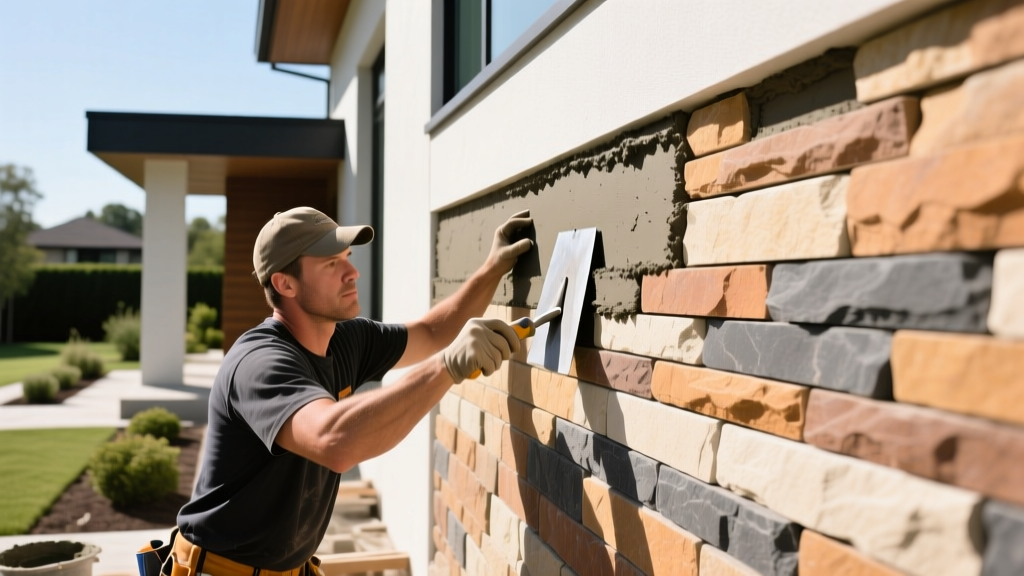
Material Costs by Profile and Premium Brands
The pricing of manufactured stone veneer products is heavily dictated by the mold complexity, color variation technology, and brand positioning. Budget lines often feature repetitive patterns and flat color palettes, while premium manufacturers use multi-stage pigmentation and hand-poured molds taken from rare natural stones.
| Brand / Manufacturer | Popular Profile | Material Cost (per sq. ft.) | Weight (lbs/sq. ft.) |
|---|---|---|---|
| Cultured Stone (Boral) | Ledgestone / Cobblefield | $9.50 – $13.50 | 11.5 |
| Eldorado Stone | Fieldstone / RoughCut | $8.50 – $12.00 | 10.5 |
| Coronado Stone | Ashlar / Classic Brick | $7.00 – $9.50 | 11.0 |
| Dutch Quality Stone | Dry Stack / Weatherboard | $8.00 – $11.50 | 12.0 |
When ordering, contractors must account for corner pieces, which are sold by the linear foot rather than the square foot. Corners typically cost 1.5 to 2 times more per coverage area than flat pieces because they require specialized molds and additional hand-finishing during manufacturing. Always calculate linear footage for all external corners, window returns, and door jambs before finalizing the material order.
Installation Labor and the "Prep Work" Cost Trap
Labor accounts for 50% to 65% of the total project cost. While some homeowners attempt to compare MSV installation to standard masonry, the substrate preparation is highly specific and non-negotiable. Skipping or shortcutting the prep phase is the primary cause of delamination and efflorescence lawsuits in the industry.
The Required Substrate Assembly
According to the Cultured Stone Installation Guidelines and ASTM C1780 standards, a compliant exterior MSV assembly requires the following layers, each adding to the labor cost:
- Weather-Resistive Barrier (WRB): Two layers of Grade D building paper or a high-performance house wrap over structural sheathing. ($0.75 - $1.25 / sq. ft. installed)
- Weep Screed: A corrosion-resistant metal weep screed installed at the base of the wall to allow moisture to escape and prevent the stone from wicking ground water. ($1.50 - $2.50 / linear ft.)
- Self-Furring Metal Lath: Minimum 2.5 lb galvanized expanded metal lath, fastened every 6 inches into wall studs (not just the sheathing). Overlaps must be 1 inch on horizontal seams and 2 inches on vertical seams. ($2.00 - $3.50 / sq. ft.)
- Scratch Coat: A 1/2-inch thick layer of Type S mortar applied to the lath and horizontally scored to provide a mechanical key for the setting bed. ($2.50 - $4.00 / sq. ft.)
Mortar Joint Profiles and Labor Multipliers
The visual style you choose directly impacts the mason's hourly output. The setting labor varies drastically based on the joint profile specified by the architect or homeowner.
- Standard Joint (Overgrout): Mortar is applied to the back of the stone and the joint is filled and tooled. This is the fastest method and represents the baseline labor rate ($8.00 - $10.00 / sq. ft. for setting).
- Dry-Stack (Tight-Fit): Stones are placed tightly together with no visible mortar joint. While this uses less mortar, it requires the mason to cut and grind stones to fit perfectly flush, increasing setting labor time by 20% to 30%. Expect labor rates of $11.00 - $14.00 / sq. ft.
- Raked / recessed Joint: Mortar is applied but pulled back 1/4 inch from the face of the stone to create deep shadows. This requires meticulous pointing and cleaning, adding 15% to the baseline labor cost.
MSV vs. Natural Stone vs. Polyurethane Faux Panels
To contextualize the investment, it is necessary to compare manufactured stone veneer products against alternative cladding materials across critical structural and financial metrics.
| Material Type | Total Installed Cost | Structural Footing Required? | Lifespan & Warranty |
|---|---|---|---|
| Manufactured Stone Veneer | $18.50 – $34.00 / sq. ft. | No (Standard foundation suffices) | 50+ Years (50-yr limited warranties) |
| Natural Full-Bed Stone | $35.00 – $60.00+ / sq. ft. | Yes (Requires reinforced concrete ledge) | 100+ Years |
| Polyurethane Faux Panels | $12.00 – $18.00 / sq. ft. | No (Screws directly to sheathing) | 15-25 Years (UV degradation risk) |
While polyurethane panels offer the lowest upfront cost and DIY-friendly installation, they lack the thermal mass, acoustic dampening, and fire-resistance ratings of cementitious MSV. Furthermore, high-end real estate appraisals frequently discount polyurethane faux stone as "plastic siding," whereas MSV is appraised equivalently to natural masonry.
ROI and Resale Value Impact
Exterior cladding upgrades are evaluated heavily during property appraisals. According to data tracked in Remodeling Magazine's annual Cost vs. Value Report, replacing a portion of the exterior siding with manufactured stone veneer consistently ranks as one of the highest-yielding remodeling projects. Historically, MSV exterior accents recoup between 90% and 102% of their installation cost at the time of resale, vastly outperforming vinyl siding replacement or fiber-cement siding upgrades. The aesthetic permanence of stone signals structural integrity and luxury to prospective buyers, justifying the premium material cost.
Expert Sourcing, Batching, and Maintenance
Procuring manufactured stone veneer products requires strategic ordering to avoid costly project delays and aesthetic flaws.
The Lot-Matching Rule
Cementitious pigments vary slightly between manufacturing runs. If you under-order and need to purchase additional flat pieces three weeks later, the new batch may exhibit noticeable color banding when installed next to the original stones. Always calculate your total square footage, add a 12% to 15% waste factor for cuts and breakage, and purchase all flat pieces in a single order from the same production lot.
Sealing and Efflorescence Prevention
MSV is porous. In climates with freeze-thaw cycles or high soil alkalinity, water can migrate through the substrate, carrying soluble salts to the surface, which crystallize as white efflorescence.
- Do Not Use Muriatic Acid: Unlike natural brick, acid will etch the Portland cement matrix and strip the iron oxide pigments from MSV.
- Use Breathable Sealers: If sealing is required (especially for flat-top stones prone to water pooling), use a silane/siloxane-based penetrating sealer. These sealers repel liquid water while allowing water vapor to escape, preventing spalling during freezing temperatures. Budget $0.40 to $0.75 per square foot for high-quality penetrating sealers.
For comprehensive technical specifications regarding mortar mixes and clearances, always consult the Eldorado Stone Installation and Technical Data sheets or the specific manufacturer's guidelines prior to finalizing your structural framing and material procurement.
Written by
Marcus ChenMarcus Chen is a licensed structural engineer (PE) and building materials analyst with over 12 years of experience across residential, commercial, and industrial construction. He holds a Master of Science in Civil Engineering from UC Berkeley and spent six years at Thornton Tomasetti before transitioning to independent consulting and technical writing. Marcus specializes in material selection for seismic-prone regions, concrete reinforcement strategies, and lifecycle cost analysis. His work has been cited by the American Concrete Institute (ACI) and the Structural Engineers Association of California (SEAOC). When he is not on a job site or at his desk, you will find him hiking the Sierra Nevada or restoring a 1920s craftsman bungalow in Oakland, CA.
More from Marcus Chen
View all
Construction Cost
How Much Did the Eiffel Tower Cost to Build?
How much did the Eiffel Tower cost to build in 1889? We adjust for inflation and compare its budget to modern skyscraper construction.
Aug 4, 2026

Fire Resistance
What Is a Fire Resistant Material? Testing & Certification Guide
Discover what is a fire resistant material through ASTM and UL testing. Learn how fire ratings, certifications, and assemblies work in construction.
Aug 4, 2026

Construction Cost
How Much Did the Burj Khalifa Cost to Build?
How much did the Burj Khalifa cost to build? We break down the $1.5B project and extract 5 money-saving strategies for your next build.
Jul 30, 2026