Marble for Counter Performance Ratings: Hardness, Porosity and Specs
Analyze marble for counter performance ratings, including Mohs hardness, porosity, flexural strength, and ASTM specifications for kitchen and bath use.
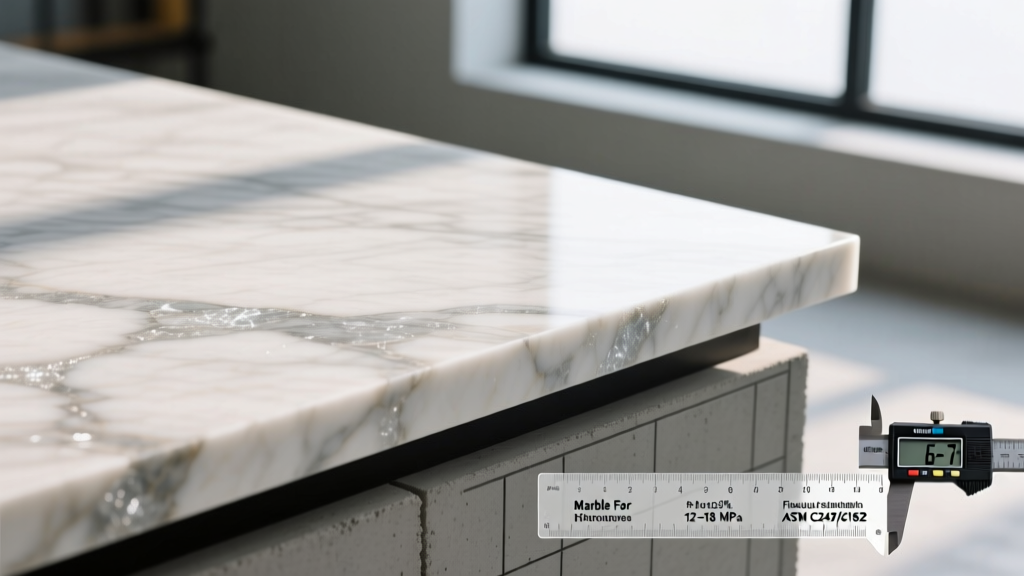
Petrographic Composition and Baseline Metrics
Evaluating marble for counter applications requires moving beyond aesthetic veining to analyze the stone's petrographic and physical properties. True marble is a metamorphic rock formed from the recrystallization of carbonate minerals, primarily calcite (calcium carbonate, CaCO3) or dolomite (calcium magnesium carbonate, CaMg(CO3)2). The mineralogical distinction between these two dictates the baseline performance ratings of the slab.
Calcite-based marbles, such as Carrara and Calacatta, register a 3 on the Mohs hardness scale. Dolomitic marbles, frequently marketed in the stone industry as 'hard marbles' (e.g., Super White or Fantasy Brown, though technically dolostones), register between 3.5 and 4. While neither approaches the 7 Mohs rating of quartzite or the 6-7 rating of granite, the 0.5 to 1.0 point increase in dolomitic marble yields a measurable improvement in abrasion resistance and a higher threshold for chemical etching.
ASTM Dimension Stone Specifications for Countertops
When specifying marble for horizontal interior surfaces, fabricators and architects rely on standardized testing protocols to ensure structural viability. The ASTM C97 Standard Test Methods govern the baseline absorption and bulk specific gravity tests, while other ASTM standards dictate mechanical thresholds. According to the Natural Stone Institute Technical Bulletins, interior marble must meet specific minimums to be cleared for countertop fabrication without secondary structural reinforcement.
| Property | ASTM Standard | Minimum Spec (Interior) | Average Marble Range |
|---|---|---|---|
| Water Absorption | ASTM C97 | 0.20% max | 0.05% - 0.18% |
| Compressive Strength | ASTM C170 | 7,500 psi | 8,000 - 12,000 psi |
| Flexural Strength | ASTM C880 | 1,000 psi | 1,200 - 2,400 psi |
| Abrasion Resistance | ASTM C241 | 10.0 Ha min | 10.5 - 14.0 Ha |
While the water absorption rates appear negligible (often under 0.15%), the micro-porosity of marble is highly interconnected. This capillary network is what allows lipid-based liquids (oils) and acidic aqueous solutions to penetrate the surface if the factory-applied resin or field-applied impregnator is compromised.
Mechanical Strength and Overhang Limits
Flexural strength (modulus of rupture) is the most critical mechanical rating for marble countertops, as stone is inherently weak in tension. Slab thickness directly governs the allowable unsupported overhang. The USGS Dimension Stone Data and industry engineering guidelines mandate strict overhang limits to prevent catastrophic tensile failure, particularly around cutouts for sinks and cooktops where the stone's cross-sectional area is reduced.
Thickness and Support Matrices
- 2cm (3/4-inch) Slabs: Maximum unsupported overhang is 10 inches. Any overhang exceeding this requires steel corbels or a structural substrate (like 3/4-inch plywood) bonded with a flexible epoxy. 2cm marble is highly susceptible to deflection and cracking over dishwasher voids due to heat and moisture cycling.
- 3cm (1-1/4-inch) Slabs: Maximum unsupported overhang is 12 inches. This thickness provides sufficient mass and flexural rigidity for standard breakfast bars without corbeling, provided the stone is graded as 'sound' (free of micro-fissures and open veining).
Chemical Resistance and Etching Thresholds
The most common performance failure in marble countertops is not structural fracture, but chemical etching. Etching is a localized corrosive reaction where acidic substances dissolve the calcium carbonate matrix, leaving a dull, matte depression on the polished surface. This is distinct from staining, which involves pigment absorption.
Calcite marble begins to etch when exposed to substances with a pH below 5.0. Common kitchen offenders include lemon juice (pH 2.0-2.5), vinegar (pH 2.4-3.4), and tomato paste (pH 3.5-4.7). Dolomitic marble exhibits a slightly higher buffer capacity, typically resisting etching until the pH drops below 4.0, but it is not immune. Once the crystalline structure is dissolved, no topical sealer can restore the optical clarity of the polish; the surface must be mechanically re-honed and re-polished using diamond abrasive pads (progressing from 400-grit to 3000-grit).
Sealer Penetration and Hydrophobic Specifications
To mitigate absorption, marble slabs undergo factory resin treatment and require post-installation chemical impregnation. Understanding the specifications of these treatments is vital for long-term performance.
Factory Resin Stabilization
Over 80% of commercial marble slabs are factory-treated with resins to fill micro-fissures and stabilize the block during cutting. Epoxy resins are the premium standard; they possess a high Shore D hardness (approx. 80), penetrate deeply into the capillary network, and exhibit minimal UV degradation. Polyester resins are cheaper, cure faster, but are brittle, prone to yellowing under UV exposure, and can delaminate from the stone matrix during thermal cycling.
Field-Applied Impregnators
For kitchen counters, standard silane/siloxane sealers are insufficient for lipid resistance. Specifications must call for fluoropolymer-based impregnators. These molecules possess both hydrophobic (water-repelling) and oleophobic (oil-repelling) chains. A properly applied fluoropolymer sealer will yield a water contact angle greater than 85 degrees and an oil contact angle greater than 60 degrees, effectively preventing both aqueous staining and lipid penetration without altering the stone's coefficient of friction or vapor transmission rate.
Technical FAQ: Marble Countertop Engineering
Does a honed finish alter the structural integrity of the marble?
No. Honing is a mechanical abrasion process that removes the polished layer (typically less than 0.5mm of material). It does not alter the flexural or compressive strength ratings of the slab. However, a honed finish masks etching significantly better than a polished finish, as the matte surface lacks the specular reflection that highlights dissolved calcium carbonate craters.
Can radiant floor heating systems damage marble countertops installed on islands?
While radiant heat is typically a flooring application, if integrated into a thick concrete sub-counter that supports a marble island top, the thermal transfer must be managed. Marble has a high thermal conductivity but low thermal shock resistance. The temperature differential between the heated substrate and the ambient room air should not exceed 35°F (19°C) at any given time to prevent thermal bowing or delamination of the setting adhesive.
What is the acceptable deflection limit for marble countertop substrates?
The structural framing supporting a marble countertop must not exceed a deflection limit of L/360 under live and dead loads. For a 10-foot span, the maximum allowable deflection is approximately 0.33 inches. Exceeding this threshold introduces tensile stress that will inevitably crack the stone, regardless of its ASTM flexural strength rating.