Natural vs Manufactured Outdoor Stone Veneer Siding
Compare natural, manufactured, and faux outdoor stone veneer siding. Analyze costs, freeze-thaw durability, moisture management, and installation.
The Core Contenders: Defining Exterior Veneer Classes
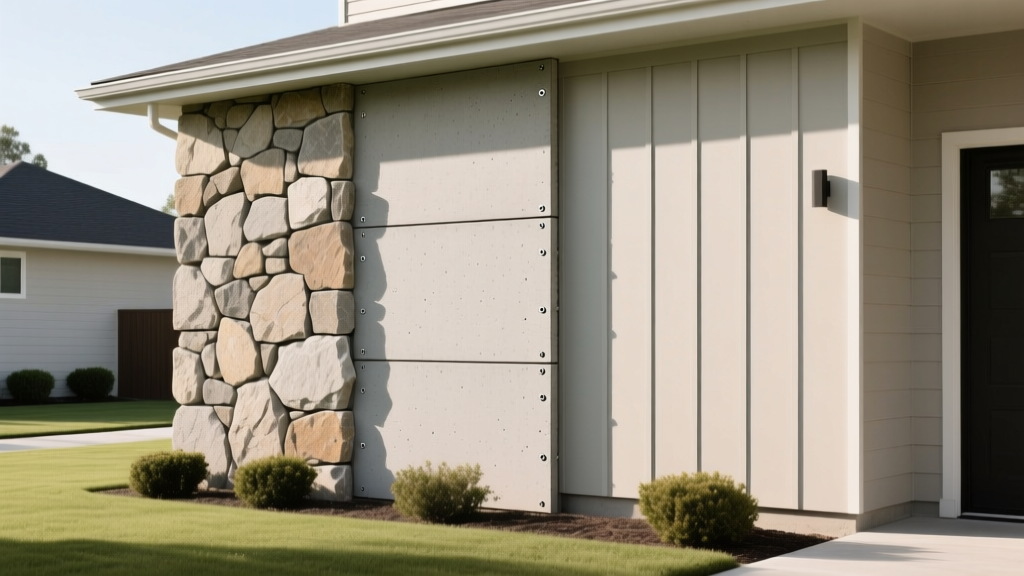
Selecting exterior cladding dictates the thermal envelope, moisture resilience, and aesthetic permanence of a structure. When evaluating outdoor stone veneer siding, builders and architects typically navigate between three distinct material classes. Each interacts differently with weather resistive barriers (WRB), structural loads, and seasonal freeze-thaw cycles. Understanding the geological and chemical makeup of these materials is the first step in preventing catastrophic exterior envelope failures.
Natural Thin Stone Veneer
Natural stone veneer is quarried limestone, granite, slate, or fieldstone that is diamond-sliced to a thickness of 0.5 to 1.5 inches. Because it is a genuine geological product, its porosity and density vary wildly depending on the source quarry. A dense granite veneer will weigh upwards of 15 lbs per square foot and absorb less than 1% of its weight in water. Conversely, a porous sandstone or limestone may weigh closer to 7 lbs per square foot but can absorb 5% to 8% of its weight in water, making it highly susceptible to efflorescence and freeze-thaw spalling if not properly sealed and detailed.
Manufactured Stone Veneer (MSV)
Manufactured stone veneer is an engineered architectural product cast in silicone molds taken from real stone. The core mixture consists of Portland cement, lightweight pumice aggregates, and iron oxide pigments. Governed by the Masonry Veneer Manufacturers Association (MVMA) and tested under ASTM C1670 standards, high-quality MSV (such as Eldorado Stone or Cultured Stone) weighs between 5 and 10 lbs per square foot. The primary advantage of MSV is uniform thickness and integrated corner pieces, which drastically reduce on-site cutting and masonry labor.
High-Density Polyurethane (Faux) Stone
Polyurethane stone panels are cast from the same real-stone molds but utilize a closed-cell, high-density foam core. Weighing merely 1 to 2 lbs per square foot, these panels interlock via shiplap edges and are mechanically fastened directly to the structural sheathing. Because the material is a closed-cell polymer, it possesses an inherent R-value (typically R-3.5 to R-4.5) and exhibits zero water absorption, completely eliminating the risk of freeze-thaw degradation.
Head-to-Head Comparison Matrix
| Performance Metric | Natural Thin Stone | Manufactured (MSV) | Polyurethane Faux |
|---|---|---|---|
| Weight per Sq. Ft. | 7 – 15 lbs | 5 – 10 lbs | 1 – 2 lbs |
| Material Cost (2026) | $12.00 – $22.00 | $7.00 – $14.00 | $9.00 – $15.00 |
| Thermal Resistance (R-Value) | ~0.08 per inch | ~0.15 per inch | R-3.5 to R-4.5 (Total) |
| Water Absorption Rate | 1% – 8% (Geology dependent) | 3% – 6% (ASTM C140 tested) | < 1% (Closed-cell) |
| Installation Method | Mortar bond, metal lath | Mortar bond, metal lath | Adhesive, mechanical screws |
| Expected Lifespan | 50 – 100+ years | 25 – 50 years | 25 – 40 years |
Moisture Management: The Reservoir Cladding Dilemma
The most common cause of exterior stone veneer failure is not the stone itself, but the mismanagement of the drainage plane behind it. Both natural stone and MSV act as reservoir claddings. When struck by wind-driven rain, these materials absorb and store significant moisture, releasing it slowly as the sun emerges.
When the sun heats a moisture-laden stone wall, the water vaporizes and attempts to move inward toward the cooler, air-conditioned interior. According to building envelope research by Building Science Corporation, if the interior side of the wall assembly features an impermeable vapor barrier (like polyethylene sheeting or closed-cell spray foam directly against the drywall), this vapor will condense inside the wall cavity, leading to severe mold growth and structural rot. Reservoir claddings mandate a ventilated rainscreen gap or a highly robust, vapor-permeable WRB to allow the wall to dry to the exterior.
Furthermore, mortar-bonded veneers require a corrosion-resistant weep screed (compliant with ASTM C2277) installed at the base of the wall, a minimum of 4 inches above grade or 2 inches above paved surfaces. This screed provides an exit point for any water that breaches the veneer and travels down the WRB. Faux polyurethane stone, being non-absorbent, does not act as a reservoir and is typically installed over standard Z-flashing without the need for a mortar bed or weep screed, simplifying the water management strategy.
Freeze-Thaw Durability and Mortar Chemistry
In northern climates, the freeze-thaw cycle is the ultimate stress test for outdoor stone veneer siding. When water trapped inside the microscopic pores of the stone freezes, it expands by 9%. If the material lacks the tensile strength to accommodate this expansion, the face of the stone will pop off—a failure mode known as spalling.
- Natural Stone: Igneous rocks like granite are virtually immune to freeze-thaw spalling due to their dense crystalline structure. Sedimentary stones like sandstone require penetrating siloxane sealers to reduce water absorption below the critical saturation threshold.
- Manufactured Stone: MSV durability relies entirely on the manufacturing process. If the water-to-cement ratio during casting is too high, microscopic voids remain after curing. Always specify MSV that has passed the rigorous freeze-thaw testing outlined in ASTM C1670. Avoid uncertified, imported MSV products, which frequently suffer from early-stage spalling.
The mortar used to adhere the stone is equally critical. Standard Type N mortar is too weak for exterior sheer loads and wind uplift. Installers must use a polymer-modified Type S mortar, such as ProSpec Veneer Stone Mortar, which contains acrylic fortifiers that increase bond strength and flexibility, allowing the mortar bed to absorb minor structural deflections without cracking and admitting water.
Installation Realities: Labor and Substrate Requirements
The labor market in 2026 continues to see a shortage of skilled masons, making the installation cost of traditional veneers a significant portion of the total project budget.
Traditional Mortar Application (Natural & MSV)
- Substrate Prep: Install a weather-resistive barrier (WRB) like Tyvek CommercialWrap over OSB or plywood sheathing.
- Lath Application: Staple 2.5 lb self-furring galvanized metal lath over the WRB, ensuring horizontal seams overlap by 1 inch and vertical seams by 2 inches.
- Scratch Coat: Apply a 3/8-inch layer of Type S mortar to the lath and score it horizontally to create a mechanical key. Allow to cure for 24 to 48 hours.
- Stone Placement: Butter the back of each stone with a 1/2-inch layer of mortar and press firmly into the scratch coat, ensuring a 100% bond with no hollow voids behind the stone.
This process is labor-intensive, weather-dependent (cannot be installed in freezing temperatures without enclosures), and typically takes a two-person masonry crew 3 to 5 days to complete a 400-square-foot facade.
Mechanical Fastening (Polyurethane)
Polyurethane panels bypass the masonry trade entirely. A carpenter or siding installer can mount these panels directly over a WRB and rigid foam continuous insulation (if required by code). The process involves applying a bead of polyurethane construction adhesive (like Loctite PL Premium) to the back of the panel and securing it with exterior-grade, corrosion-resistant screws driven into the wall studs. A 400-square-foot facade can be fully installed, flashed, and sealed in 1 to 2 days, drastically reducing labor overhead.
Total Cost Breakdown: Material vs. Installed Reality
When budgeting for outdoor stone veneer siding, evaluating material costs in isolation leads to severe budget overruns. The installed cost reveals the true financial footprint of each option.
Estimated Installed Cost per Square Foot (2026)
Natural Thin Stone: $24.00 – $38.00 / sq. ft.
Breakdown: $12-$22 material + $12-$16 specialized masonry labor.
Manufactured Stone Veneer: $16.00 – $26.00 / sq. ft.
Breakdown: $7-$14 material + $9-$12 masonry labor. (Savings driven by uniform sizing and pre-cast corners).
Polyurethane Faux Stone: $15.00 – $22.00 / sq. ft.
Breakdown: $9-$15 material + $6-$7 carpentry labor. (Higher material cost is offset by rapid, non-masonry installation).
Strategic Selection Based on Climate and Substrate
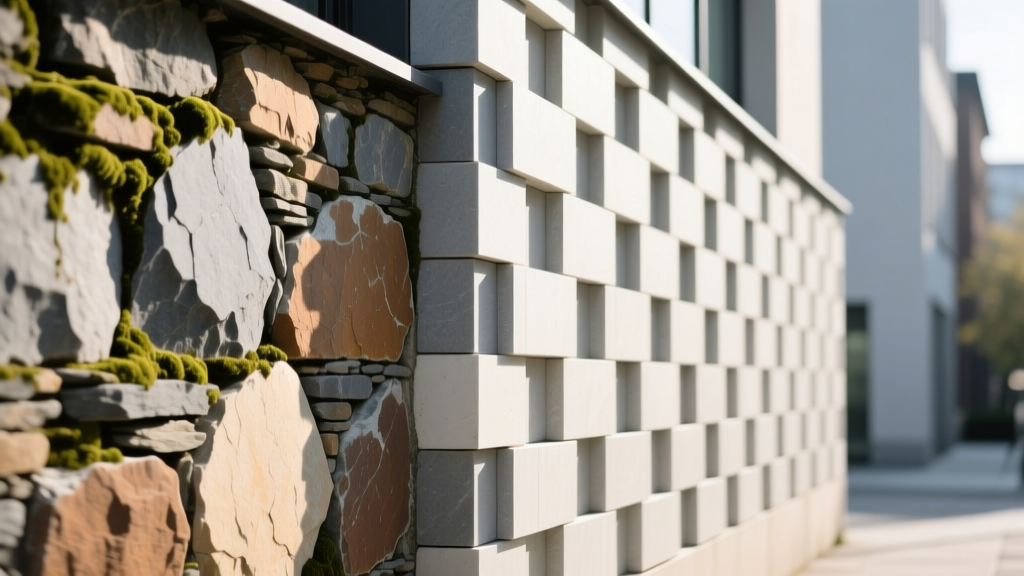
There is no universally superior outdoor stone veneer siding; the correct choice is dictated by the specific structural and environmental parameters of the build.
Specify Natural Thin Stone for high-end, legacy builds where budget is secondary to geological authenticity and multi-generational lifespan. It is mandatory for curved walls or complex architectural radii where rigid panels cannot bend, provided the structural framing can support the 15 lb/sq ft dead load.
Specify Manufactured Stone Veneer (MSV) for the majority of residential and commercial renovations where the aesthetic of real stone is required, but weight restrictions and material budgets are constrained. It is the optimal balance of authenticity and cost, provided the wall assembly is detailed with a proper rainscreen or vapor-permeable WRB to manage reservoir moisture.
Specify Polyurethane Faux Stone for rapid commercial facelifts, DIY exterior renovations, or applications over non-masonry substrates like existing vinyl siding or insulated concrete forms (ICFs). It is also the only viable choice for regions with extreme, rapid freeze-thaw cycles where traditional mortar joints and porous stones consistently fail within the first decade.
Written by
David NakamuraDavid Nakamura is a licensed architect (AIA) and construction technology writer focused on sustainable building methods, mass timber engineering, and high-performance building envelopes. He holds a Master of Architecture from the University of Washington and is a certified Passive House Consultant (CPHC). David spent eight years at the Seattle firm Mithun, where he led the design of three LEED Platinum projects, before founding his own practice specializing in net-zero residential design. He serves on the editorial advisory board of GreenBuilder Magazine and has authored peer-reviewed papers on cross-laminated timber (CLT) connections for the Journal of Structural Engineering. In his spare time, David teaches woodworking at Pratt Fine Arts Center and kayaks the Puget Sound.
More from David Nakamura
View all
Construction Cost
Labor Cost to Build a Deck Per Sq Ft: 2026 Installation Guide
Discover the exact labor cost to build a deck per sq ft in 2026. This installation guide breaks down contractor rates, complexity factors, and hidden fees.
Aug 4, 2026

Construction Cost
How Much Does It Cost to Build a 3 Bedroom House? Financing Guide
Learn exactly how much it costs to build a 3 bedroom house and explore 2026 financing options, construction loan types, and budget frameworks for your build.
Aug 4, 2026

Construction Cost
Cost to Build a Tennis Court: 2026 Guide
How much does it cost to build a tennis court in 2026? Breakdowns for asphalt, concrete, and synthetic surfaces plus fencing and lighting.
Jul 30, 2026