2026 Stone Veneer Exterior Wall Cost & Pricing Guide
Analyze 2026 stone veneer exterior wall costs. Breakdowns for MSV vs. natural stone, labor rates, prep materials, and hidden installation expenses.
2026 Executive Cost Summary
- National Average Installed Cost: $28.50 per sq. ft.
- Typical Range: $21.00 - $39.00 per sq. ft.
- Material Cost (MSV): $7.00 - $14.00 per sq. ft.
- Material Cost (Natural Thin Veneer): $11.00 - $22.00 per sq. ft.
- ROI at Resale: 92% - 95% (Manufactured Stone Veneer)
Material Cost Matrix: Natural vs. Manufactured Stone Veneer (MSV)
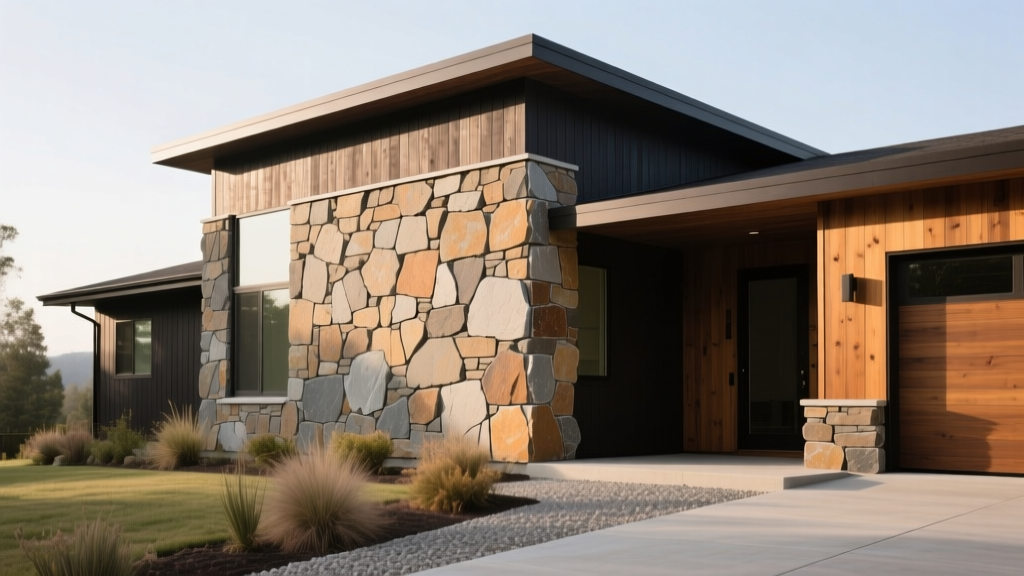
When budgeting a stone veneer exterior wall, the primary cost divergence occurs at the material selection phase. Manufactured Stone Veneer (MSV) dominates the residential market due to its lighter weight, integrated color oxides, and predictable sizing. However, natural thin veneer offers unique geological variations that MSV cannot perfectly replicate.
| Material Type | Brand / Example Profile | Cost per Sq. Ft. (Flat) | Corner Pieces (per Lin. Ft.) | Waste Factor |
|---|---|---|---|---|
| MSV (Standard) | Boral Cultured Stone (Cobblefield) | $7.50 - $9.50 | $11.00 - $14.00 | 10% |
| MSV (Premium) | Coronado Stone (Ledgestone) | $10.00 - $14.00 | $15.00 - $19.00 | 10% |
| Natural Thin Limestone | Real Stone Thin Veneer | $11.00 - $15.00 | $16.00 - $22.00 | 15% |
| Natural Thin Granite | Mountain Valley Stone | $16.00 - $22.00 | $24.00 - $32.00 | 15% |
Procurement Insight: Always calculate corner pieces by linear footage, not square footage. A common estimating error is attempting to cover exterior corners with flat stones, which results in visible cut edges, compromised weather resistance, and a voided manufacturer warranty. According to the National Veneer Masonry Association (NVMA), failing to use manufactured corner units violates standard installation protocols for water management at wall transitions.
The Mortar Misconception: Preventing Efflorescence
A frequent and costly failure in stone veneer exterior wall installations is the use of standard Type N or Type S masonry cement. Standard Portland cement-based mortars contain high levels of soluble salts. When moisture penetrates the veneer, these salts are drawn to the surface, resulting in severe efflorescence (white, powdery staining) that is nearly impossible to remove from the porous surface of MSV.
Expert Specification
Mandate the use of polymer-modified veneer stone mortars, such as ProSpec Veneer Stone Mortar or SPEC MIX VSM. These formulations are specifically engineered with low-alkali cements and integral water-retention additives. While they cost approximately $18 to $24 per 80-lb bag (compared to $9 for standard masonry cement), they eliminate the risk of efflorescence callbacks and reduce the need for post-installation chemical cleaning.
Substrate Preparation: Where Budgets Actually Break
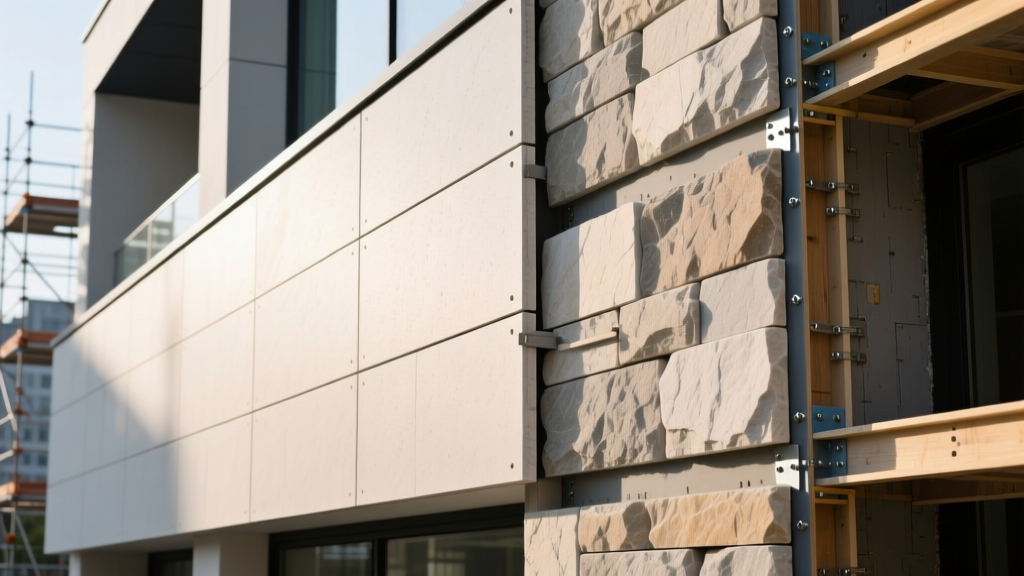
The visible stone accounts for only a fraction of the total wall assembly. The substrate preparation is non-negotiable for structural integrity and moisture management. For a wood-framed or metal-stud exterior wall, the preparation cost adds $3.50 to $5.50 per square foot to the project baseline.
Itemized Prep Costs (Per Sq. Ft.)
- Water-Resistive Barrier (WRB): $0.75 - $1.25. Use a fluid-applied membrane like Prosoco R-Guard FastFlash or a premium commercial wrap (e.g., Tyvek CommercialWrap). Standard felt paper is no longer recommended for high-end veneer assemblies due to its susceptibility to tearing during lath installation.
- Corrosion-Resistant Metal Lath: $1.20 - $1.80. Specify 2.5 lb self-furring galvanized diamond mesh. The 'self-furring' dimples are critical; they hold the lath away from the WRB, allowing the scratch coat to fully encapsulate the metal.
- Scratch Coat Application: $1.55 - $2.45. A 3/8-inch thick layer of mortar applied to the lath and horizontally scored to provide a mechanical key for the setting bed.
Critical Failure Point: The Weep Screed
Omitting a weep screed at the foundation line is the leading cause of stone veneer failure. The Masonry Society and international building codes mandate a corrosion-resistant weep screed placed a minimum of 4 inches above grade or 2 inches above paved surfaces. If water penetrates the veneer, the weep screed provides the only exit path. Without it, moisture wicks into the wood framing, causing catastrophic rot and structural compromise within 3 to 5 years.
Labor Rates, Scaffolding, and Hidden Variables
Labor for stone veneer installation is highly specialized. Unlike vinyl or fiber cement siding, stone masonry cannot be rushed without sacrificing joint integrity and pattern randomization. In 2026, skilled masonry labor rates range from $65 to $110 per hour, translating to an installation cost of $12.00 to $22.00 per square foot.
Hidden Cost Drivers to Budget For:
- Scaffolding and Hoists: For two-story facades, scaffold erection and rental will add $1,200 to $2,500 to the project. Masons require stable, wide-deck scaffolding to manage heavy mortar tubs and stone pallets safely.
- Pattern Randomization Time: High-end installations require the mason to pull from multiple pallets simultaneously to avoid 'color banding' (visible blocks of identical hues). This slows the installation rate by roughly 15% compared to basic stacked stone patterns.
- Joint Tooling and Cleanup: Specify a 'dry-stack' or 'tight-fit' profile if you want to minimize labor time. Profiles requiring deep, raked, or over-grouted joints (like traditional fieldstone) require significantly more finishing labor and specialized pointing tools.
ROI and Market Positioning vs. Competing Claddings
When evaluating the stone veneer exterior wall cost, it must be weighed against the return on investment and the performance of alternative materials. Data from the Remodeling Magazine Cost vs. Value Report consistently places Manufactured Stone Veneer at the top of exterior upgrades for cost recouped at resale.
| Exterior Cladding | Avg. Installed Cost (Sq. Ft.) | Estimated Lifespan | Resale ROI |
|---|---|---|---|
| Manufactured Stone Veneer | $21.00 - $32.00 | 50+ Years | 92% - 95% |
| Fiber Cement Siding | $10.00 - $16.00 | 30 - 50 Years | 75% - 82% |
| Full Brick Masonry | $35.00 - $55.00 | 100+ Years | 80% - 85% |
| Premium Vinyl Siding | $7.00 - $11.00 | 20 - 30 Years | 65% - 70% |
While fiber cement offers a lower upfront cost, it requires periodic painting and caulking. Stone veneer is virtually maintenance-free post-installation, requiring only occasional low-pressure washing to remove organic growth in shaded, humid climates. The 92%+ ROI of MSV makes it the most financially sound exterior upgrade for homeowners planning to sell within a 5 to 10-year window.
Frequently Asked Questions
Can stone veneer be installed directly over existing brick or stucco?
Yes, but it requires specific preparation. You cannot adhere veneer directly to painted brick or sealed stucco. The existing surface must be scarified or sandblasted to expose a porous substrate, followed by the application of a bonding agent or the installation of metal lath anchored directly into the structural masonry with concrete screws. Budget an additional $2.50 to $4.00 per square foot for this demolition and prep work.
Does stone veneer require a structural foundation footing?
Unlike full-thickness natural stone or solid brick, both MSV and natural thin veneer weigh between 10 and 15 pounds per square foot. Because of this lightweight profile, building codes generally do not require an independent concrete footing, provided the wall framing is designed to support the standard dead loads. However, a weep screed and proper flashing at the base are still mandatory.
How does climate affect the installation cost?
In freezing climates, masons must utilize cold-weather masonry practices if temperatures drop below 40°F (4°C). This includes heating the mixing water, using accelerating admixtures, and covering the freshly laid veneer with insulated tarps. These protocols can increase labor and material costs by 10% to 15% during late fall and early spring installations.
Written by
James ThorntonJames Thornton is a construction industry veteran with 25 years of hands-on experience in wood framing, lumber grading, and residential building codes. He started as a framing carpenter in rural Oregon, earned his ICC Residential Building Inspector certification, and eventually became a senior plan reviewer for the City of Portland Bureau of Development Services. James holds a B.S. in Wood Science & Technology from Oregon State University and is a certified lumber grader through the West Coast Lumber Inspection Bureau (WCLIB). He has inspected over 3,000 residential construction sites and authored the city's internal guide on advanced framing techniques (2x6 at 24" O.C.). James lives in Bend, OR, where he builds custom timber-frame cabins and competes in lumberjack sports.
More from James Thornton
View all
Insulation
Best Home Insulation Materials: Complete 2026 Guide
Compare top home insulation materials for 2026. Find R-values, installed costs per square foot, and best uses for fiberglass, spray foam, and mineral wool.
Aug 4, 2026

Sustainable Building
Certify Your Green Building Material for LEED and WELL
Step-by-step guide to certifying a green building material for LEED v5 and WELL v2. Master EPDs, HPDs, and VOC limits for 2026 project specifications.
Aug 4, 2026

Stone & Masonry
Veneer Stacked Stone Panels: Interior Design & Style Showcase
Discover how veneer stacked stone panels transform interiors. Explore modern design profiles, material pairings, and technical installation specs.
Aug 4, 2026