Veneer Stone Installation Cost: Natural vs. Manufactured 2026
Compare 2026 veneer stone installation costs for natural, manufactured, and panelized systems. Breakdown of materials, labor, and hidden fees.
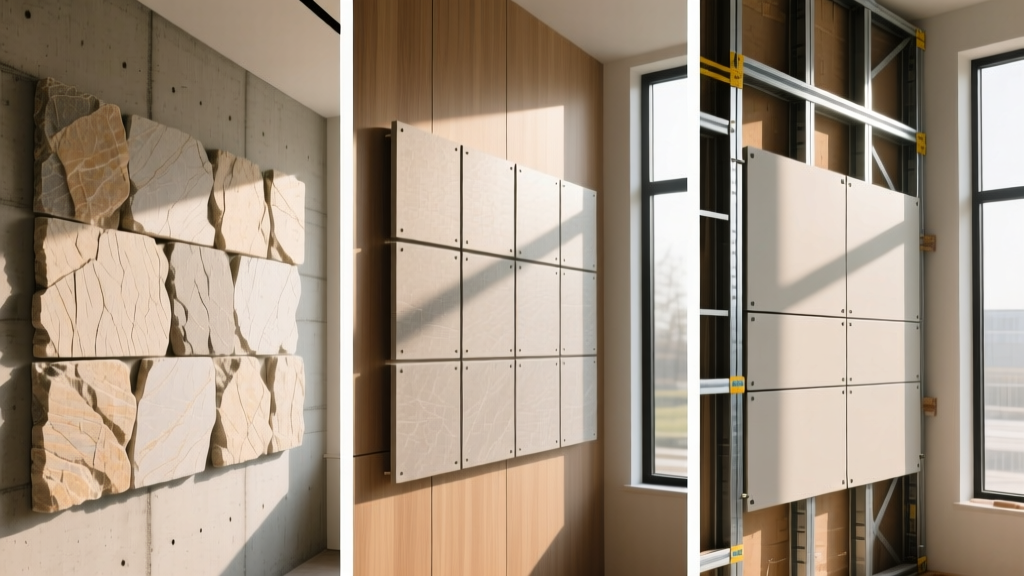
The True Economics of Stone Veneer in 2026
Calculating the true veneer stone installation cost requires looking far beyond the price tag on the pallet. In 2026, supply chain stabilization has slightly reduced the cost of Portland cement-based manufactured stones, while natural stone quarrying and freight costs remain elevated due to fuel and labor constraints. The national average for fully installed stone veneer ranges from $18 to $47 per square foot, but this spread is dictated by the material category, structural preparation, and regional masonry labor rates.
This comparison review dissects the installed costs of Natural Stone Veneer (NSV), Manufactured Stone Veneer (MSV), and Panelized/Mortarless systems, providing the exact financial and structural data needed to choose the right system for your project.
Head-to-Head Cost Matrix: Natural vs. Manufactured vs. Panelized
The following matrix breaks down the 2026 national average costs per square foot. Note that 'Prep & Hidden Costs' includes weather-resistive barriers (WRB), metal lath, scratch coats, and weep screeds where applicable.
| System Type | Material Cost / SqFt | Labor Cost / SqFt | Prep & Hidden Costs | Total Installed / SqFt | Weight / SqFt |
|---|---|---|---|---|---|
| Natural Stone (Limestone/Slate) | $12.00 - $24.00 | $15.00 - $25.00 | $4.50 - $7.00 | $31.50 - $56.00 | 15 - 28 lbs |
| Manufactured Stone (MSV) | $6.50 - $13.00 | $12.00 - $20.00 | $4.50 - $7.00 | $23.00 - $40.00 | 10 - 14 lbs |
| Panelized / Mortarless | $8.00 - $15.00 | $3.00 - $8.00 | $0.50 - $1.50 | $11.50 - $24.50 | 1.5 - 3 lbs |
Natural Stone Veneer: Premium Pricing and Structural Demands
Natural stone veneer is quarried, sliced to a 0.75-inch to 1.5-inch thickness, and sold by the square foot or ton. While it offers unmatched authenticity and longevity, it carries the highest veneer stone installation cost due to material density and specialized masonry labor.
Material Nuances and Cutting Waste
When ordering natural stone, you must account for cutting waste. Unlike uniform manufactured stones, natural ledgestone or fieldstone requires custom shaping on-site. Expect a 12% to 18% overage requirement. Furthermore, cutting natural stone requires a masonry wet saw equipped with a continuous rim diamond blade to prevent spalling the face of the stone. Equipment rental for a 10-inch wet saw adds roughly $85 to $120 per day to your project overhead.
Structural Reinforcement Requirements
At up to 28 lbs per square foot for dense slate or quartzite, natural stone veneer cannot simply be adhered to standard wood framing. According to guidelines from the Natural Stone Institute, installations exceeding 40 lbs per square foot (including mortar and lath) require structural support. This often necessitates pouring a continuous concrete footing or installing heavy-duty steel masonry ties, such as Simpson Strong-Tie corrugated wall ties, anchored directly into the wall studs at 16-inch intervals.
Manufactured Stone Veneer (MSV): The Cost-to-Value Sweet Spot
Manufactured Stone Veneer is cast in molds taken from real stone using a blend of Portland cement, lightweight aggregates, and iron oxide pigments. In 2026, premium brands like Cultured Stone and Eldorado Stone have achieved near-indistinguishable visual parity with natural stone, making MSV the dominant choice for residential exteriors and interior accent walls.
Labor Realities: The Scratch Coat Delay
While MSV material costs are roughly 40% lower than natural stone, the labor costs remain high because the installation methodology is nearly identical. MSV requires a weather-resistive barrier, wire lath, and a mortar scratch coat. The critical cost driver here is time. The scratch coat must cure for a minimum of 24 to 48 hours before the stone can be applied. This forces a two-day mobilization for the masonry crew, meaning you are paying for two separate site visits, setup, and teardown cycles, which inflates the labor cost by roughly 15% compared to single-day applications.
Mortar and Efflorescence Management
Because MSV is cementitious, it is susceptible to efflorescence (white salt deposits) if installed with improper mortar mixes or without adequate drainage. Professional installers must use a polymer-modified Type S mortar and ensure a strict 1/2-inch to 1-inch mortar joint. Attempting to save money by using unmodified Type N mortar on exterior MSV applications is a primary cause of joint cracking and subsequent water intrusion.
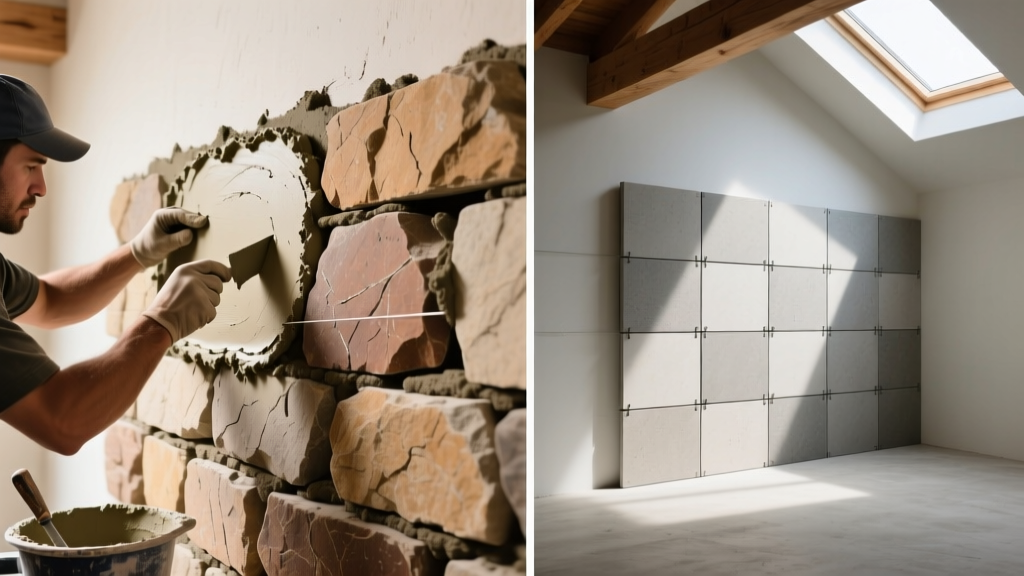
Interlocking & Panelized Systems: The DIY Labor Saver
For projects where budget constraints prohibit hiring a licensed mason, high-density polyurethane or EPS panelized systems (such as GenStone or NextStone) offer a radical reduction in veneer stone installation cost. These panels interlock and screw directly into the wall sheathing or furring strips.
- No Mortar Required: Eliminates the need for lath, scratch coats, and masonry wet saws.
- Weight Reduction: At roughly 1.5 lbs per square foot, panelized systems require zero structural reinforcement and can be applied to interior drywall or exterior OSB without modification.
- Speed of Installation: A two-person crew can typically install 150 to 200 square feet in a single 8-hour day, compared to 40 to 60 square feet for traditional mortar-set MSV.
However, panelized systems have a distinct financial drawback: Corner and Trim Pieces. Because the panels are flat molds, outside and inside corners require specialized, pre-molded corner posts that often cost 3x to 4x the linear price of the flat panels. A project with multiple window returns and building corners will see material costs spike unexpectedly.
Hidden Cost Triggers That Blow Up Veneer Budgets
Contractor quotes often exclude the critical moisture management components required by the International Residential Code (IRC R703.7). If your quote for exterior veneer stone installation does not explicitly include the following, you are looking at an incomplete bid that will result in change orders or catastrophic water damage.
Mandatory Exterior Prep Costs (Per Linear/Square Foot)
- Grade D Paper or Housewrap (WRB): $0.50 - $0.85 / SqFt. (Must be two layers of Grade D paper for cementitious MSV to prevent the mortar from sucking moisture out of the WRB).
- Galvanized Wire Lath (2.5 lb): $1.20 - $1.80 / SqFt. Must be self-furring to allow mortar to wrap behind the wire.
- Weep Screed Installation: $2.50 - $4.00 / Linear Ft. Code requires the weep screed to terminate a minimum of 4 inches above earth grade or 2 inches above paved surfaces to prevent capillary water draw and termite entry.
- Flashing Integration: $150 - $300 per opening. Head flashings above windows and doors must be integrated behind the WRB and extend over the stone veneer.
According to industry data aggregated by Angi's 2026 masonry cost guides, homeowners who fail to account for these prep materials often see their final project invoices increase by 18% to 22% over the initial material-only estimates.
Decision Framework: Which System Fits Your Project?
Use this conditional framework to finalize your material selection based on your specific site conditions and budget parameters.
Choose Natural Stone Veneer IF:
- You are building a custom, high-end residential exterior or a permanent commercial facade.
- The architectural plans already include a structural brick ledge or concrete footing.
- Local zoning or HOA guidelines explicitly prohibit synthetic or manufactured exterior cladding.
Choose Manufactured Stone Veneer (MSV) IF:
- You want the aesthetic of natural stone but need to reduce material costs by 30% to 40%.
- You are cladding a retrofit exterior where pouring a new concrete footing is financially unfeasible (MSV's lighter weight often allows for structural ledger attachment rather than ground-bearing footings).
- You are installing a full-height interior fireplace surround where the heat resistance of Portland cement is required.
Choose Panelized / Mortarless Systems IF:
- You are executing a DIY installation and lack masonry trowel skills.
- The project is an interior basement remodel, media room, or accent wall where weight restrictions and dust/mess from mortar mixing are primary concerns.
- You are operating on a strict timeline and require same-day completion without curing delays.
Written by
David NakamuraDavid Nakamura is a licensed architect (AIA) and construction technology writer focused on sustainable building methods, mass timber engineering, and high-performance building envelopes. He holds a Master of Architecture from the University of Washington and is a certified Passive House Consultant (CPHC). David spent eight years at the Seattle firm Mithun, where he led the design of three LEED Platinum projects, before founding his own practice specializing in net-zero residential design. He serves on the editorial advisory board of GreenBuilder Magazine and has authored peer-reviewed papers on cross-laminated timber (CLT) connections for the Journal of Structural Engineering. In his spare time, David teaches woodworking at Pratt Fine Arts Center and kayaks the Puget Sound.
More from David Nakamura
View all
Construction Cost
Labor Cost to Build a Deck Per Sq Ft: 2026 Installation Guide
Discover the exact labor cost to build a deck per sq ft in 2026. This installation guide breaks down contractor rates, complexity factors, and hidden fees.
Aug 4, 2026

Construction Cost
How Much Does It Cost to Build a 3 Bedroom House? Financing Guide
Learn exactly how much it costs to build a 3 bedroom house and explore 2026 financing options, construction loan types, and budget frameworks for your build.
Aug 4, 2026

Construction Cost
Cost to Build a Tennis Court: 2026 Guide
How much does it cost to build a tennis court in 2026? Breakdowns for asphalt, concrete, and synthetic surfaces plus fencing and lighting.
Jul 30, 2026