How to Source Quality Stone Veneer Near Me: A Buyer's Guide
Discover how to evaluate local stone veneer suppliers, compare freight costs, and select the right natural or manufactured stone for your project.
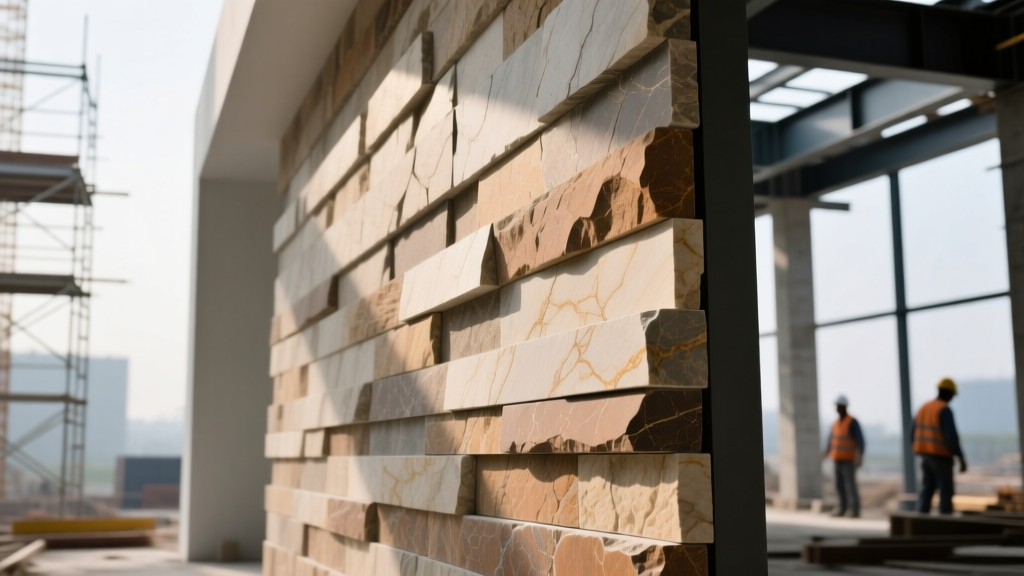
The Freight Factor: Why Local Sourcing Dictates Your Budget
When contractors and homeowners search for 'stone veneer near me,' the primary motivation is usually logistical. Stone is exceptionally dense, and shipping it across the country via Less-Than-Truckload (LTL) freight rapidly destroys project margins. Manufactured stone veneer (MSV) typically weighs 10 to 12 pounds per square foot, while natural stone veneer can exceed 15 pounds per square foot. For a standard 500-square-foot exterior facade, you are moving 5,000 to 7,500 pounds of material.
In 2026, national LTL freight rates for palletized masonry products average between $0.85 and $1.60 per square foot, depending on the destination and fuel surcharges. By sourcing from a regional masonry supply yard or a local quarry, you eliminate this freight premium, saving $425 to $800 on a mid-sized project. Furthermore, local pickup allows you to inspect the batch for color consistency and structural integrity before the material is permanently affixed to your property.
Many big box home improvement stores stock manufactured stone veneer, but their inventory is often limited to 2 or 3 basic profiles. If your project requires 450 square feet and the local store only has 300 square feet in stock, you may be forced to mix different production batches. Even with strict manufacturing tolerances, dye-lot variations between batches can result in noticeable color banding on your finished wall. Always verify that a single supplier can fulfill your entire square footage requirement from the same production run.
Decoding Local Supplier Tiers
Not all local suppliers offer the same caliber of material or technical support. Understanding the hierarchy of local stone yards will help you align your purchasing decision with your project's architectural demands.
| Supplier Type | Typical Inventory | Price Range (per sq ft) | Best Application |
|---|---|---|---|
| Big Box Retailers | Entry-level MSV (e.g., basic ledger panels, standard fieldstone) | $7.50 - $11.00 | Interior accent walls, basic DIY fireplace surrounds |
| Dedicated Masonry Yards | Premium MSV (Eldorado, Cultured Stone), full accessory systems | $10.00 - $16.50 | Full exterior envelopes, high-end commercial facades |
| Regional Stone Quarries | Natural thin veneer (limestone, slate, granite), custom cuts | $13.00 - $24.00+ | Historic restorations, luxury custom homes, landscaping |
Natural vs. Manufactured: Evaluating Local Performance Data
When visiting local suppliers, you will inevitably choose between natural thin stone veneer and manufactured stone veneer (MSV). While MSV is engineered to mimic natural stone, the performance metrics differ significantly, particularly regarding moisture absorption and freeze-thaw durability.
If you are evaluating natural stone from a local quarry, request the material's absorption rate. According to testing standards outlined by the Natural Stone Institute, stones with an absorption rate below 3% (like most granites and dense slates) are highly resistant to freeze-thaw spalling. Porous stones like certain sandstones or limestones may require the application of a breathable, silane-based penetrating sealer after installation, adding $0.40 to $0.75 per square foot to your long-term maintenance budget.
For manufactured stone, the governing standard is ASTM C1670. The Masonry Veneer Manufacturers Association (MVMA) mandates that compliant MSV must undergo rigorous freeze-thaw cycling and compressive strength testing. When speaking with a local masonry supply manager, ask to see the manufacturer's ASTM C1670 compliance certificate. If the supplier cannot produce this documentation for the specific brand they carry, walk away. Non-compliant, unbranded cast stone will rapidly degrade, crack, and delaminate in climates with seasonal temperature fluctuations.
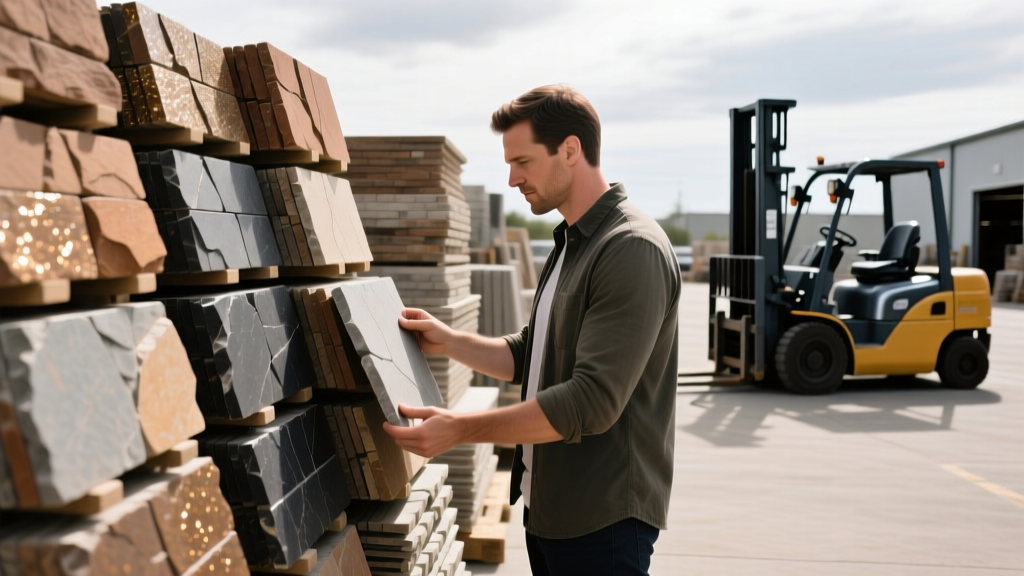
The 5-Point Vetting Checklist for Local Yards
Finding a supplier via a local search is only the first step. Use this technical checklist when visiting the yard to ensure you are purchasing a viable, code-compliant product.
- Verify Dye-Lot Consistency: Open at least three different boxes from the pallet. Manufactured stone should exhibit intentional, natural color variation within the box, but the baseline hue should match across all boxes. If Box A is distinctly warmer than Box B, the yard has mixed inventory.
- Inspect the Edges and Corners: The true test of high-quality MSV is the return edge. Premium brands like Cultured Stone or Eldorado Stone wrap the color and texture around the 90-degree return edge. Budget stones often have a raw, gray concrete edge that will be visible on outside corners unless heavily mortared.
- Check Pallet Storage Conditions: Stone veneer should be stored under tarps or in a covered warehouse. If manufactured stone has been sitting exposed to heavy rain and direct UV for months, the efflorescence risk (white, powdery salt deposits) increases dramatically once installed and heated.
- Confirm Accessory Availability: A reputable yard will stock the exact color-matched mortar, trim pieces, and transition profiles required for the specific stone line you are buying.
- Ask About the Breakage Allowance: Standard industry breakage for stone veneer during transport and cutting is 5% to 8%. Ask the supplier if their quoted square footage includes a standard overage, or if you need to manually add 10% to your final order to account for cuts and damaged pieces.
Sourcing the Complete System: Beyond the Stone
A common failure point for DIYers and inexperienced buyers is focusing entirely on the aesthetic stone while neglecting the moisture management and structural attachment systems. When you buy stone veneer locally, you must purchase the complete assembly to comply with the International Building Code (IBC) and ASTM C1063.
- Weather-Resistive Barrier (WRB): You need two layers of Grade D building paper or a high-performance housewrap rated for masonry applications. This creates a drainage plane behind the lath.
- Corrosion-Resistant Weep Screed: Mandatory at the base of all exterior stone veneer installations. It must be placed a minimum of 4 inches above grade or 2 inches above paved surfaces to allow trapped moisture to escape and prevent soil-borne moisture from wicking into the stone.
- Metal Lath: Use 2.5 lb self-furring galvanized steel lath for exterior applications. The 'self-furring' dimples hold the lath away from the WRB, allowing the scratch coat of mortar to fully encapsulate the metal mesh.
- Mortar: Do not use standard brick mortar. You need a Type S masonry cement or a polymer-modified veneer mortar specifically designed for the high-shear adhesion required by thin stone profiles.
Expert Insight: If you are hiring a local mason to install the veneer, verify that their contract explicitly includes the weep screed and self-furring lath. Many cut-rate contractors will attempt to adhere stone directly to existing painted siding or bare drywall using construction adhesive. This violates building codes, voids all manufacturer warranties, and guarantees catastrophic moisture damage and delamination within 24 to 36 months.
Coordinating Delivery and Staging
Once you have selected your material from a local supplier, coordinate the delivery logistics carefully. Stone pallets weigh between 2,500 and 4,000 pounds each. Standard residential driveways, especially those with older concrete or asphalt bases, can crack under the concentrated point-load of a forklift unloading a pallet.
Request that the delivery truck stage the pallets on the street or on a reinforced section of your driveway. Furthermore, ensure the supplier uses a truck equipped with a pallet jack and lift gate if you do not have a forklift on-site. Pallets must be kept completely dry prior to installation; if rain is forecasted before your mason begins the scratch coat, you must have heavy-duty 6-mil polyethylene sheeting on hand to wrap the pallets immediately upon delivery.
Written by
David NakamuraDavid Nakamura is a licensed architect (AIA) and construction technology writer focused on sustainable building methods, mass timber engineering, and high-performance building envelopes. He holds a Master of Architecture from the University of Washington and is a certified Passive House Consultant (CPHC). David spent eight years at the Seattle firm Mithun, where he led the design of three LEED Platinum projects, before founding his own practice specializing in net-zero residential design. He serves on the editorial advisory board of GreenBuilder Magazine and has authored peer-reviewed papers on cross-laminated timber (CLT) connections for the Journal of Structural Engineering. In his spare time, David teaches woodworking at Pratt Fine Arts Center and kayaks the Puget Sound.
More from David Nakamura
View all
Construction Cost
Labor Cost to Build a Deck Per Sq Ft: 2026 Installation Guide
Discover the exact labor cost to build a deck per sq ft in 2026. This installation guide breaks down contractor rates, complexity factors, and hidden fees.
Aug 4, 2026

Construction Cost
How Much Does It Cost to Build a 3 Bedroom House? Financing Guide
Learn exactly how much it costs to build a 3 bedroom house and explore 2026 financing options, construction loan types, and budget frameworks for your build.
Aug 4, 2026

Construction Cost
Cost to Build a Tennis Court: 2026 Guide
How much does it cost to build a tennis court in 2026? Breakdowns for asphalt, concrete, and synthetic surfaces plus fencing and lighting.
Jul 30, 2026