Natural vs Manufactured Stacked Veneer Stone: 2026 Comparison
Compare natural and manufactured stacked veneer stone for 2026 projects. Analyze costs, weight, installation, and durability to choose the right material.
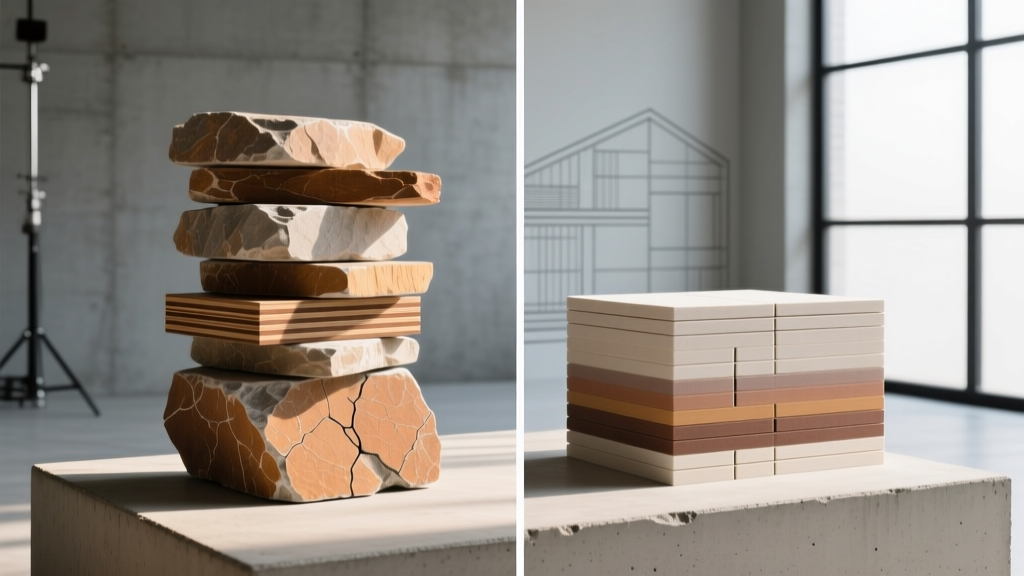
The Core Differences: Geology vs. Engineering
When specifying stacked veneer stone for architectural facades, interior accent walls, or landscape features, the primary decision hinges on material origin. Natural stacked veneer stone is quarried from the earth—typically slate, quartzite, or limestone—and mechanically sliced into 1-inch to 2.5-inch thick profiles. Manufactured stacked veneer stone, conversely, is an engineered composite of Portland cement, lightweight aggregates (like pumice or expanded shale), and iron oxide pigments cast in polyurethane molds derived from real stone.
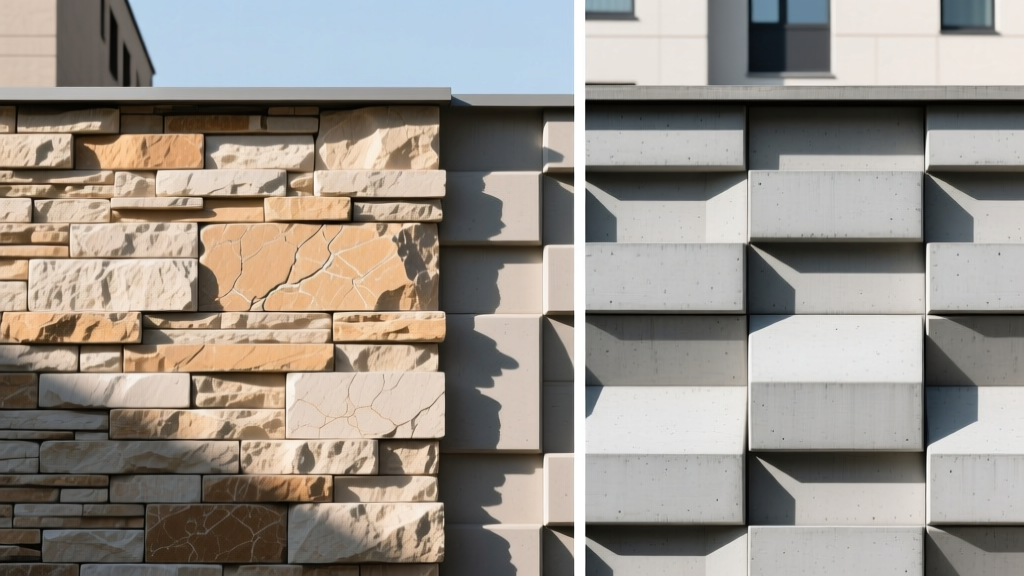
While early manufactured products suffered from repetitive patterns and flat coloration, 2026 manufacturing techniques utilize multi-stage casting and acid-washing processes that yield a visual depth virtually indistinguishable from natural ledgestone. However, the physical properties, structural demands, and long-term maintenance profiles of these two materials diverge significantly.
Structural Load and Weight Limits
Adhered masonry veneers are governed by strict weight limitations under the International Building Code (IBC). Because stacked veneer stone relies on a mortar bond to a backing wall rather than structural ties to a foundation, the dead load must be carefully calculated.
- Natural Stone Veneer: 10 to 18 lbs per square foot (psf), depending on the mineral density. Quartzite ledgestone often pushes the upper limit.
- Manufactured Stone Veneer (MSV): 8 to 12 psf. The inclusion of lightweight aggregates reduces the overall mass by up to 35% compared to natural equivalents.
- Code Maximum: Adhered veneers generally must not exceed 40 psf, making both options compliant for standard wood-frame or CMU (Concrete Masonry Unit) backing walls.
For multi-story commercial projects or retrofits over existing aging sheathing, manufactured stacked veneer stone offers a distinct structural advantage. The reduced weight lowers the shear stress on the mortar bond and minimizes deflection concerns in timber-framed walls. For further technical parameters on adhered masonry, the National Veneer Masonry Association provides comprehensive load-bearing guidelines and backing wall preparation standards.
2026 Cost Breakdown: Material and Labor
Pricing for stacked veneer stone fluctuates based on regional quarry access and freight costs. Natural stone carries a heavier freight penalty due to its density, while manufactured stone is typically produced regionally to minimize shipping expenses. Below is a comparative cost matrix for a standard 500-square-foot exterior installation.
| Cost Component | Natural Stacked Stone | Manufactured Stacked Stone |
|---|---|---|
| Material (per sq. ft.) | $9.50 - $18.00 | $6.50 - $12.50 |
| Lath & Scratch Coat Materials | $1.80 - $2.50 | $1.80 - $2.50 |
| Mortar & Adhesives | $1.20 - $1.80 | $1.20 - $1.80 |
| Professional Labor (per sq. ft.) | $16.00 - $26.00 | $14.00 - $22.00 |
| Total Installed Cost (per sq. ft.) | $28.50 - $48.30 | $23.50 - $38.80 |
Labor costs for natural stone are inherently higher. Masons must spend additional time selecting, trimming, and fitting irregular natural stones to maintain a tight, uniform stacked profile without excessive mortar joints. Manufactured stones are designed with interlocking edges and consistent heights, accelerating the installation pace by roughly 15% to 20%.
Installation Nuances: Mortar, Lath, and Clearances
Regardless of the material chosen, the failure rate of stacked veneer stone is almost entirely dictated by the substrate preparation and moisture management details. Both materials require a continuous Weather-Resistive Barrier (WRB), 2.5 lb galvanized diamond metal lath, and a 1/2-inch Portland cement scratch coat.
Mortar Selection
For exterior applications, Type S mortar is mandatory. It offers a minimum compressive strength of 1,800 psi and superior bond strength compared to Type N, which is reserved for interior, non-load-bearing applications. Using polymer-modified mortars specifically formulated for veneer applications (such as those meeting ASTM C1670 standards) ensures maximum adhesion and flexibility to accommodate thermal expansion.
Moisture Management and Weep Screeds
The most critical edge case in stacked veneer stone installation is ground moisture wicking. Code requires a weep screed to be installed at the base of the wall.
- Grade Clearance: The bottom of the weep screed must be a minimum of 4 inches above the final earth grade, or 2 inches above paved surfaces like concrete walkways.
- Flashing Integration: The WRB must lap over the weep screed attachment flange to ensure any water penetrating the veneer is directed outward, not into the wall cavity.
- Mortar Droppings: During installation, masons must keep the weep screed channel clear of mortar droppings. Clogged weep screeds trap water, leading to freeze-thaw spalling and interior wood rot.
Climate Performance and Efflorescence
When evaluating long-term durability, climate dictates the optimal choice. Natural stone, particularly dense quartzite and slate, is virtually impervious to water absorption, boasting absorption rates below 1%. This makes natural stacked veneer stone the superior choice for high-moisture environments, coastal regions with salt spray, and areas with severe freeze-thaw cycles.
Manufactured stone is more porous, with absorption rates typically ranging from 8% to 15%. In freezing climates, trapped moisture can expand and cause the cementitious face to spall or delaminate. To mitigate this, premium manufactured brands apply integral water repellents during the casting process, but these require reapplication of a breathable, silane-based penetrating sealer every 5 to 7 years.
The Efflorescence Factor: Because manufactured stone contains Portland cement and soluble salts, it is highly susceptible to efflorescence—a white, powdery residue that migrates to the surface when moisture evaporates. Natural stone rarely exhibits this issue. If installing manufactured stacked veneer stone, ensure the backing wall is completely dry before applying the scratch coat, and use low-alkali Portland cement to minimize salt migration.
Decision Matrix: Which Stacked Veneer Stone Fits Your Project?
Use the following framework to finalize your material specification based on project constraints and environmental factors.
| Project Scenario | Recommended Material | Primary Rationale |
|---|---|---|
| Multi-Story Commercial Facade | Manufactured | Reduces dead load on upper-story wood or steel framing; lowers freight costs for large volume orders. |
| Exterior Retaining Wall / Landscape | Natural | Near-zero water absorption prevents freeze-thaw spalling; withstands direct soil contact and irrigation splash. |
| Interior Fireplace Surround | Either (Tie) | Weight and moisture are non-issues. Choose Natural for unique, non-repeating aesthetics; choose Manufactured for budget and ease of cutting. |
| Coastal / High Salt-Spray Zone | Natural | Salt accelerates the corrosion of cementitious binders and metal lath. Dense natural stone resists chemical degradation. |
| DIY Interior Accent Wall | Manufactured (Mortarless) | Interlocking, dry-stack manufactured panels eliminate the need for wet mortar, lath, and specialized masonry tools. |
Ultimately, the choice between natural and manufactured stacked veneer stone is rarely about which material is universally "better," but rather which material aligns with the structural capacity of the substrate, the local climate, and the project budget. By prioritizing proper WRB integration, weep screed clearances, and correct mortar chemistry, either material will deliver a durable, high-end architectural finish.
Written by
Marcus ChenMarcus Chen is a licensed structural engineer (PE) and building materials analyst with over 12 years of experience across residential, commercial, and industrial construction. He holds a Master of Science in Civil Engineering from UC Berkeley and spent six years at Thornton Tomasetti before transitioning to independent consulting and technical writing. Marcus specializes in material selection for seismic-prone regions, concrete reinforcement strategies, and lifecycle cost analysis. His work has been cited by the American Concrete Institute (ACI) and the Structural Engineers Association of California (SEAOC). When he is not on a job site or at his desk, you will find him hiking the Sierra Nevada or restoring a 1920s craftsman bungalow in Oakland, CA.
More from Marcus Chen
View all
Construction Cost
How Much Did the Eiffel Tower Cost to Build?
How much did the Eiffel Tower cost to build in 1889? We adjust for inflation and compare its budget to modern skyscraper construction.
Aug 4, 2026

Fire Resistance
What Is a Fire Resistant Material? Testing & Certification Guide
Discover what is a fire resistant material through ASTM and UL testing. Learn how fire ratings, certifications, and assemblies work in construction.
Aug 4, 2026

Construction Cost
How Much Did the Burj Khalifa Cost to Build?
How much did the Burj Khalifa cost to build? We break down the $1.5B project and extract 5 money-saving strategies for your next build.
Jul 30, 2026