Stone Veneer Adhesive Cost Analysis: Mortar vs Polymer
Analyze stone veneer adhesive costs for 2026. Compare polymer thin-set, Type S mortar, and pre-mixed mastics with real coverage rates and labor savings.
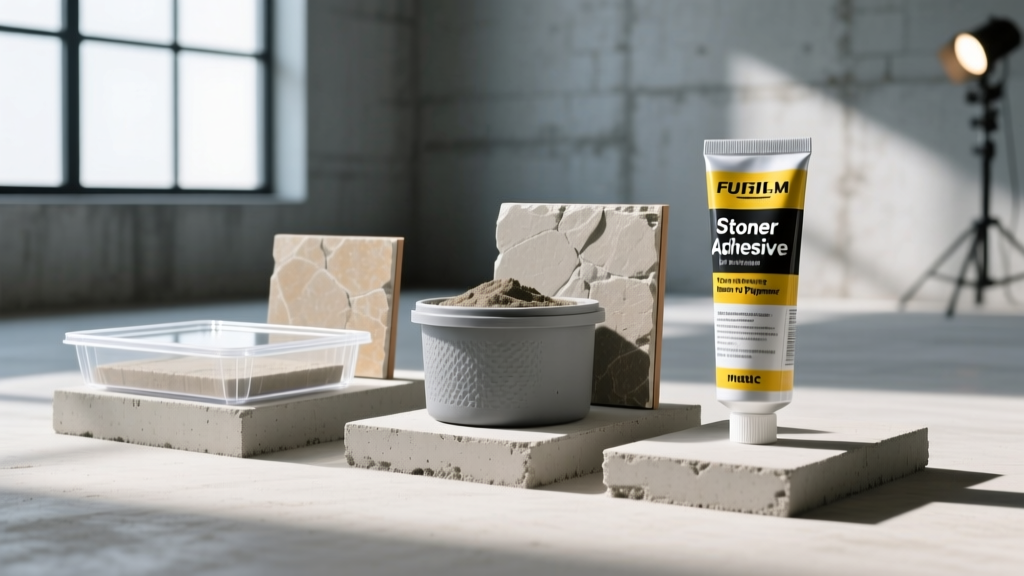
The True Cost of Stone Veneer Adhesive Systems
Selecting the correct stone veneer adhesive is a structural decision disguised as a line-item budget choice. While adhesive typically accounts for only 10% to 15% of total material costs in a veneer project, it dictates 100% of the system's failure risk. In 2026, the market has shifted heavily away from traditional cementitious mortars toward advanced polymer-modified thin-sets and specialized masonry adhesives. This shift is driven not by material preference, but by installed cost economics: higher upfront adhesive costs are frequently offset by drastic reductions in labor time, mixing requirements, and long-term warranty liabilities.
This cost analysis breaks down the exact pricing, coverage yields, and labor implications of the three primary stone veneer adhesive categories: traditional Type S mortar, polymer-modified thin-set mortars, and pre-mixed acrylic/polymer mastics. By calculating the true installed cost per square foot, contractors and homeowners can accurately budget for both interior feature walls and exterior cladding applications.
Quick Cost Snapshot (2026 Averages)
- Traditional Type S Mortar: $0.55 - $0.85 per sq. ft. (Material only)
- Polymer-Modified Thin-Set: $1.10 - $1.60 per sq. ft. (Material only)
- Pre-Mixed Polymer Mastic: $1.80 - $2.50 per sq. ft. (Material only)
- Labor Premium for Mortar: Adds $3.00 - $5.00 per sq. ft. in extra mixing and application time compared to pre-mixed alternatives.
Material Cost Breakdown: Polymer vs. Cementitious Adhesives
The baseline cost of adhesive varies wildly depending on the chemical composition and the specific ANSI standards the product meets. Understanding these categories is critical for accurate procurement.
1. Traditional Type S Masonry Mortar
Composed of Portland cement, hydrated lime, and masonry sand, Type S mortar (meeting ASTM C270 standards outlined by the MVMA) is the legacy choice for exterior natural stone veneer. It is exceptionally cheap per unit but requires significant on-site labor. An 80 lb. bag costs between $8.00 and $12.00. However, it must be mixed with water, slaked for 10 minutes, remixed, and has a strict 2-hour pot life before it must be discarded. It also requires a scratch coat on non-masonry substrates, adding a secondary material and labor step.
2. Polymer-Modified Thin-Set Mortars
Products like Laticrete MVIS (Masonry Veneer Installation System) or Custom Building Products ProLite represent the modern standard for both natural and manufactured stone. These are dry-set mortars fortified with liquid or dry latex polymers, meeting ANSI A118.4 or the higher ANSI A118.15 (Improved Modified) standards. A 50 lb. bag ranges from $28.00 to $45.00 depending on the polymer concentration. They offer superior bond strength, eliminate the need for a scratch coat on properly prepared cement board, and feature extended open times, reducing waste.
3. Pre-Mixed Acrylic/Polymer Mastics
Sold in 3.5-gallon buckets for $65.00 to $85.00, these ready-to-use adhesives contain zero Portland cement. They are strictly limited to interior applications and lightweight manufactured stone veneer panels. While the material cost per square foot is the highest, the elimination of mixing, cleanup, and slaking time makes them highly cost-effective for small-scale DIY or interior remodels where labor rates are a primary concern.
| Adhesive Type | Unit Cost (2026) | Coverage per Unit | Material Cost / Sq. Ft. | Best Application |
|---|---|---|---|---|
| Type S Mortar (80lb bag) | $8.00 - $12.00 | 12 - 15 sq. ft. | $0.55 - $0.85 | Exterior natural stone over masonry |
| Polymer Thin-Set (50lb bag) | $28.00 - $45.00 | 18 - 25 sq. ft. | $1.10 - $1.60 | Interior/Exterior manufactured & natural |
| Pre-Mixed Mastic (3.5 gal) | $65.00 - $85.00 | 35 - 45 sq. ft. | $1.80 - $2.50 | Interior lightweight veneer panels |
| Polyurethane Tube (10oz) | $8.00 - $12.00 | 10 - 15 lin. ft. | $2.50+ (estimated) | Interlocking panel systems only |
Calculating Coverage and Yield: The Hidden Cost Factor
The most frequent budgeting error in stone veneer installation is relying on the manufacturer's maximum coverage rate printed on the bag. Maximum coverage assumes a perfectly flat substrate and a small trowel notch. Natural stone veneer is inherently uneven, requiring deeper notches and extensive back-buttering, which decimates theoretical yield.
Trowel Notch Size Impact on Adhesive Spend
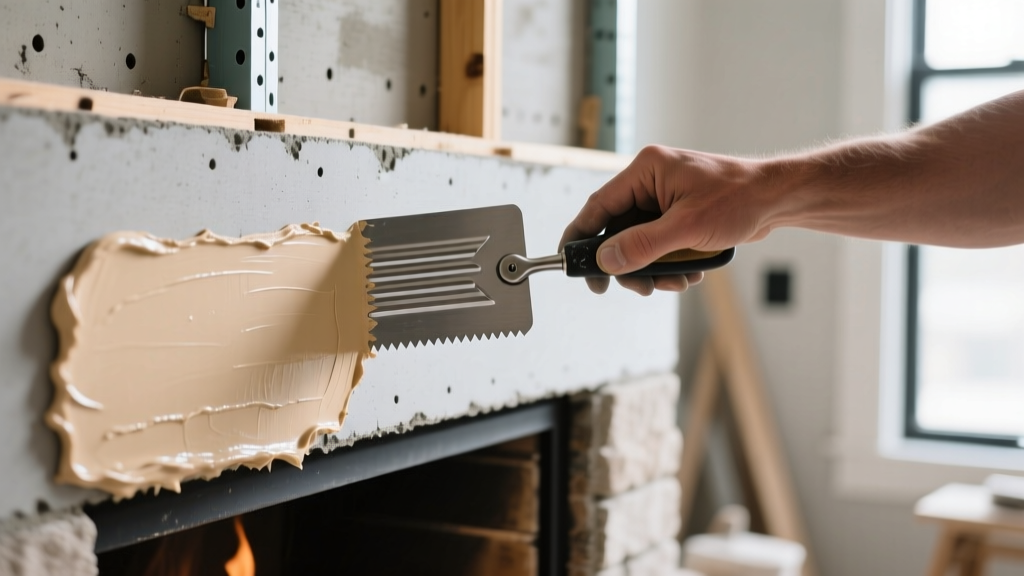
For manufactured stone veneer, a 3/8-inch x 3/8-inch square notch trowel is standard. A 50 lb. bag of polymer thin-set will cover approximately 25 square feet at this depth. However, for natural stacked stone or heavy fieldstone, installers must use a 1/2-inch x 1/2-inch square notch to ensure adequate mortar contact and structural support. This single increase in notch depth reduces the coverage of that same 50 lb. bag to roughly 14 square feet—a 44% drop in yield that instantly doubles the material cost per square foot.
Furthermore, the Masonry Veneer Manufacturers Association (MVMA) mandates 100% mortar coverage on the back of the stone. For irregular natural stone, this requires 'back-buttering'—applying a flat layer of adhesive directly to the stone before pressing it into the combed wall bed. Back-buttering increases total adhesive consumption by an additional 25% to 35%. When budgeting, always apply a 1.35x multiplier to your calculated square footage to account for notch depth and back-buttering waste.
Exterior vs. Interior Adhesive Requirements
Cost analysis must account for environmental exposure. Interior climate-controlled environments allow for the use of standard ANSI A118.4 modified thin-sets or even pre-mixed mastics for lightweight panels. Exterior applications subject to freeze-thaw cycles, wind sheer, and hydrostatic pressure strictly require high-performance adhesives.
For exterior natural stone, specify an ANSI A118.15 Improved Modified thin-set mortar or a dedicated masonry veneer mortar with a liquid latex additive (such as Laticrete 3701 Mortar Admix). While the liquid additive costs an additional $45.00 to $60.00 per 5-gallon pail (replacing the mixing water), it increases flexural strength and freeze-thaw resistance. Skipping this additive to save $0.40 per square foot in material costs risks catastrophic delamination, where the cost of scaffolding, demolition, and reinstallation will exceed the original project budget by 300%.
Labor Costs and Application Speed
Adhesive selection directly dictates labor hours. With masonry labor rates averaging $65 to $110 per hour in 2026, the time spent mixing and managing adhesive is a massive variable.
Field Insight: A two-person crew using traditional Type S mortar will spend roughly 45 minutes per 8-hour day just mixing, slaking, cleaning the drill paddle, and discarding expired mortar. Over a 5-day project, that is nearly 4 hours of lost productivity—equating to $300 to $450 in wasted labor that completely eclipses the savings of buying cheap mortar.
Polymer-modified thin-sets mixed with a low-RPM drill take 5 minutes to prepare and feature extended open times (up to 30 minutes), allowing the mason to comb a larger section of the wall without the adhesive skinning over. Pre-mixed mastics eliminate mixing entirely, allowing a single installer to begin setting stone the second the lid is removed, cutting installation time on small interior projects by up to 40%.
Real-World Project Budgeting: 100 Sq. Ft. Fireplace Surround
To illustrate the true installed cost, consider a 100 square foot interior fireplace surround using manufactured stacked stone veneer over cement board. We will compare the traditional mortar route against a polymer thin-set route.
Scenario A: Traditional Type S Mortar
- Material: 8 bags of Type S Mortar @ $10.00 = $80.00
- Prep/Scratch Coat: 2 bags mortar + metal lath = $45.00
- Labor: 10 hours (includes scratch coat curing time, mixing, and setting) @ $85/hr = $850.00
- Total Installed Cost: $975.00
Scenario B: Polymer-Modified Thin-Set (ANSI A118.4)
- Material: 5 bags of Polymer Thin-Set @ $32.00 = $160.00 (Accounts for 1/2" notch and back-buttering waste)
- Prep/Scratch Coat: $0.00 (Direct application to primed cement board)
- Labor: 6 hours (no scratch coat, faster mixing, extended open time) @ $85/hr = $510.00
- Total Installed Cost: $670.00
Despite the polymer thin-set costing exactly twice as much in raw materials ($160 vs $80), the total project cost is $305 cheaper due to the elimination of the scratch coat and the reduction in billable labor hours.
Sourcing and Procurement Strategies
To optimize adhesive budgets on large-scale exterior cladding projects (500+ square feet), bypass big-box retail pricing. Contact regional masonry supply distributors to procure 3,000 lb. pallets of polymer-modified thin-set. Pallet purchasing typically yields a 12% to 18% discount over retail bag pricing. Additionally, ensure the adhesive is stored in a climate-controlled environment on-site; polymer-modified mortars exposed to high humidity in the back of a truck will absorb ambient moisture, clumping in the bag and resulting in total material loss before the project even begins.
Written by
Marcus ChenMarcus Chen is a licensed structural engineer (PE) and building materials analyst with over 12 years of experience across residential, commercial, and industrial construction. He holds a Master of Science in Civil Engineering from UC Berkeley and spent six years at Thornton Tomasetti before transitioning to independent consulting and technical writing. Marcus specializes in material selection for seismic-prone regions, concrete reinforcement strategies, and lifecycle cost analysis. His work has been cited by the American Concrete Institute (ACI) and the Structural Engineers Association of California (SEAOC). When he is not on a job site or at his desk, you will find him hiking the Sierra Nevada or restoring a 1920s craftsman bungalow in Oakland, CA.
More from Marcus Chen
View all
Construction Cost
How Much Did the Eiffel Tower Cost to Build?
How much did the Eiffel Tower cost to build in 1889? We adjust for inflation and compare its budget to modern skyscraper construction.
Aug 4, 2026

Fire Resistance
What Is a Fire Resistant Material? Testing & Certification Guide
Discover what is a fire resistant material through ASTM and UL testing. Learn how fire ratings, certifications, and assemblies work in construction.
Aug 4, 2026

Construction Cost
How Much Did the Burj Khalifa Cost to Build?
How much did the Burj Khalifa cost to build? We break down the $1.5B project and extract 5 money-saving strategies for your next build.
Jul 30, 2026