2026 Stone Veneer Flashing Costs: Materials, Labor & ROI
Analyze 2026 stone veneer flashing costs, including material prices, labor rates, and the hidden expenses of water damage repairs from improper installation.
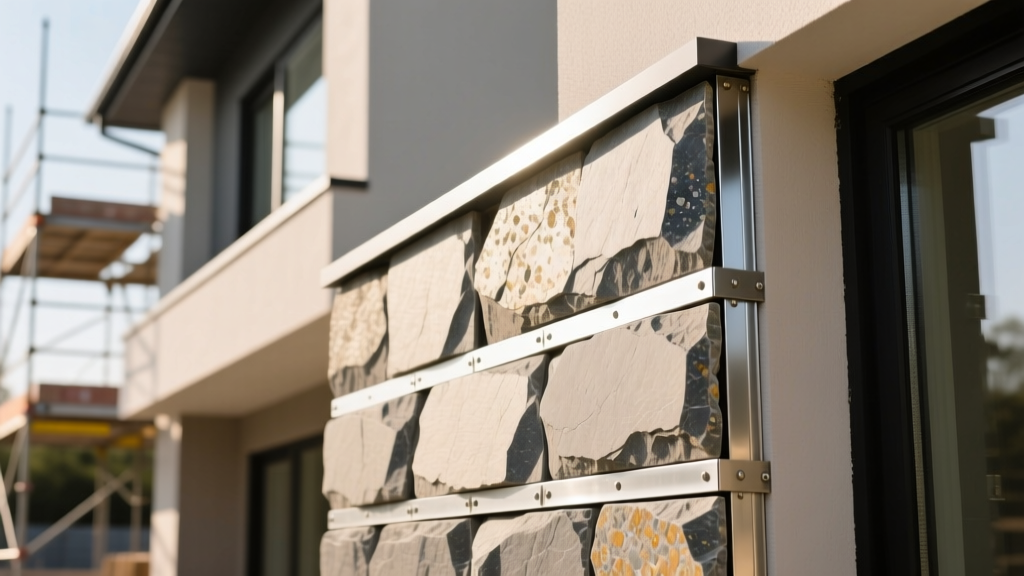
The True Cost of Stone Veneer Flashing in 2026
Stone veneer is fundamentally a reservoir cladding system. When driven rain strikes a stone facade, the masonry absorbs and holds significant moisture. Without a meticulously integrated flashing system, that trapped water migrates behind the weather-resistive barrier (WRB), leading to catastrophic sheathing rot, mold proliferation, and structural framing decay. In 2026, the cost of stone veneer flashing represents a fractional premium—typically 2% to 4% of the total cladding budget—yet it dictates the entire lifespan of the exterior envelope.
This cost analysis breaks down the exact material pricing, labor variables, and hidden financial risks associated with stone veneer flashing, providing contractors and homeowners with a precise framework for budgeting and procurement.
Material Cost Breakdown: Flashing Types & Prices
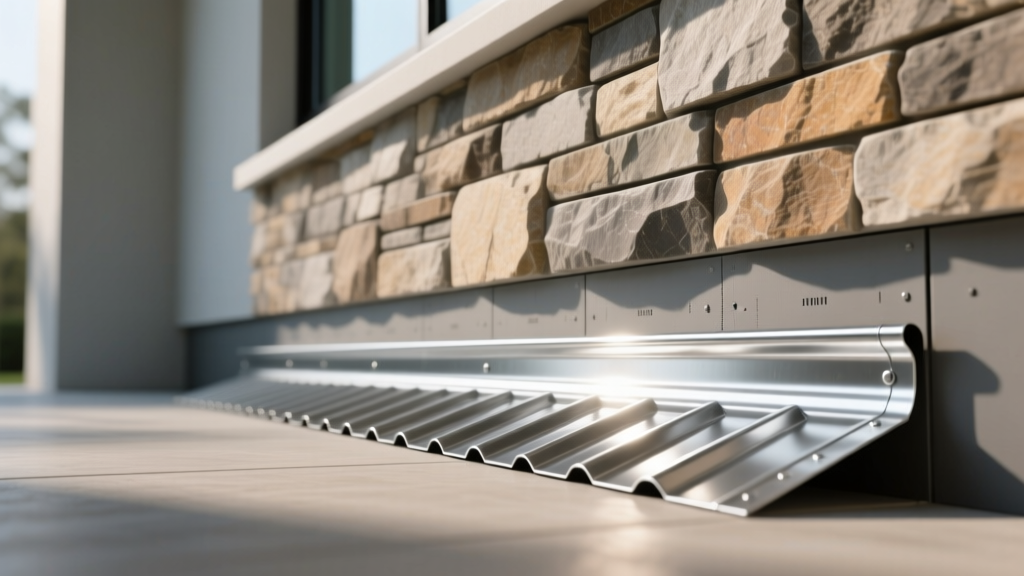
The flashing assembly for adhered manufactured stone veneer (AMSV) and natural stone requires multiple components: weep screeds at the base, Z-flashing at horizontal transitions, step flashing at roof intersections, and self-adhered membranes at fenestrations. Material costs in 2026 reflect recent adjustments in galvanized steel and copper commodities, alongside the widespread adoption of engineered PVC alternatives.
| Flashing Component | Material Specification | 2026 Cost (Per Linear Ft.) | Primary Application |
|---|---|---|---|
| Weep Screed | 26-Ga Galvanized Steel w/ Mesh | $2.15 - $3.40 | Base of wall, above foundation |
| Weep Screed | Extruded PVC w/ Fiberglass Mesh | $1.60 - $2.50 | Base of wall (corrosive environments) |
| Z-Flashing | 24-Ga Galvanized Steel | $2.80 - $4.10 | Horizontal transitions, band boards |
| Kick-Out Diverter | Pre-formed Copper / PVC Hybrid | $35.00 - $65.00 (Per Piece) | Roof-to-wall intersections |
| Flexible Membrane | Butyl Self-Adhered (e.g., Vycor) | $1.30 - $1.90 (Per Sq. Ft.) | Window/door rough openings |
| Step Flashing | 16oz Copper | $14.50 - $19.00 | Premium roof-to-wall integration |
Procurement Insight: While PVC weep screeds are cheaper upfront, galvanized steel offers superior rigidity during the lath and scratch-coat phases, reducing the labor time spent re-aligning bent tracks. However, in coastal zones with high salt spray, PVC or heavy-gauge copper is mandatory to prevent premature corrosion that could stain the stone facade.
Labor Rates and Installation Variables
Flashing installation is rarely billed as a standalone line item; it is typically absorbed into the water-proofing or masonry preparation labor. In 2026, specialized envelope technicians charge between $65 and $95 per hour, while general masonry laborers range from $45 to $60 per hour. The critical variable is the sequencing of the flashing integration with the WRB.
Complexity Multipliers in Labor
- Standard Linear Runs: Installing weep screed along a straight foundation costs roughly $3.50 to $5.00 per linear foot (LF) in labor. This assumes the WRB is already draped and the screed is being pinned with cap nails or staples at 6-inch intervals.
- Inside/Outside Corners: Cutting, folding, and overlapping flashing at corners adds $12 to $18 per corner. Pre-fabricated corner pieces cost $8 to $14 each but can reduce labor time by 50%.
- Roof-to-Wall Intersections: Integrating step flashing with the roofer and installing a kick-out diverter is highly complex. Expect labor costs of $120 to $185 per intersection due to the required coordination between trades and the precision needed to maintain the shingle-lap drainage plane.
⚠ The $25,000 Kick-Out Mistake
The most common and devastating failure in stone veneer installations is the omission or improper integration of the kick-out diverter at the bottom of a roof-to-wall intersection. According to Building Science Corporation, a missing kick-out allows concentrated roof runoff to bypass the WRB and funnel directly into the wall cavity. A $45 kick-out diverter and 30 minutes of labor prevents water intrusion that routinely causes $15,000 to $35,000 in OSB sheathing replacement and mold remediation.
Hidden Costs: Remediation vs. Prevention
To understand the ROI of premium flashing materials and meticulous labor, one must compare the upfront prevention costs against the forensic and reconstructive costs of a failure. When water infiltrates a stone veneer wall, the repair is not limited to swapping a piece of metal; it requires destructive testing, demolition of the masonry, and structural rebuilding.
| Project Phase | Proper Flashing (Prevention) | Failure Remediation (Per 100 Sq. Ft.) |
|---|---|---|
| Diagnostics & Invasive Testing | $0 | $800 - $1,500 |
| Demo & Stone Salvage | $0 | $1,200 - $2,500 |
| Sheathing & Framing Repair | $0 | $3,500 - $8,000 |
| WRB & Flashing Re-installation | $450 - $750 | $1,800 - $2,500 |
| Lath, Scratch Coat & Stone | Included in Masonry Bid | $4,000 - $7,500 |
| Total Estimated Cost | $450 - $750 | $11,300 - $22,000 |
Code Requirements and Specification Standards
Budgeting for stone veneer flashing must account for strict adherence to the International Residential Code (IRC) and industry standards. The Masonry Veneer Manufacturers Association (MVMA) provides the definitive installation guide for AMSV, which is frequently cited by building inspectors to verify compliance.
Key code-mandated specifications that impact material selection and cost include:
- Weep Screed Clearance: The IRC mandates a minimum 4-inch clearance between the weep screed and finished grade, or 2 inches above paved surfaces. This often requires custom-cutting the bottom row of stone or adjusting the foundation stem wall height, adding $2.00 to $4.00 per LF in masonry labor.
- Corrosion Resistance: Flashing must be corrosion-resistant. Galvanized steel must meet ASTM A653 (G90 coating minimum), and weep screeds must have a minimum thickness of 0.019 inches (26-gauge). Using cheaper, non-compliant 28-gauge material will result in failed inspections and mandatory tear-outs.
- WRB Integration: The WRB must lap over the weep screed's flange by a minimum of 2 inches. If the framing contractor installs the WRB too high, the mason must apply a secondary layer of building paper or self-adhered membrane to bridge the gap, adding $1.10 per LF in material and labor.
Strategic Procurement: Optimizing the Flashing Budget
General contractors and masonry subcontractors can optimize their 2026 flashing budgets without compromising envelope integrity by focusing on labor-saving material features.
First, specify weep screeds with factory-applied fiberglass mesh. While these cost roughly $0.40 more per linear foot than bare metal or PVC screeds, they eliminate the need for the mason to manually cut and fold the WRB or lath over the flange, saving approximately 12 to 15 minutes per 10-foot stick. On a 2,500-square-foot commercial facade, this easily offsets the material premium.
Second, utilize pre-formed, one-piece kick-out diverters rather than attempting to fold custom step-flashing on-site. Site-folded kick-outs are notorious for micro-tears and improper angles that fail to eject water clear of the cladding. A $45 engineered diverter guarantees the correct 45-degree ejection angle and integrates seamlessly with standard asphalt shingles and stone WRBs.
Finally, consolidate flashing and WRB procurement from a single specialized envelope distributor rather than sourcing metals from a roofing supplier and membranes from a lumber yard. Envelope specialists often provide system warranties that cover both the membrane and the flashing transitions, shifting the liability away from the installer and providing long-term financial protection against latent defects.
Written by
Sarah WhitfieldSarah Whitfield is a chartered quantity surveyor (MRICS) and construction cost analyst with 15 years of experience in material pricing, procurement strategy, and project budgeting. She earned her degree in Construction Management from the University of Reading (UK) and has worked on projects ranging from $2M custom homes to $180M mixed-use developments across North America and Europe. Sarah currently leads cost estimating for BuildMat Insight, maintaining a proprietary database of 4,000+ material price points updated quarterly. She is a frequent contributor to RSMeans cost data panels and has presented at the International Cost Engineering Council (ICEC) congress. Based in Denver, CO, Sarah is an avid trail runner and volunteer mentor for Women in Construction.
More from Sarah Whitfield
View all
Wood & Lumber
What Are the Different Types of Wood? A Builder's Guide
Compare structural softwoods, finish hardwoods, and engineered lumber. Analyze Janka ratings, MOE values, and 2026 pricing for construction.
Aug 4, 2026

Walls & Panels
Steel Framing vs Wood Framing: Corrosion and Moisture Defense
Compare steel framing vs wood framing for moisture resistance. Learn about galvanized coatings, condensation risks, and corrosion protection strategies.
Jul 21, 2026

Stone & Masonry
How to Cut Stone Veneer: Wet Saw vs Grinder Comparison
Compare the best tools for cutting stone veneer. We review wet saws, angle grinders, and chop saws to help you achieve clean, chip-free cuts.
Jul 21, 2026