Best Stone Veneer for Outside of House: 2026 Buyer Guide
Compare the best stone veneer for outside of house in 2026. Explore manufactured vs. natural options, moisture management, costs, and top brand profiles.
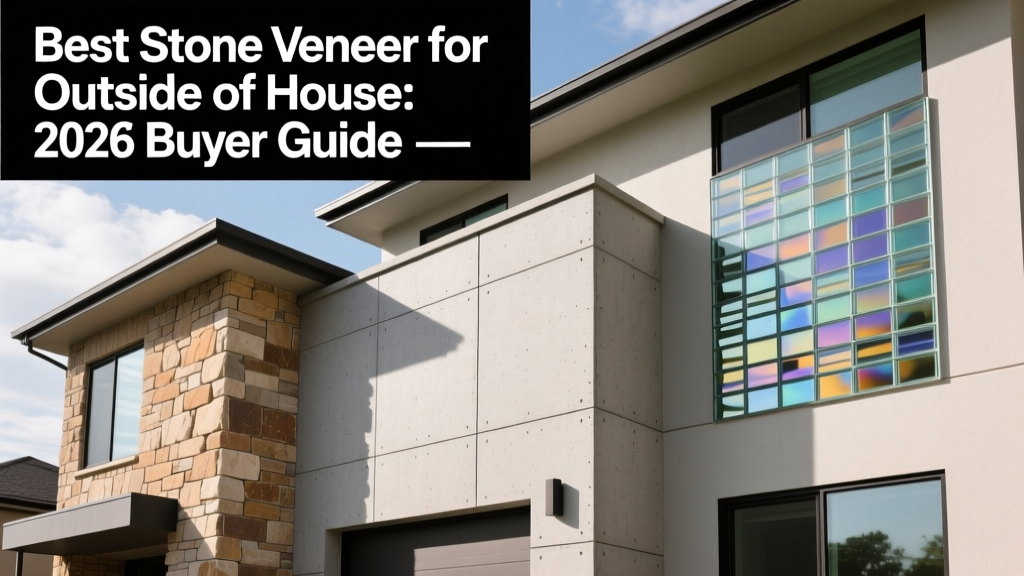
The Core Decision: Manufactured vs. Natural Exterior Stone
Selecting the right stone veneer for outside of house applications is one of the highest-ROI exterior upgrades available, routinely returning 90% or more of its cost in added home value. However, the market is split into two distinct categories: Manufactured Stone Veneer (MSV) and Natural Thin Stone Veneer. Understanding the structural and aesthetic differences between these materials is the first step in your buyer's journey.
| Feature | Manufactured Stone Veneer (MSV) | Natural Thin Stone Veneer |
|---|---|---|
| Composition | Portland cement, lightweight aggregates, iron oxide pigments | Quarried natural stone (granite, slate, limestone) sliced to 1-2 inches |
| Weight | 10 – 12 lbs per sq. ft. | 15 – 40 lbs per sq. ft. (varies by stone density) |
| Industry Standard | ASTM C1670 | ASTM C616 (Sandstone) / C568 (Limestone) |
| Color Consistency | Highly consistent; pigments are baked throughout | Variable; natural mineral veining and geological banding |
| Material Cost (2026) | $9.00 – $15.00 per sq. ft. | $16.00 – $35.00+ per sq. ft. |
For most residential exterior cladding projects in 2026, Manufactured Stone Veneer (MSV) is the default choice. It requires no additional structural footing reinforcement due to its lightweight nature, whereas heavier natural stones may require a structural engineer's assessment of your foundation's load-bearing capacity.
Critical Moisture Management: Where Exterior Installations Fail
The most common reason stone veneer fails on exterior walls is not the stone itself, but improper moisture management. Stone and mortar are reservoir claddings. They absorb rainwater and hold it. If that moisture cannot dry to the exterior or drain downward, it will rot your wood framing or cause freeze-thaw spalling in colder climates.
According to the Masonry Veneer Manufacturers Association (MVMA) and the International Residential Code (IRC), a corrosion-resistant weep screed must be installed at the base of all exterior stone veneer walls. Furthermore, the stone must maintain a 4-inch clearance above soil grade and a 2-inch clearance above paved surfaces (like concrete patios or driveways). Burying the bottom edge of stone veneer in mulch or soil guarantees moisture wicking, efflorescence, and premature failure.
Behind the stone and mortar scratch coat, your contractor must install a Weather-Resistive Barrier (WRB) such as Tyvek HomeWrap, followed by a drainage mat or a dimpled rainscreen membrane (like Keene DriWall). This creates a capillary break, allowing any water that penetrates the mortar to drain safely down and out through the weep screed. For a deeper understanding of how reservoir claddings interact with wall assemblies, the U.S. Department of Energy's guide on wall moisture control provides excellent building science fundamentals.
Top Stone Veneer Brands & Profiles for Exterior Use
The manufacturing landscape has consolidated in recent years. When sourcing materials, you will primarily be choosing between products manufactured by Oldcastle APG (CRH) and Westlake Royal Building Products. Here are the top-tier brands and their best-selling exterior profiles for 2026.
1. Eldorado Stone (Oldcastle APG)
Eldorado is widely considered the premium benchmark in the MSV industry. Their molds are taken directly from natural outcroppings, resulting in unparalleled textural realism.
- Top Exterior Profile: Cliffstone. A rectangular, dry-stack profile that mimics weathered sedimentary rock. It pairs exceptionally well with modern farmhouse and contemporary architectural styles.
- Best Application: Full-house exterior cladding and prominent front-facing gables.
- Warranty: 50-year limited warranty on structural integrity and fade resistance.
2. Cultured Stone (Westlake Royal Stone Solutions)
Following Westlake Royal's acquisition of Boral's stone division, Cultured Stone has expanded its distribution network significantly. They are famous for their deep, shadow-casting profiles.
- Top Exterior Profile: Dressed Fieldstone. Features large, rounded, and heavily textured stones that provide a rustic, old-world masonry look.
- Best Application: Traditional estates, craftsman-style wainscoting, and exterior chimney chases.
3. Coronado Stone (Westlake Royal Stone Solutions)
Coronado offers a slightly more budget-friendly entry point while maintaining strict ASTM C1670 compliance.
- Top Exterior Profile: Thin Brick. While technically a clay/concrete hybrid, their manufactured brick veneers are incredibly popular for exterior accent walls and modern urban infill homes.
Never use standard Type N mortar for exterior stone veneer. You must specify Type S mortar or a polymer-modified veneer setting mortar (such as PROSOCO's SureKlean or Custom Building Products' ProLite). Type S offers higher tensile strength to withstand exterior wind loads and thermal expansion/contraction cycles.
Cost Breakdown: What You Will Actually Pay in 2026
Budgeting for exterior stone requires looking beyond the price of the stone itself. The preparation, lath, scratch coat, and skilled masonry labor make up the bulk of the expense. Below is a realistic cost matrix for a standard 500 sq. ft. exterior wainscoting project.
| Cost Component | Material/Labor Details | Estimated Cost per Sq. Ft. |
|---|---|---|
| Stone Veneer Material | Mid-tier Manufactured Stone (e.g., Cultured Stone) | $11.00 - $14.00 |
| Prep & Substrate | WRB, weep screed, 2.5 lb galvanized metal lath, corrosion-resistant fasteners | $2.50 - $4.00 |
| Mortar & Scratch Coat | Type S mortar, polymer-modified setting mix, jointing bags | $1.50 - $2.50 |
| Masonry Labor | Professional installation (lath, scratch, setting, pointing) | $12.00 - $22.00 |
| Total Installed Cost | Turnkey exterior application | $27.00 - $42.50 |
Note: If your exterior requires scaffolding for second-story gables, add an additional $3.00 to $5.00 per square foot for equipment rental and setup.
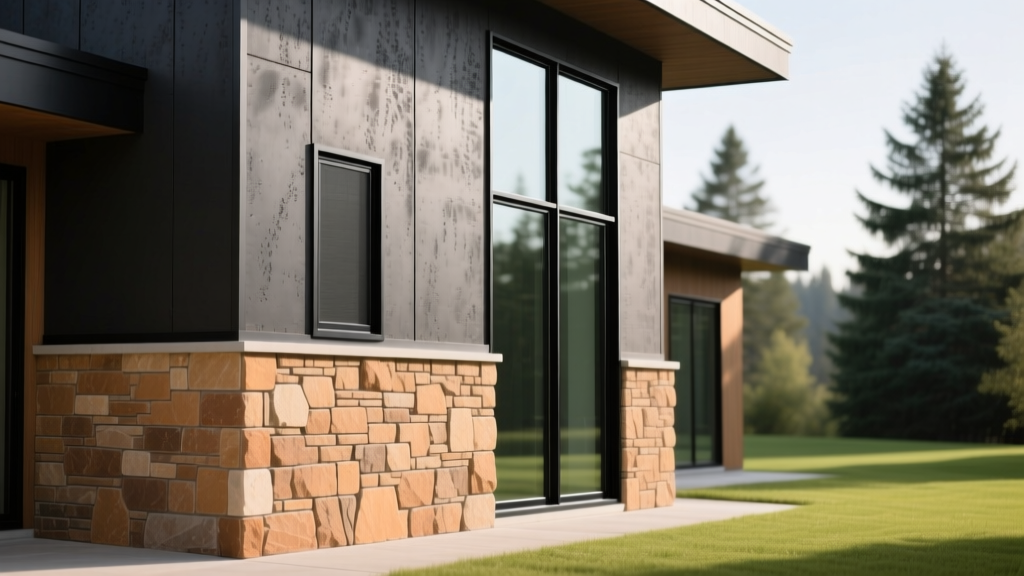
The Buyer's Verification Checklist
Before signing a contract with a masonry contractor, ensure their proposal explicitly includes the following specifications. If they omit these, they are cutting corners that will lead to moisture intrusion.
- WRB Specification: Does the quote include a code-approved Weather-Resistive Barrier (e.g., Tyvek CommercialWrap or equivalent)?
- Drainage Plane: Are they installing a rainscreen mat or furring strips to allow water to drain behind the mortar scratch coat?
- Lath Weight: Verify they are using minimum 2.5 lb self-furring galvanized metal lath, attached directly to the wall studs (not just the OSB sheathing) with corrosion-resistant nails or staples.
- Weep Screed & Clearances: Confirm the 4-inch soil clearance and 2-inch hardscape clearance are detailed in the scope of work.
- Sealing (Optional but Recommended): Will they apply a breathable, silane/siloxane penetrating sealer after the mortar has fully cured (usually 28 days)? This prevents efflorescence (white salt deposits) without trapping moisture inside the stone.
Frequently Asked Questions
Can I install stone veneer over existing exterior brick?
Yes, but not directly. Existing brick must be cleaned, and a metal lath must be mechanically fastened through the brick into the structural framing behind it using masonry anchors. A scratch coat of mortar is then applied over the lath before setting the veneer. Alternatively, you can install pressure-treated furring strips over the brick, attach cement backer board, and then apply the stone.
Does exterior stone veneer require a brick ledge?
No. Unlike full-thickness natural masonry (which weighs 40+ lbs per sq. ft. and requires a structural brick ledge on the concrete foundation), manufactured stone veneer is an adhered cladding. It is supported entirely by the wall sheathing and the structural framing, provided the metal lath is properly fastened to the studs.
How do I clean exterior stone veneer?
Never use a high-pressure power washer, as it can erode the mortar joints and force water behind the cladding. Use a soft-bristle brush, mild dish soap, and a garden hose. For stubborn organic stains or mildew, a diluted solution of white vinegar and water is safe for most manufactured stones, but always test in an inconspicuous area first.
Written by
Sarah WhitfieldSarah Whitfield is a chartered quantity surveyor (MRICS) and construction cost analyst with 15 years of experience in material pricing, procurement strategy, and project budgeting. She earned her degree in Construction Management from the University of Reading (UK) and has worked on projects ranging from $2M custom homes to $180M mixed-use developments across North America and Europe. Sarah currently leads cost estimating for BuildMat Insight, maintaining a proprietary database of 4,000+ material price points updated quarterly. She is a frequent contributor to RSMeans cost data panels and has presented at the International Cost Engineering Council (ICEC) congress. Based in Denver, CO, Sarah is an avid trail runner and volunteer mentor for Women in Construction.
More from Sarah Whitfield
View all
Wood & Lumber
What Are the Different Types of Wood? A Builder's Guide
Compare structural softwoods, finish hardwoods, and engineered lumber. Analyze Janka ratings, MOE values, and 2026 pricing for construction.
Aug 4, 2026

Walls & Panels
Steel Framing vs Wood Framing: Corrosion and Moisture Defense
Compare steel framing vs wood framing for moisture resistance. Learn about galvanized coatings, condensation risks, and corrosion protection strategies.
Jul 21, 2026

Stone & Masonry
How to Cut Stone Veneer: Wet Saw vs Grinder Comparison
Compare the best tools for cutting stone veneer. We review wet saws, angle grinders, and chop saws to help you achieve clean, chip-free cuts.
Jul 21, 2026