Travertine Flooring Taxonomy: Grades, Finishes, and Selection Guide
Master the travertine flooring taxonomy. Compare grades, finishes, and cuts to select the perfect natural stone for your interior or exterior project.
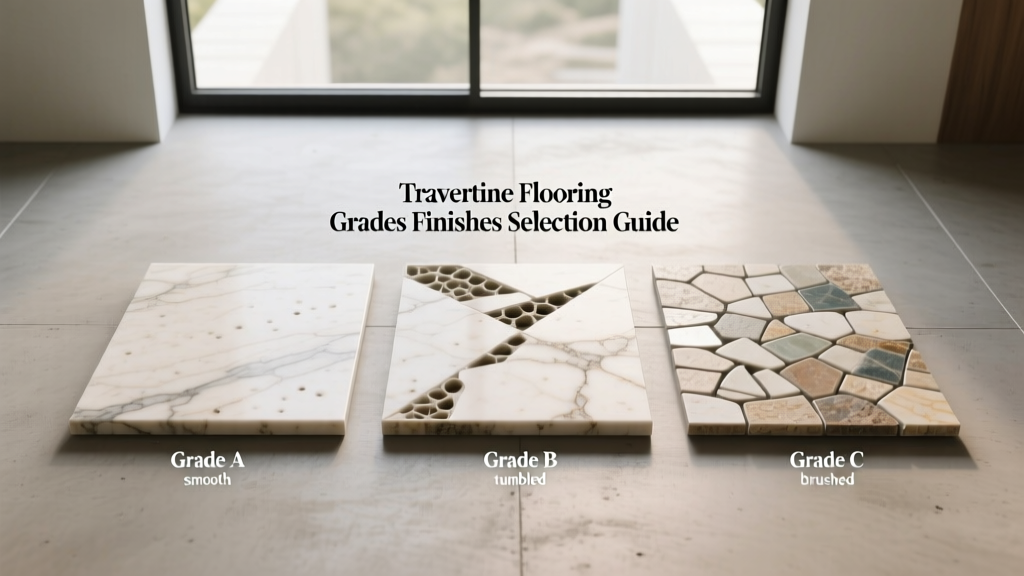
Understanding the Geological Taxonomy of Travertine
Travertine is a terrestrial sedimentary rock formed by the rapid precipitation of calcium carbonate (CaCO3), typically at the mouth of geothermal hot springs or within limestone caves. Unlike marble, which undergoes metamorphic recrystallization, travertine retains a highly porous, fibrous structure characterized by natural voids and pitting. This inherent porosity dictates every aspect of its manufacturing, grading, and installation as a flooring material. When selecting travertine flooring, understanding this geological baseline is critical; the stone is naturally reactive to acidic compounds and requires specific structural support to prevent cracking under load.
The Three Commercial Grades of Travertine Flooring
The natural stone industry categorizes travertine into three primary commercial grades based on visual consistency, structural integrity, and the volume of voids requiring factory filling. The type of filler used—ranging from basic cementitious grouts to advanced UV-cured epoxies—heavily influences the floor's long-term durability and stain resistance.
| Grade Classification | Visual & Structural Characteristics | Factory Filler Type | Best Application |
|---|---|---|---|
| Premium (First) | Uniform color, minimal voids, tight grain structure. No structural fissures. | Color-matched epoxy or high-grade polyester resin. | High-traffic interior floors, luxury residential, commercial lobbies. |
| Standard (Second) | Moderate color variation, larger natural voids, occasional minor fissures. | Cementitious fillers or standard resins; may require on-site re-filling. | Moderate-traffic residential areas, feature walls, low-traffic bathrooms. |
| Commercial (Third) | High color variation, large voids, open pits, potential structural weaknesses. | Basic cement fillers; often sold unfilled for on-site grouting. | Exterior paving (unfilled), rustic aesthetic projects, budget installations. |
Finish and Cut Variations: How They Dictate Performance
The surface finish and the angle at which the block is sliced from the quarry fundamentally alter the stone's slip resistance, maintenance requirements, and aesthetic profile. According to guidelines published by the Natural Stone Institute, finish selection must align with the expected moisture levels and traffic type of the environment.
Surface Finishes
- Honed and Filled: The industry standard for interior travertine flooring. The surface is ground smooth (honed) and natural voids are filled at the factory. It offers a matte appearance and, when properly textured, can meet the ANSI A326.3 standard for wet areas requiring a Dynamic Coefficient of Friction (DCOF) of ≥0.42.
- Tumbled: Tiles are mechanically tumbled to round the edges and distress the surface, yielding a rustic, antiqued look. Tumbled travertine is rarely factory-filled, meaning the installer must grout the voids on-site. It provides excellent slip resistance but traps dirt easily.
- Brushed and Chiseled: Wire brushes remove the softer calcite layers, leaving a highly textured, three-dimensional surface. The edges are hand-chiseled. This finish is exceptionally slip-resistant but entirely unsuitable for barefoot traffic or areas requiring frequent mopping.
- Polished: Ground to a high-gloss, mirror-like shine. Polishing closes the micro-pores, making it highly stain-resistant, but it drastically reduces slip resistance (DCOF often drops below 0.30). It is strictly recommended for dry, low-traffic formal areas.
The Cutting Matrix: Vein-Cut vs. Cross-Cut
How the stone is sliced from the quarry block changes the visual taxonomy entirely:
- Cross-Cut (Default): Slicing parallel to the natural bed of the stone. This reveals the circular, floral patterns of the geothermal sedimentation. It is the traditional, most common appearance for travertine flooring.
- Vein-Cut: Slicing perpendicular to the natural bed (against the grain). This exposes the linear, parallel veining of the stone, mimicking the look of wood grain or linear slate. Vein-cut travertine is structurally slightly more prone to delamination along the bedding planes if subjected to heavy point loads, requiring stricter subfloor deflection limits.
The Selection Matrix: Matching Travertine to Your Environment
Selecting the correct travertine flooring requires balancing aesthetic desires with physical limitations. Use this decision framework to specify the right material for your project.
| Environment | Recommended Grade & Finish | Critical Specification Requirement |
|---|---|---|
| Kitchens (High Traffic, Acid Spills) | Premium, Honed & Filled (Epoxy) | Must be sealed with an impregnating fluoropolymer sealer to resist etching from citrus and vinegar. |
| Bathrooms (Wet, Barefoot) | Premium or Standard, Honed (DCOF ≥0.42) | Avoid polished finishes. Ensure voids are completely filled to prevent water ingress and mold growth. |
| Exterior Patios (Freeze-Thaw Climates) | Commercial or Standard, Tumbled (Unfilled) | Must be installed on a fully sloped, permeable mortar bed. Do not use in climates with severe freeze-thaw cycles without verifying absorption rates (<3%). |
| Living Areas (Dry, Formal) | Premium, Polished or Honed | Use large-format tiles (e.g., 24x24) with minimal grout joints for a seamless, monolithic appearance. |
Real-World Cost Breakdown and Installation Tolerances
Budgeting for travertine flooring extends far beyond the per-square-foot cost of the stone. Natural stone requires specialized setting materials and rigorous subfloor preparation. As of 2026, expect the following cost parameters for a professional installation:
- Material Costs: Commercial grade ($3.00 - $5.50/sq ft); Standard grade ($6.00 - $9.00/sq ft); Premium grade ($10.00 - $18.00+/sq ft).
- Setting Materials: High-performance modified thinset (ANSI A118.15 compliant), crack isolation membrane, and premium grout add approximately $2.50 - $4.00/sq ft.
- Labor and Preparation: Subfloor leveling, membrane installation, and stone setting typically range from $9.00 to $16.00/sq ft, depending on regional labor rates and tile format.
- Sealing and Maintenance: Professional pre-grout and post-install sealing adds $1.50 - $3.00/sq ft.
Critical Subfloor and Deflection Requirements
The most common cause of travertine flooring failure is cracked tiles due to subfloor deflection. While standard ceramic tile requires a subfloor deflection limit of L/360, natural stone demands a much stiffer structure. The Tile Council of North America (TCNA) mandates a maximum deflection of L/720 for natural stone installations. This often requires sistering floor joists, adding a second layer of exterior-grade plywood, and applying a decoupling or crack-isolation membrane (such as Schluter-DITRA or a liquid-applied elastomeric membrane) before setting the stone.
Common Failure Modes and Preventative Specifications
Travertine is unforgiving of installation errors and poor maintenance. Anticipate these failure modes and specify preventative measures in your project documentation:
Etching and Chemical Burn: Travertine is highly alkaline. Contact with acidic substances (wine, coffee, pet urine, standard bathroom cleaners) causes a chemical reaction that dissolves the calcium carbonate, leaving dull, rough spots known as etches. Prevention: Specify a high-quality impregnating sealer (which slows liquid absorption) and educate the end-user on using only pH-neutral stone cleaners. Note that sealers do not make the stone acid-proof; they only buy time for cleanup.
- Efflorescence: A white, powdery salt deposit on the surface caused by moisture migrating through the stone from the substrate. Prevention: Ensure the concrete slab has a moisture vapor emission rate (MVER) of less than 3 lbs per 1,000 sq ft per 24 hours (ASTM F1869) before installation. Use a vapor-retarding membrane if levels are higher.
- Filler Pop-Out: Factory fillers dislodging under rolling loads or foot traffic. Prevention: Specify epoxy-filled Premium grade stone. If using cement-filled Standard grade, plan for a maintenance cycle to re-fill voids with a color-matched epoxy grout every 3 to 5 years.
- Lippage: Uneven tile edges caused by warped stone or poor leveling. Prevention: Travertine is naturally prone to warping. Installers must use a mechanical lippage control system (wedge and clip system) and back-butter every tile with thinset to ensure 100% mortar coverage, which is mandatory for natural stone to prevent hollow spots and cracking.
Sealing and Maintenance Protocols
To preserve the structural and aesthetic integrity of travertine flooring, a strict maintenance protocol is required. Upon installation, the stone should be treated with a penetrating, breathable sealer (such as a siloxane or fluoropolymer base) that repels water and oil-based stains without altering the stone's natural vapor transmission. Avoid topical acrylic sealers, which trap moisture within the stone and lead to spalling and efflorescence. For daily maintenance, utilize microfiber dust mops and pH-neutral cleaners specifically formulated for calcareous stones. Never use vinegar, ammonia, or generic abrasive scrubbing pads, as these will permanently degrade the honed or polished surface.