Veneer Stone Fire Pit Guide: Materials, Heat Ratings & Costs
Build a durable veneer stone fire pit with our complete material guide. Compare natural vs. manufactured stone, heat-rated mortars, and 2026 costs.
The Core Challenge: Thermal Expansion and Veneer Adhesion
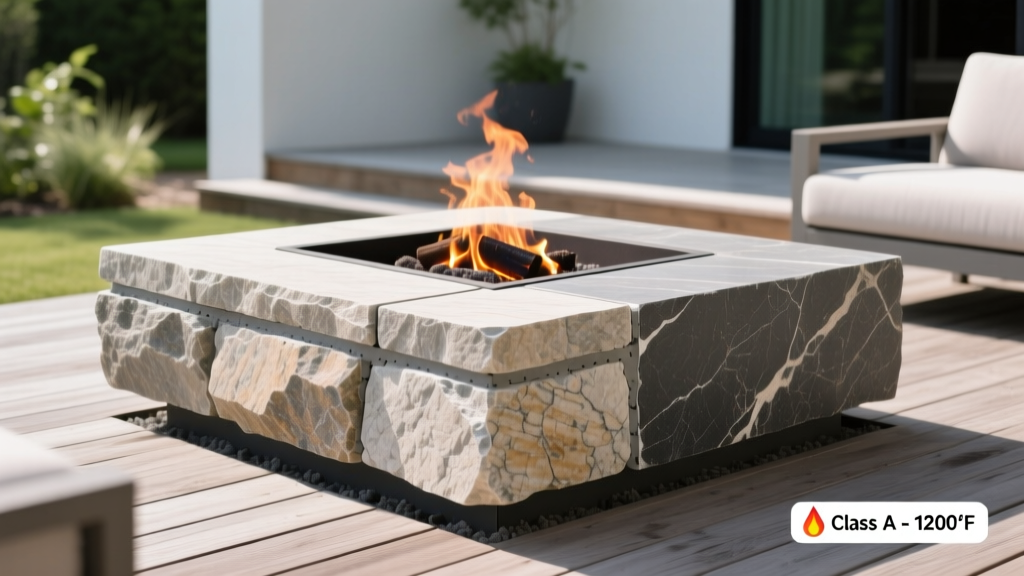
Designing a veneer stone fire pit requires navigating a fundamental conflict in material science: thermal expansion mismatch. When a fire burns, the internal steel fire ring or masonry core expands rapidly. If the exterior stone veneer is rigidly tied to this core without accommodating movement, the resulting shear stress will crack the mortar joints and delaminate the stone. Standard exterior wall installations do not face these extreme thermal gradients, making fire pit construction a specialized subset of masonry veneer work.
Natural vs. Manufactured Veneer: Material Matrix
Choosing between natural and manufactured stone veneer (MSV) dictates the structural load of your fire pit base and the long-term durability of the finish. While both offer aesthetic appeal, their physical properties behave very differently under cyclic heating and cooling.
| Property | Natural Stone Veneer | Manufactured Stone Veneer (MSV) |
|---|---|---|
| Weight | 25 - 40 lbs / sq. ft. | 8 - 12 lbs / sq. ft. |
| Heat Tolerance | Varies wildly by geology | Consistent (Portland cement base) |
| Thickness | 0.75" - 2.5" | 0.5" - 1.5" |
| Material Cost (2026) | $15.00 - $28.00 / sq. ft. | $8.00 - $14.00 / sq. ft. |
| Best Profile for Pits | Tight-fit mosaic or ashlar | Ledgestone or dry-stack |
The Sedimentary Rock Hazard
If you opt for natural stone, you must strictly avoid sedimentary rocks like sandstone, limestone, and certain porous slates. These stones contain microscopic pore networks that trap ambient moisture. When exposed to the radiant heat of a fire pit, this trapped water flashes into steam. Because the stone's permeability is too low to allow rapid vapor escape, internal pressure builds until the stone literally explodes or spalls off the wall. Igneous rocks like basalt and granite, or high-density metamorphic quartzite, are the only natural stones safe for direct proximity to fire pit heat zones.
The Mortar Matrix: Specifying for High-Heat Environments
Standard Type N or Type S masonry mortar begins to degrade and lose adhesion when subjected to sustained temperatures exceeding 300°F. For a veneer stone fire pit, your mortar specification must be zoned based on proximity to the flame.
- Zone 1: The Firebox Core (Direct Flame Contact)
Use a calcium aluminate-based refractory mortar. Products like Rutland Premium Firebrick Mortar withstand temperatures up to 2,000°F. This is used exclusively for setting the interior firebrick or lining the immediate core. - Zone 2: The Veneer Face (Radiant Heat Only)
If a proper 2-inch air gap and steel ring separate the fire from the veneer, a high-quality polymer-modified Type S mortar is sufficient. The polymer additives (like those found in SPEC MIX Polymer Modified Mortar) provide superior flexural strength, allowing the mortar joint to absorb minor thermal expansion without micro-cracking. - Zone 3: The Capstone or Ledge
The horizontal capstone absorbs massive radiant heat rising from the pit. Use a high-heat silicone or specialized masonry adhesive rated for 500°F+ to set the capstone, ensuring it does not debond during peak burn cycles.
For comprehensive installation parameters on manufactured profiles, always cross-reference the manufacturer's current technical data sheets, such as the Cultured Stone installation guidelines, which outline specific scratch coat and curing requirements for exterior thermal applications.
Substrate Engineering: Framing the Core
The longevity of your veneer stone fire pit relies entirely on the rigidity of the substrate. Wood framing is strictly prohibited due to fire code violations and rot susceptibility. Follow this engineered sequence for the core structure:
- Base Foundation: Pour a reinforced concrete footing extending 12 inches below the local frost line. A 4-foot diameter pit requires a minimum 6-inch thick footing with #4 rebar grid.
- Core Block: Build the inner cylinder using solid concrete masonry units (CMU) or a heavy-gauge steel fire ring (minimum 10-gauge carbon steel). If using CMU, parge the interior with a 1/2-inch layer of refractory cement to protect the blocks from thermal spalling.
- Veneer Substrate: Wrap the exterior of the CMU core with a water-resistive barrier (WRB), followed by 2.5 lb galvanized diamond mesh metal lath. Secure the lath with concrete tapcon screws every 6 inches.
- Scratch Coat: Apply a 1/2-inch scratch coat of Type S mortar. Scarify the surface horizontally with a coarse rake to create a mechanical key for the veneer mortar. Allow 24 hours to cure before setting stone.
2026 Cost Breakdown: Budgeting Your Veneer Stone Fire Pit
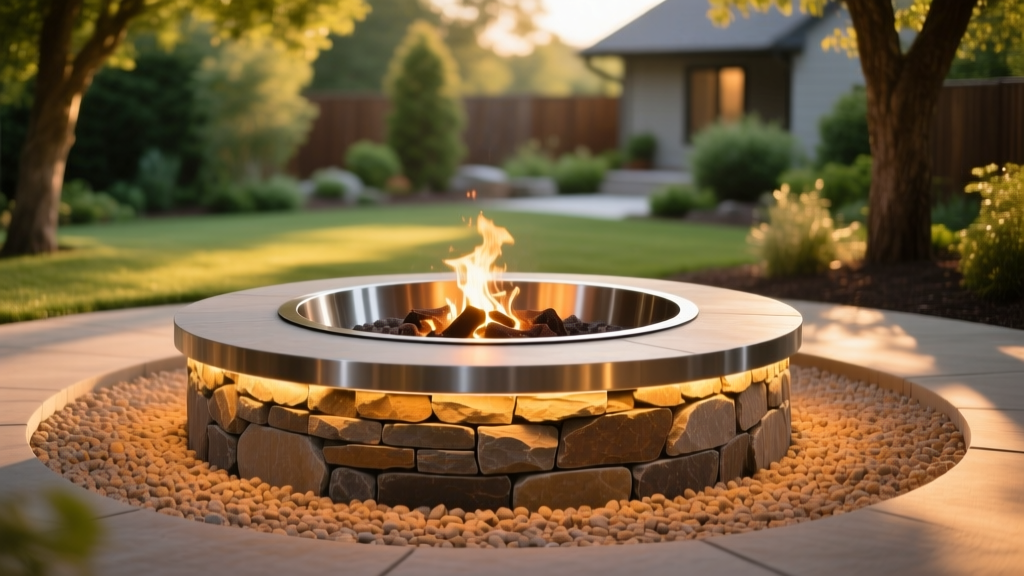
Pricing for masonry materials has stabilized following the supply chain disruptions of the early 2020s, but specialized high-heat mortars and engineered steel rings carry a premium. Below is a realistic cost matrix for a standard 4-foot outer diameter, 24-inch tall circular fire pit (approximately 32 square feet of veneer surface area).
| Component | Economy Tier (DIY / Basic) | Premium Tier (Pro / High-End) |
|---|---|---|
| Concrete Footing & CMU Core | $250 - $350 | $450 - $600 |
| Steel Fire Ring Insert | $120 (Standard 10-ga) | $350 (Corten steel, custom) |
| Stone Veneer Material | $280 (Basic MSV) | $800 (Natural Basalt/Granite) |
| Mortar, Lath, & Fasteners | $90 | $180 (Refractory + Polymer) |
| Professional Labor (if hired) | $0 (DIY) | $800 - $1,200 |
| Total Estimated Cost | $740 - $840 | $2,580 - $3,130 |
Code Compliance and Safety Clearances
Fire pit construction is governed by local municipal fire codes and broad standards set by organizations like the National Fire Protection Association. While veneer stone itself is non-combustible, the clearances around the pit and the internal drafting mechanics are heavily regulated.
'Outdoor fireplaces and fire pits must maintain a minimum clearance of 10 feet to any combustible structure, including wooden decks, overhanging branches, and vinyl siding. The use of combustible framing within the fire pit core assembly is a direct violation of NFPA 211 standards for solid fuel-burning appliances.'
— Adapted from NFPA 211 Code Parameters
Furthermore, if your fire pit includes a chimney or smoke stack, the interior flue must be lined with a UL-listed stainless steel or pumice liner. Never vent a wood-burning fire pit directly against unlined CMU or veneer substrates, as creosote buildup can ignite and transfer heat to the exterior veneer, causing catastrophic failure.
Common Failure Modes and Prevention
Even with premium materials, veneer stone fire pits frequently fail within the first three years if specific environmental factors are ignored. Diagnose and prevent these common issues:
- Efflorescence Blooming: White, powdery salt deposits on the stone face. This occurs when water enters the top of the pit, dissolves soluble salts in the Portland cement mortar, and exits through the veneer face. Prevention: Install a sloped, impermeable capstone with a drip edge, and use a low-alkali mortar mix.
- Base Delamination: The bottom course of stone detaches. This is caused by ground moisture wicking up into the masonry core and freezing. Prevention: Flash the base of the veneer with a weep screed and maintain a 4-inch gap between the finished grade and the bottom of the stone veneer.
- Thermal Spalling on Capstones: The top ledge cracks horizontally. Prevention: Never use poured concrete or thin limestone for the cap. Specify a minimum 2-inch thick high-density granite or bluestone slab, set on a flexible, high-heat silicone bed to allow for expansion.
For deeper technical specifications on masonry clearances and firebox drafting ratios, consult the Brick Industry Association Technical Notes, which provide exhaustive engineering tables for solid masonry fire structures that apply directly to veneer-clad fire pit cores.
Written by
Marcus ChenMarcus Chen is a licensed structural engineer (PE) and building materials analyst with over 12 years of experience across residential, commercial, and industrial construction. He holds a Master of Science in Civil Engineering from UC Berkeley and spent six years at Thornton Tomasetti before transitioning to independent consulting and technical writing. Marcus specializes in material selection for seismic-prone regions, concrete reinforcement strategies, and lifecycle cost analysis. His work has been cited by the American Concrete Institute (ACI) and the Structural Engineers Association of California (SEAOC). When he is not on a job site or at his desk, you will find him hiking the Sierra Nevada or restoring a 1920s craftsman bungalow in Oakland, CA.
More from Marcus Chen
View all
Construction Cost
How Much Did the Eiffel Tower Cost to Build?
How much did the Eiffel Tower cost to build in 1889? We adjust for inflation and compare its budget to modern skyscraper construction.
Aug 4, 2026

Fire Resistance
What Is a Fire Resistant Material? Testing & Certification Guide
Discover what is a fire resistant material through ASTM and UL testing. Learn how fire ratings, certifications, and assemblies work in construction.
Aug 4, 2026

Construction Cost
How Much Did the Burj Khalifa Cost to Build?
How much did the Burj Khalifa cost to build? We break down the $1.5B project and extract 5 money-saving strategies for your next build.
Jul 30, 2026