Veneer Stone Installation: Mortar vs Mortarless Systems Compared
Compare traditional mortar and mortarless veneer stone installation methods. Discover costs, failure modes, and the best system for your project.
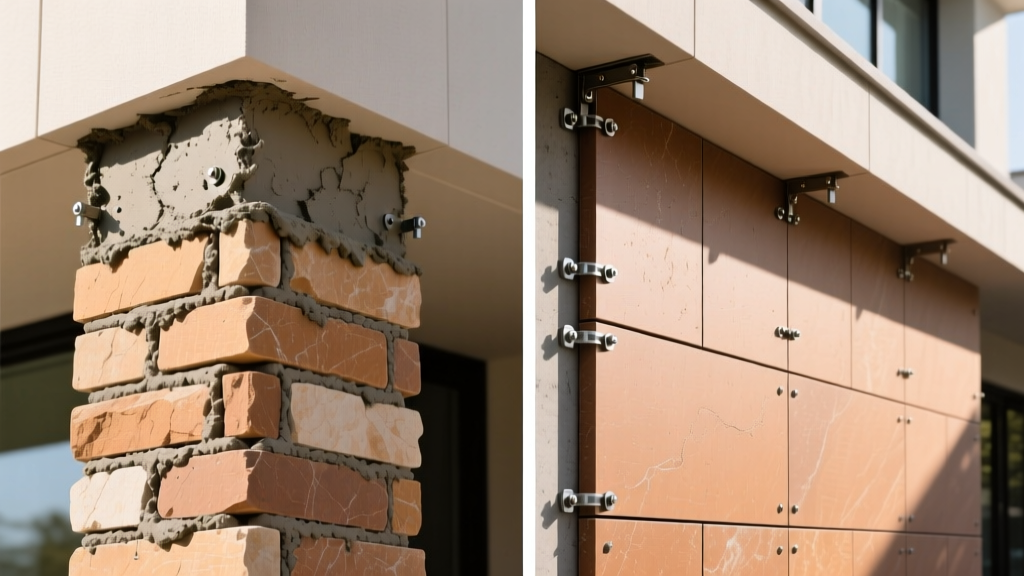
The Core Contenders: Traditional Mortar vs. Mortarless Systems
Selecting the right veneer stone installation method dictates not only the aesthetic outcome of your project but also the structural longevity, moisture management, and total budget. The industry currently divides into two primary paradigms: traditional mortar-set manufactured stone veneer (MSV) and modern mortarless interlocking or direct-fasten panel systems. While traditional MSV relies on a cementitious bond and metal lath, mortarless systems utilize high-density polymers or polyurethane (PU) foam that fasten directly to the substrate. Understanding the mechanical and chemical differences between these two approaches is critical for architects, contractors, and advanced DIYers.
Technical Specifications & Substrate Requirements
Before evaluating the installation workflows, it is necessary to compare the physical properties of the materials. The weight and thickness of the veneer directly impact the required substrate preparation and structural load limits.
| Specification | Traditional Mortar MSV | Mortarless Polymer (e.g., Evolve Stone) | Mortarless PU Foam (e.g., GenStone) |
|---|---|---|---|
| Average Weight | 10 – 15 lbs / sq. ft. | 3 – 4 lbs / sq. ft. | 1.5 – 2.5 lbs / sq. ft. |
| Profile Thickness | 1.5 – 3.0 inches | 0.75 – 1.25 inches | 1.0 – 2.0 inches |
| R-Value (Insulation) | ~0.10 (Negligible) | ~0.20 (Minimal) | ~3.5 – 5.0 (Significant) |
| Mandatory Substrate | OSB/Plywood + WRB + Metal Lath + Scratch Coat | OSB/Plywood + WRB (Direct Nail) | OSB/Plywood + WRB (Direct Screw) |
| Required Clearance to Grade | 4 inches minimum (8 inches for soil) | 2 inches minimum | 2 inches minimum |
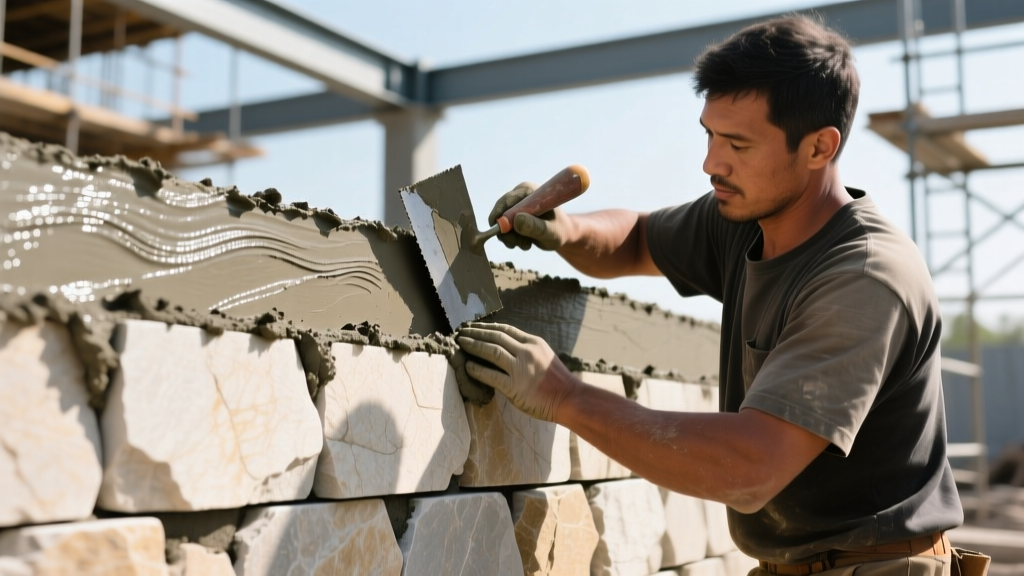
Traditional Mortar Veneer Stone Installation
The Workflow and Timing
Traditional MSV installation is a multi-day, labor-intensive process governed by strict masonry standards. The workflow begins with the application of a Weather-Resistive Barrier (WRB), typically two layers of Grade D building paper or a fluid-applied membrane. Next, 2.5 lb self-furring galvanized metal lath is fastened to the wall studs using corrosion-resistant nails or staples, penetrating the studs by at least 1/4 inch.
Following the lath, a 1/2-inch to 3/4-inch Portland cement scratch coat is applied and scored horizontally to provide a mechanical key. This scratch coat requires 24 to 48 hours of curing time. Only after curing can the mason apply the setting mortar (typically Type S or Type N) to the back of each individual stone and press it into the scratch coat, maintaining a 1/2-inch to 1-inch joint for grouting. A standard two-person masonry crew will install approximately 100 to 150 square feet per day, excluding prep and curing time.
Critical Failure Mode: Weep Screed Omission. According to the National Veneer Masonry Association (NVMA), failing to install a corrosion-resistant weep screed at the base of the wall is the leading cause of MSV failure. The screed must feature a minimum 3.5-inch vertical flange and be installed at least 4 inches above grade to allow trapped moisture to escape, preventing freeze-thaw spalling and wood rot.
Common Failure Modes: Efflorescence and Spalling
Mortar-based systems are highly susceptible to moisture-related degradation if the drainage plane is compromised. Efflorescence—the white, powdery salt deposit on the stone surface—occurs when water migrates through the cementitious matrix, dissolving soluble salts and depositing them on the surface upon evaporation. While primarily cosmetic, severe efflorescence indicates chronic water intrusion. More destructive is freeze-thaw spalling, where unsealed or improperly mixed mortar absorbs water, freezes, and expands, causing the stone face to shear off.
Mortarless and Interlocking Panel Systems
The Workflow and Timing
Mortarless systems have disrupted the market by eliminating the need for metal lath, scratch coats, and specialized masonry labor. High-density polymer systems, such as Evolve Stone, utilize finish nails or cap nails driven directly through the stone profile into the structural sheathing. Polyurethane (PU) foam panels, like GenStone, employ a shiplap or interlocking edge design and are secured with exterior-grade screws.
The installation workflow is remarkably streamlined. After applying the WRB, installers snap chalk lines to ensure level starter tracks. Panels are fastened sequentially from the bottom up, with interlocking seams hiding the fastener heads of the preceding row. Because there is no curing time, a two-person crew can realistically install 300 to 500 square feet in a single day. The official Evolve Stone installation guidelines emphasize that while the material is lightweight, fastener placement must strictly adhere to the manufacturer's wind-load matrices, especially in high-velocity hurricane zones (HVHZ).
Common Failure Modes: Thermal Expansion and UV Degradation
While mortarless systems bypass moisture-trapping mortar joints, they introduce new vulnerabilities related to material science. Polyurethane foam panels are subject to significant thermal expansion and contraction. If installers fail to leave the manufacturer-specified 1/8-inch expansion gaps at the ends of panels and at corner transitions, the panels will buckle and warp during peak summer temperatures. Furthermore, early-generation PU foams suffered from UV degradation, leading to chalking and color fading. Modern 2026 iterations utilize advanced acrylic and polyurea topcoats to mitigate this, but cheap, unbranded imports remain highly susceptible to solar degradation.
Moisture Management: Where Both Methods Diverge
The most critical distinction between the two systems lies in how they manage bulk water. Traditional MSV is a 'face-sealed' or 'mass-wall' system. It relies on the thickness and density of the mortar and stone to absorb and slowly release moisture. Consequently, it requires a robust, ventilated air gap or a highly effective WRB behind the lath to protect the sheathing.
Conversely, mortarless polymer systems act more like traditional siding (e.g., vinyl or fiber cement). They are designed to shed water immediately off the face. However, because they sit flush against the WRB without a furring strip air gap, any bulk water that bypasses the interlocking seams is trapped directly against the weather barrier. As noted in Building Science Corporation's research on water management, when installing flush-mount claddings over wood-frame construction, utilizing a drainage mat or furring strips to create a capillary break and ventilation channel is a best practice that elevates the assembly from a simple water-resistive barrier to a fully drained and back-ventilated rainscreen.
2026 Cost Breakdown: Material, Labor, and Total ROI
The financial calculus of veneer stone installation heavily favors mortarless systems when factoring in total project costs, despite the higher per-square-foot material price of premium polymers.
| Cost Factor (Per Sq. Ft.) | Traditional Mortar MSV | Mortarless Polymer / PU |
|---|---|---|
| Material Cost | $6.00 – $12.00 | $10.00 – $16.00 |
| Prep Materials (Lath, Mortar, Screed) | $3.50 – $5.00 | $0.50 – $1.00 (Fasteners only) |
| Professional Labor | $14.00 – $22.00 | $4.00 – $8.00 |
| Total Installed Cost | $23.50 – $39.00 | $14.50 – $25.00 |
| DIY Viability | Low (Requires masonry skills) | High (Basic carpentry skills) |
Decision Framework: Which Installation Method Wins?
There is no universally superior method; the optimal choice depends on your project parameters, substrate conditions, and labor availability.
- Choose Traditional Mortar MSV if: You are cladding a commercial building, a masonry firebox, or an interior feature wall where the thermal mass and acoustic density of real cement and aggregate are required. It is also mandatory if local building codes strictly prohibit combustible exterior claddings (PU foam and some polymers) on your specific structure type.
- Choose Mortarless Polymer if: You are executing a residential exterior renovation over existing siding or sheathing where minimizing structural load is critical. It is the definitive choice for DIYers, tight timelines, and projects in seismic zones where the lightweight, flexible nature of the panels prevents cracking during ground movement.
- Choose Mortarless PU Foam if: You are upgrading an uninsulated exterior wall and need to simultaneously add R-value and stone aesthetics, or if you are working in extreme cold climates where mixing and curing traditional mortar is chemically unfeasible during winter months.
Ultimately, a successful veneer stone installation relies less on the stone itself and more on the meticulous execution of the weather-resistive barrier, flashing details, and substrate preparation. Whether you are troweling a scratch coat or driving finish nails into a polymer profile, respecting the manufacturer's clearances and moisture management protocols will ensure the facade outlasts the structure it adorns.
Written by
Sarah WhitfieldSarah Whitfield is a chartered quantity surveyor (MRICS) and construction cost analyst with 15 years of experience in material pricing, procurement strategy, and project budgeting. She earned her degree in Construction Management from the University of Reading (UK) and has worked on projects ranging from $2M custom homes to $180M mixed-use developments across North America and Europe. Sarah currently leads cost estimating for BuildMat Insight, maintaining a proprietary database of 4,000+ material price points updated quarterly. She is a frequent contributor to RSMeans cost data panels and has presented at the International Cost Engineering Council (ICEC) congress. Based in Denver, CO, Sarah is an avid trail runner and volunteer mentor for Women in Construction.
More from Sarah Whitfield
View all
Wood & Lumber
What Are the Different Types of Wood? A Builder's Guide
Compare structural softwoods, finish hardwoods, and engineered lumber. Analyze Janka ratings, MOE values, and 2026 pricing for construction.
Aug 4, 2026

Walls & Panels
Steel Framing vs Wood Framing: Corrosion and Moisture Defense
Compare steel framing vs wood framing for moisture resistance. Learn about galvanized coatings, condensation risks, and corrosion protection strategies.
Jul 21, 2026

Stone & Masonry
How to Cut Stone Veneer: Wet Saw vs Grinder Comparison
Compare the best tools for cutting stone veneer. We review wet saws, angle grinders, and chop saws to help you achieve clean, chip-free cuts.
Jul 21, 2026