Sheetrock Mud Durability: Lifespan, Shrinkage & Failure Modes
Analyze sheetrock mud durability, expected lifespan, and common failure modes. Learn how compound selection impacts long-term drywall finish integrity.
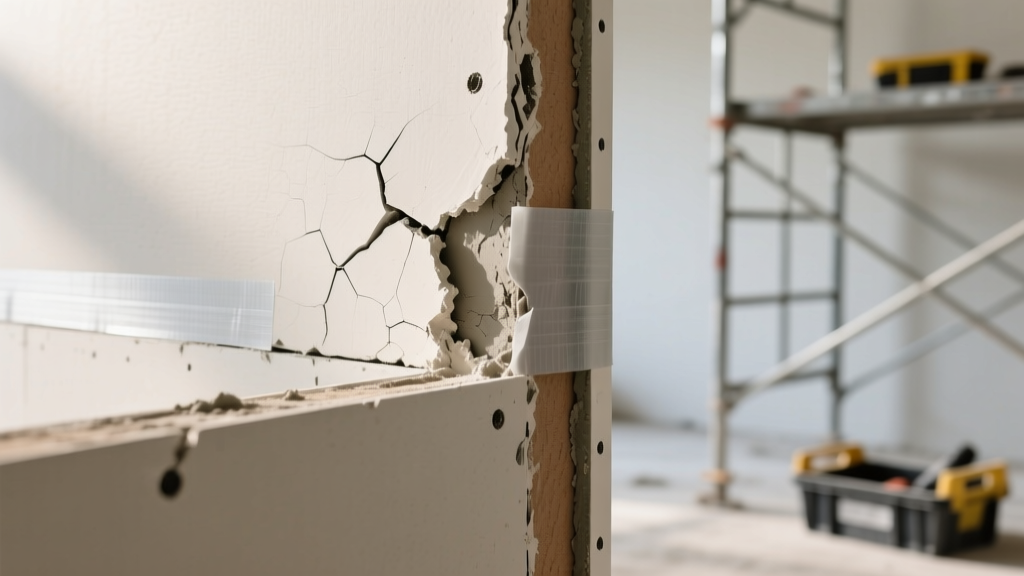
The True Lifespan of a Joint Compound Finish
Most contractors view sheetrock mud (joint compound) merely as a cosmetic filler to hide drywall seams. From a building science perspective, it is the critical membrane that unifies the gypsum board assembly, dictating the structural integrity of the interior finish. Under stable interior conditions—specifically an ambient relative humidity (RH) between 30% and 50% and temperatures ranging from 60°F to 75°F—a properly applied, taped, and painted joint compound finish will last 50 to 100 years. Effectively, the mud itself outlasts the paper facing of the gypsum board.
However, this multi-decade lifespan is entirely contingent on correct chemical selection, application thickness, and environmental control during the curing phase. When sheetrock mud fails prematurely, it is rarely due to the natural degradation of the material; rather, it is the result of volumetric shrinkage, hygroscopic moisture absorption, or shear stress at the board joints.
Drying vs. Setting Compounds: A Shrinkage Analysis
To understand the long-term durability of sheetrock mud, you must understand its curing mechanism. Joint compounds fall into two distinct chemical categories, each with vastly different shrinkage profiles and structural lifespans.
Air-Drying Compounds (Standard & Lightweight)
Products like USG Sheetrock All-Purpose or ProForm ProMix cure through water evaporation. The matrix consists of calcium carbonate (limestone), attapulgite clay, and organic binders like starch. As the water evaporates, the physical volume of the mud decreases. This volumetric shrinkage can reach 10% to 15% in thick applications. If a contractor attempts to fill a deep tapered edge joint in a single coat exceeding 1/8-inch, the surface will skin over while the interior remains wet. As the interior eventually dries and shrinks, it pulls away from the gypsum board edge, creating micro-fissures that telegraph through the paint over time.
Setting-Type Compounds (Hot Mud)
Setting compounds, such as USG Durabond 90 or Easy Sand 45, rely on a chemical crystallization process. They contain calcium sulfate hemihydrate (calcined gypsum). When mixed with water, the hemihydrate converts back into calcium sulfate dihydrate, forming an interlocking crystalline matrix. Because the water is chemically bound into the crystal structure rather than evaporating into the air, volumetric shrinkage is virtually zero (typically <1%). For high-durability applications, setting compounds provide a rock-hard, shrink-proof foundation that will never pull away from the board edge.
Primary Failure Modes and Prevention Matrix
When analyzing warranty callbacks and long-term drywall failures, the degradation of the sheetrock mud finish almost always falls into one of four distinct categories. The matrix below outlines the failure mode, the visual symptom, and the required material correction to ensure a 50-year lifespan.
| Failure Mode | Visual Symptom | Root Cause | Durability Fix |
|---|---|---|---|
| Shrinkage Cracking | Spider-web cracks or linear splits over recessed joints | Applying air-drying mud too thickly; rapid drying via forced heat | Use setting compound for deep fills; limit air-drying coats to 1/16" |
| Nail/Screw Pops | Circular bulges or cracked craters over fasteners | Lumber framing shrinkage pushing drywall outward, fracturing the mud | Pre-fill gaps with Durabond; use kiln-dried lumber; set screws 1/32" deep |
| Edge Delamination | Mud peeling away from cut (butt) joints | Paper facing absorbs moisture from mud, blistering the face paper | Seal cut edges with drywall primer/sealer before taping |
| Mold Bloom | Black or green speckling beneath the paint film | Organic starch binders in standard mud feeding spores in high RH | Specify mold-tough compounds (e.g., USG UltraLight Mold Tough) |
Moisture Degradation and Mold Vulnerability
Standard sheetrock mud is highly hygroscopic. The starch and cellulose ethers used as binders to improve workability and adhesion are essentially food sources for mold. According to testing standards outlined in ASTM C474 for joint treatment materials, standard compounds have no inherent resistance to fungal growth. If the interior environment consistently exceeds 70% RH, or if the mud is exposed to liquid water from a roof leak or plumbing failure, the organic binders will support the rapid colonization of Aspergillus and Penicillium spores.
Upgrading to Mold-Resistant Formulations
For high-humidity zones (bathrooms, laundry rooms, basements), standard all-purpose mud represents a critical durability weak point. Even if the gypsum board is water-resistant (green or purple board), using standard mud at the seams compromises the assembly. Upgrading to a mold-resistant formulation, which replaces organic starch binders with synthetic polymers and includes mildewcides, extends the functional lifespan of the finish in damp environments by preventing biological degradation. These products maintain their structural integrity even after temporary moisture exposure, provided they are allowed to dry out completely.
The 3-Coat Durability Framework
Achieving maximum lifespan requires a strategic, multi-layered approach to compound selection. The Gypsum Association recommends a minimum three-coat system for fire-rated and high-durability assemblies. Here is the optimal material framework for a finish designed to last half a century without cracking:
- Coat 1 (Taping & Bedding): Use a high-strength setting compound (e.g., Durabond 90) embedded with paper tape. This creates a rigid, shrink-proof structural bridge across the joint that resists the shear forces of building settlement and framing movement.
- Coat 2 (Fill & Leveling): Use a lightweight setting compound (e.g., Easy Sand 45) or a high-quality air-drying taping compound. The goal is to fill the taper and build the joint flush with the board surface. If using air-drying mud, ensure the ambient temperature is above 65°F to prevent delayed shrinkage.
- Coat 3 (Skim & Finish): Use a dedicated topping compound (e.g., USG Sheetrock UltraLight Topping). Topping compounds are engineered with finer limestone particles and fewer binders, making them exceptionally easy to sand. Because they are applied in a micro-thin layer (less than 1/32-inch), shrinkage stress is negligible, resulting in a glass-smooth surface that accepts paint uniformly without flashing.
"The longevity of a drywall finish is not determined by the paint, but by the dimensional stability of the joint compound beneath it. A failure to manage volumetric shrinkage during the first 48 hours of curing will manifest as structural telegraphing years later."
By treating sheetrock mud as a structural bonding agent rather than a simple paste, builders and remodelers can eliminate the vast majority of long-term drywall callbacks. Selecting the correct chemical formulation for the specific layer and environmental condition ensures the gypsum board assembly performs flawlessly for the life of the structure.