Installation Best Practices for Each Different Type of Wood
Master installation best practices for each different type of wood. Learn species-specific fastening, acclimation, and subfloor prep for flawless results.
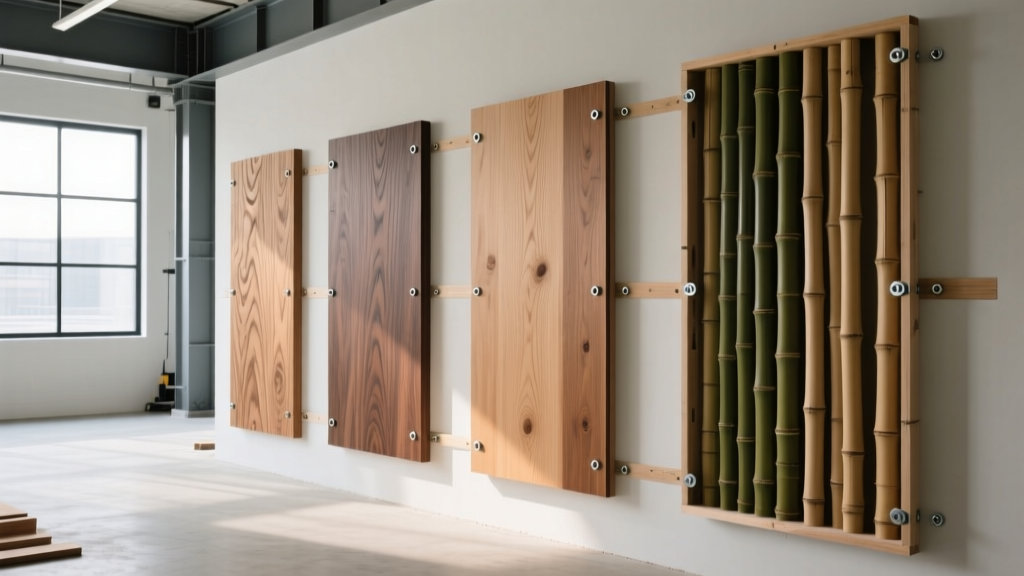
The Moisture Matrix: Acclimation Rules by Species
Treating every species identically during the acclimation phase is the primary cause of post-installation dimensional failure. Wood is hygroscopic, and its Equilibrium Moisture Content (EMC) must match the interior environment before installation. According to the USDA Forest Products Laboratory Wood Handbook, failing to achieve EMC parity results in irreversible cupping or severe gapping.
Use a pin-type moisture meter (such as the Wagner Orion 910 or Delmhorst J-2000) to test a minimum of 40 boards per 1,000 square feet. Do not rely on surface scanning meters for dense exotics, as they only read the top 1/4 inch.
| Wood Species | Janka Hardness (lbf) | Target Interior EMC | Min. Acclimation Time | Cross-Stacking Required? |
|---|---|---|---|---|
| Red Oak (Quercus rubra) | 1,290 | 6% - 9% | 72 Hours | Yes (1/2 inch spacing) |
| Hard Maple (Acer saccharum) | 1,450 | 6% - 9% | 96 Hours | Yes (1/2 inch spacing) |
| Longleaf Pine (Pinus palustris) | 870 | 8% - 11% | 48 Hours | No (keep strapped) |
| Ipe (Handroanthus spp.) | 3,510 | 10% - 14% | 14 Days | Yes (1 inch spacing) |
Fastener Selection and Spacing Framework
The density and cellular structure of a different type of wood dictate the mechanical fastening strategy. Using a standard 15.5-gauge staple on brittle, high-density hickory will cause cell-wall shearing and tongue splitting. Conversely, using a 16-gauge cleat on wide-plank softwood pine lacks the holding power to resist seasonal shrinkage.
Domestic Hardwoods (Oak, Maple, Hickory)
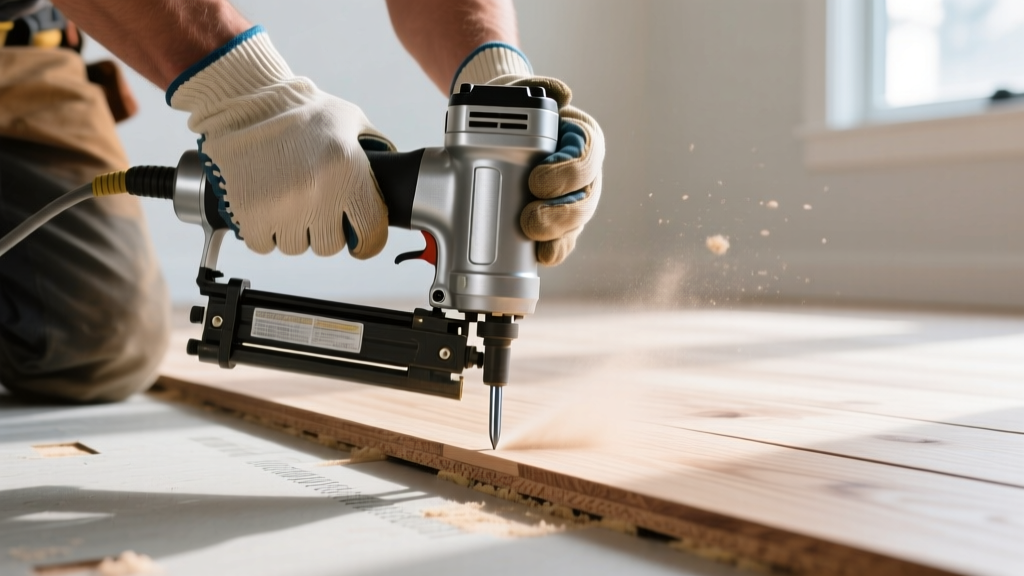
For standard 3/4-inch thick, 2-1/4-inch to 3-1/4-inch wide domestic hardwoods, pneumatic flooring nailers are the industry standard. Set your air compressor between 70 and 90 PSI. Exceeding 100 PSI will dent the surface of maple or blow out the tongue of oak. Use 16-gauge L-cleats or 15.5-gauge 1/2-inch crown staples, spaced every 8 to 10 inches along the joist, and no further than 3 inches from the end joints. As of 2026, the National Wood Flooring Association (NWFA) strongly recommends cleats over staples for hickory and maple due to their lower wedge-displacement, which minimizes tongue splitting.
Softwoods and Wide-Plank Millwork (Pine, Fir, Cedar)
Softwoods dent easily and possess lower screw-withdrawal resistance. For wide-plank pine (5 inches and wider), mechanical fasteners alone are insufficient to prevent edge-cupping. Implement a 'glue-assist' method: apply a 1/4-inch serpentine bead of silane-modified polymer (SMP) adhesive (such as Bona K850 or Loxon) to the back of each board before blind-nailing. For trim and casing installations, use 15-gauge angled finish nails (2 to 2.5 inches long) driven into the wall studs, avoiding the delicate plaster or drywall edges.
Tropical Exotics (Ipe, Cumaru, Teak)
Exotic species contain high levels of silica and natural oils that degrade standard carbon-steel fasteners and prevent PVA wood glues from curing. You must use Type 316 marine-grade stainless steel fasteners. Never use galvanized or zinc-plated screws; the tannins in woods like Ipe will react with the zinc, causing black weeping stains that cannot be sanded out. Pre-drill every hole with a carbide-tipped bit slightly larger than the screw shank to account for the wood's extreme density and lack of compressibility.
Tropical hardwoods can contain up to 5% silica by weight. Standard high-speed steel (HSS) saw blades will dull after cutting less than 20 linear feet of Ipe or Cumaru, resulting in severe tear-out on the board ends. Always use C4 micro-grain carbide-tipped blades with a high tooth count (80-tooth for crosscutting) and immediately seal all end-grain cuts with a commercial wax emulsion like Anchorseal within 60 seconds of cutting to prevent end-checking.
Subfloor Preparation and Tolerance Limits
The longevity of any wood installation is entirely dependent on the substrate. The NWFA mandates that subfloors must be flat to within 3/16 of an inch over a 10-foot radius, or 1/8 of an inch over a 6-foot radius.
- Wood Subfloors: Use minimum 5/8-inch CDX plywood for joists spaced 16 inches on center (OC), or 3/4-inch for 19.2-inch OC spacing. Avoid Oriented Strand Board (OSB) for wide-plank glue-down applications, as OSB's surface wax and resin can inhibit adhesive bonding and its edges are prone to swelling if exposed to moisture during construction.
- Concrete Subfloors: Never install wood directly over below-grade concrete without a vapor retarder. Test concrete moisture using an in-situ Relative Humidity (RH) probe test (ASTM F2170). If RH exceeds 75%, apply a two-part epoxy moisture mitigation system (like Bostik MVP4) before proceeding with a sleeper system or approved adhesive.
Troubleshooting Common Installation Failures
Even with meticulous preparation, environmental shifts can trigger physical reactions in the timber. Below is a diagnostic matrix for the most frequent field failures.
| Symptom | Root Cause Analysis | Corrective Action Protocol |
|---|---|---|
| Cupping (Edges higher than center) | Moisture differential; the bottom of the board is wetter than the top. Often caused by a missing crawl space vapor barrier or wet concrete subfloor. | Identify and eliminate the moisture source. Run commercial dehumidifiers. Do NOT sand the floor until moisture readings stabilize, or it will crown when it dries. |
| Severe Gapping (>1/16 inch) | Wood was installed at high EMC (e.g., 11%) during a humid summer, then shrank when winter HVAC systems dropped interior humidity below 30%. | Maintain interior relative humidity between 35-55% year-round using whole-home humidifiers. Fill gaps exceeding 1/8 inch with color-matched elastomeric wood filler. |
| Squeaking / Popping | Friction between the flooring and subfloor due to inadequate fastening, or subfloor deflection exceeding L/360 limits under live loads. | For localized squeaks, inject a 2-part structural epoxy or specialized squeak-relief adhesive through a 1/16-inch drilled hole. For widespread issues, reinforce subfloor joists with structural blocking. |
Environmental Control and Post-Installation Handoff
The installer's responsibility does not end when the last board is fastened. Wood continues to exchange moisture with the ambient air indefinitely. Before handing over the project, verify that the building's HVAC system is fully operational and balanced. The interior temperature must be maintained between 60°F and 80°F, with relative humidity strictly controlled between 30% and 50%. Provide the building owner with a digital hygrometer and explicit instructions that failing to maintain these parameters during seasonal transitions will void the manufacturer's structural warranty.
Written by
Priya KapoorPriya Kapoor is a real estate market analyst and construction economics researcher with expertise in housing affordability, development feasibility, and infrastructure investment. She holds a Master of Regional Planning from Cornell University and previously worked as a senior analyst at CBRE's Investment Properties group, where she modeled returns for $4B in mixed-use development pipelines. Priya now runs an independent research practice advising developers, municipalities, and REITs on construction cost forecasting and market timing. She publishes the quarterly "BuildMat Market Pulse" report tracking material price indices across 12 commodity categories. Based in Austin, TX, Priya serves on the board of Habitat for Humanity Austin and is a marathon runner.
More from Priya Kapoor
View all
Construction Cost
Cost to Build a 1600 Sq Ft Home in 2026: Full Breakdown
Accurate 2026 cost to build a 1600 sq ft home—material, labor, and regional pricing breakdowns included. Plan your budget with real-time estimates.
Aug 11, 2026

Wood & Lumber
Name the Types of Wood for Pressure Treatment and Preservation
Learn how to name the types of wood best suited for pressure treatment. Compare species treatability, chemical retention levels, and 2026 preservation costs.
Aug 4, 2026

Stone & Masonry
Stone Veneer Suppliers Lindenhurst: 2026 Cost Analysis
Analyze 2026 stone veneer costs in Lindenhurst, NY. Compare local supplier pricing, delivery fees, and Suffolk County installation labor rates.
Aug 4, 2026