Is Bamboo a Type of Wood? Structural Framing & Load Limits
Is bamboo a type of wood? Botanically no, but structurally it rivals timber. Explore load limits, engineered bamboo lumber, and framing codes.
The Botanical Reality: Grass, Not Wood
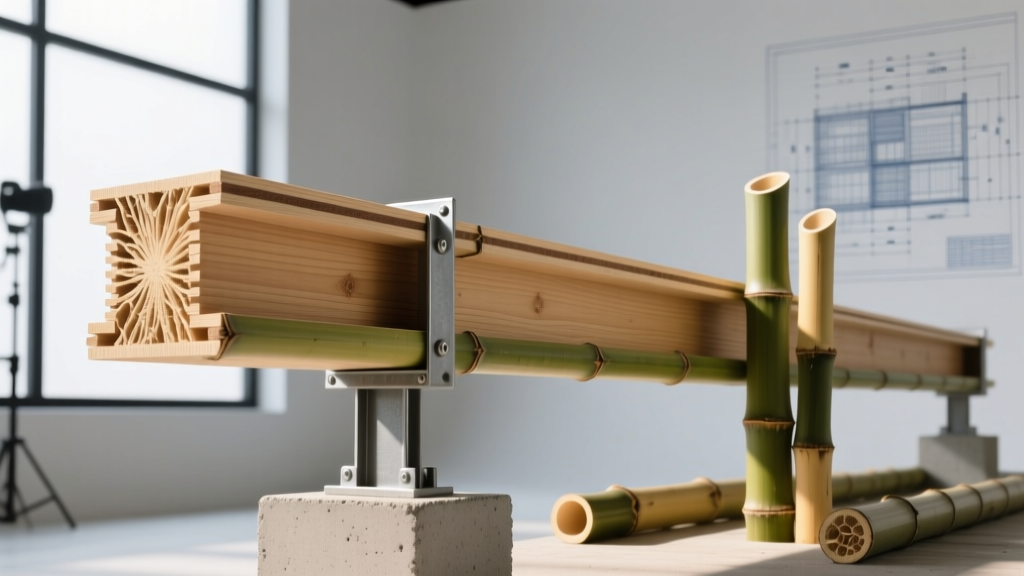
To answer the fundamental question: is bamboo a type of wood? Botanically, no. Bamboo is a giant grass belonging to the Poaceae family. Unlike true wood (xylem tissue produced by the secondary growth of trees), bamboo lacks a vascular cambium and does not produce annual growth rings. Instead, it is a lignocellulosic composite material where cellulose fibers are embedded in a lignin matrix, concentrated heavily in the outer epidermal layer.
From a structural engineering perspective, this biological distinction dictates entirely different load-bearing behaviors, failure modes, and connection methodologies compared to traditional dimensional lumber. While a pine stud fails through predictable fiber crushing or shear, a raw bamboo culm is prone to longitudinal splitting and node-shear failures if not properly engineered.
Structural Bamboo vs. Traditional Timber: Load-Bearing Metrics
When evaluating bamboo for structural framing, engineers compare its mechanical properties against standard softwoods. The highest-performing structural species, Guadua angustifolia (native to South America) and Phyllostachys edulis (Moso bamboo, native to Asia), exhibit tensile and compressive strengths that frequently outperform standard framing lumber.
| Material / Species | Density (lbs/ft³) | Modulus of Elasticity (MOE) | Modulus of Rupture (MOR) | Compressive Strength (psi) |
|---|---|---|---|---|
| Guadua angustifolia (Raw Culm) | 43 - 50 | 2,900,000 psi | 18,500 psi | 11,200 psi |
| Douglas Fir-Larch (No. 2 Grade) | 32 - 34 | 1,600,000 psi | 8,750 psi | 6,250 psi |
| Southern Yellow Pine (No. 2 Grade) | 35 - 38 | 1,700,000 psi | 9,350 psi | 6,450 psi |
| Laminated Bamboo Lumber (LBL) | 50 - 56 | 2,200,000 psi | 19,000 psi | 13,500 psi |
As the data indicates, raw Guadua offers a superior strength-to-weight ratio compared to Douglas Fir. However, the anisotropic nature of the hollow culm makes raw bamboo highly variable. This variability is why modern structural applications heavily rely on engineered bamboo products.
Engineered Bamboo: The Solution for Code-Compliant Framing
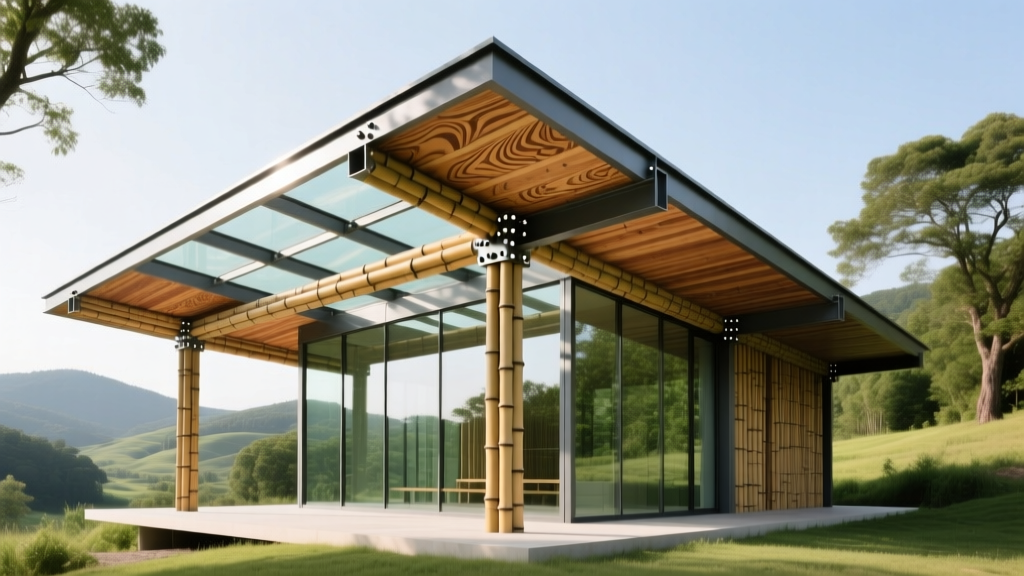
Raw bamboo culms are rarely used in commercial or code-compliant residential framing in North America due to the inability to standardize dimensions and connection points. Instead, the industry utilizes Engineered Bamboo Lumber, primarily in two forms:
Laminated Bamboo Lumber (LBL)
LBL is manufactured by stripping bamboo culms into flat strips, carbonizing or bleaching them, and laminating them under high pressure using phenol-formaldehyde or polyurethane adhesives. The resulting product is a dense, homogeneous beam or stud that can be milled to standard dimensional lumber sizes (e.g., 2x6, 2x8, 4x12). Brands like Plyboo and MOSO offer architectural-grade LBL that machines similarly to dense hardwoods, allowing for precise joinery and standard fastener schedules.
Bamboo Scrimber (Strand Woven)
Scrimber is produced by crushing bamboo culms into a fibrous mat, impregnating the mat with resin, and hot-pressing it into solid billets. Scrimber boasts a higher density (up to 75 lbs/ft³) and exceptional hardness, making it ideal for heavy-duty structural columns, sill plates, and high-wear flooring, though its extreme density makes on-site cutting and fastening more labor-intensive than LBL.
While engineered bamboo has high initial load capacity, it is susceptible to long-term creep under sustained heavy loads, particularly in high-humidity environments. When specifying LBL for primary roof beams or floor joists, engineers must apply a higher creep deflection multiplier (typically 2.0 to 2.5) compared to solid sawn timber (1.5), and ensure the material is sealed with a vapor-retardant finish to prevent moisture-induced plasticization of the lignin matrix.
Connection Details: Fastening Bamboo in Structural Nodes
The most common point of catastrophic failure in bamboo structures is the connection node. If you are integrating raw or semi-processed bamboo into a hybrid structural system, standard wood framing techniques will cause the material to split.
- The Node-Spanning Bolt Technique: Never drive a bolt directly through the bamboo diaphragm (the solid node). Holes must be drilled in the hollow internode section. The hollow cavity surrounding the bolt must then be injected with a high-modulus structural epoxy (such as West System 105/206) or packed with non-shrink cementitious grout to prevent the culm wall from crushing under the bolt head's clamping force.
- Hose Clamp Reinforcement: Before drilling, wrap the culm at the connection point with stainless steel hose clamps or carbon-fiber wrap. This provides radial confinement, effectively eliminating longitudinal splitting during seismic or high-wind lateral loading.
- Steel Gusset Plates: For LBL and engineered bamboo, standard steel joist hangers and gusset plates can be used, provided you use self-drilling structural screws designed for high-density composite materials (e.g., Simpson Strong-Tie SDWS or FastenMaster TimberLOK) to prevent fastener shear.
Code Compliance and Permitting in 2026
Navigating building codes with bamboo requires an understanding of both international standards and local alternative material provisions. Globally, the benchmark is ISO 22156:2021 (Bamboo — Structural design), which provides comprehensive guidelines for limit-state design, load combinations, and material partial safety factors specific to bamboo's unique biological variance.
In the United States, the International Residential Code (IRC) and International Building Code (IBC) do not yet have prescriptive span tables for raw bamboo. Structural engineers must utilize the Alternative Materials and Methods provision (IRC Section R104.11). To secure a permit, you must submit a stamped engineering package that includes:
- Mill certificates verifying the species, harvest age (minimum 3-5 years for optimal lignification), and boron-based preservative treatment.
- Third-party testing data for the specific batch of LBL or scrimber, confirming MOE and MOR values.
- Calculated connection details utilizing the specific shear and withdrawal capacities of the chosen fasteners in high-density bamboo composites.
Cost Analysis: Raw Culm vs. Engineered Bamboo Lumber
Material costs for bamboo vary wildly depending on the level of processing. As of 2026, supply chain stabilization has normalized pricing for engineered products, though raw materials remain subject to international shipping fluctuations.
| Material Type | Estimated Cost | Best Structural Application |
|---|---|---|
| Raw Guadua Culms (Imported) | $3.50 - $6.00 per linear foot | Decorative trusses, non-load-bearing screens, hybrid tensile structures |
| Laminated Bamboo Lumber (2x8) | $9.00 - $14.00 per board foot | Floor joists, exposed roof beams, window/door headers |
| Bamboo Scrimber Columns (6x6) | $18.00 - $25.00 per linear foot | Primary load-bearing columns, exterior sill plates, marine docks |
| Douglas Fir (2x8 No. 2) | $2.50 - $4.00 per board foot | Standard concealed framing (for cost-comparison baseline) |
While engineered bamboo carries a premium over standard softwoods, its aesthetic value as an exposed architectural element often offsets the cost of secondary finishing materials like drywall or wood veneers, making it highly competitive in high-end commercial and custom residential projects.
Frequently Asked Questions
Can bamboo be used for load-bearing walls?
Yes, but typically in the form of Laminated Bamboo Lumber (LBL) studs or bamboo-reinforced rammed earth panels. Raw bamboo culms are rarely used for sheer load-bearing walls in modern code-compliant construction due to the difficulty of creating airtight, insulated wall cavities around cylindrical shapes.
Does bamboo rot faster than wood?
Untreated raw bamboo contains high levels of starch and sugars, making it highly susceptible to powderpost beetles and fungal decay. It must be treated with borate solutions (like Tim-bor) via the Boucherie sap-displacement method immediately after harvest. Properly treated and sealed engineered bamboo, however, matches or exceeds the rot resistance of pressure-treated pine.
Is bamboo framing fire-resistant?
Raw bamboo has a high silica content in its outer epidermis, which provides slight natural fire resistance, but the hollow interior creates a chimney effect that can accelerate flame spread. Engineered bamboo (LBL and scrimber) achieves a Class A or Class B fire rating depending on the specific fire-retardant resins used during the hot-pressing manufacturing process. Always verify the ASTM E84 surface burning characteristics report from the manufacturer before specifying it for commercial egress routes.
Written by
Elena RodriguezElena Rodriguez is a civil engineer and technical writer specializing in concrete technology, masonry systems, and ASTM/ACI compliance. She earned her B.S. in Civil Engineering from Texas A&M University and spent a decade at a materials testing laboratory, performing over 2,000 concrete compressive strength tests and masonry prism evaluations. Elena is an ACI-certified Field Testing Technician (Grade I) and a member of ASTM Committee C12 on Natural Building Stone. She currently consults on forensic engineering cases involving concrete failures and moisture intrusion. Based in San Antonio, TX, Elena is a proud member of the Society of Women Engineers (SWE) and coaches her daughter's FIRST Robotics team.
More from Elena Rodriguez
View all
Walls & Panels
Cost Analysis: Light Gauge Steel Framing Advantages and Disadvantages
Evaluate light gauge steel framing advantages and disadvantages through a strict cost analysis lens, comparing material, labor, and lifecycle expenses.
Aug 4, 2026

Walls & Panels
Gypsum Board Types: Exact Specifications, Thickness & Dimensions
Compare standard, Type X, and moisture-resistant gypsum board types. Get exact specifications, thicknesses, dimensions, and ASTM standards for your project.
Aug 4, 2026

Fire Resistance
Best Fire-Resistant Outdoor Decking Materials: 2026 Buyer Guide
Discover the best fire-resistant outdoor decking materials for 2026. Compare Class A PVC, aluminum, and hardwood options for WUI compliance and safety.
Aug 4, 2026