Best Types of Wood Trees for Structural Framing and Load-Bearing Walls
Compare the best types of wood trees for structural framing. Learn how species like Douglas Fir and Southern Pine dictate load-bearing capacity and spans.
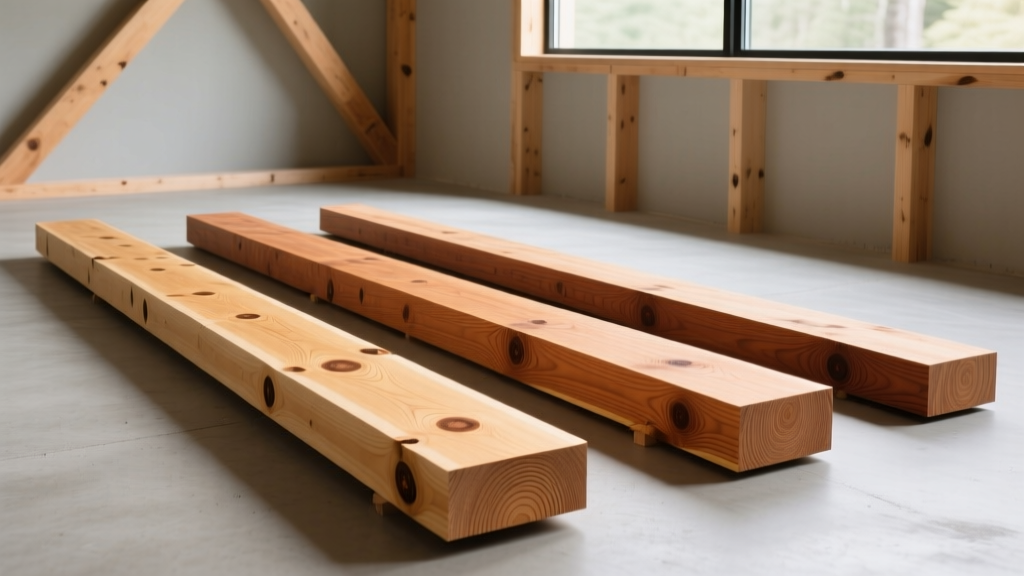
The Structural Hierarchy: Why Tree Species Dictate Framing Capacity
When engineers and framers select lumber for load-bearing walls, floor joists, and roof rafters, they are not just buying wood; they are buying the cellular geometry of a specific tree species. The phrase "types of wood trees" encompasses thousands of species, but in structural framing, this list is rapidly narrowed down to a few high-performing softwoods. The structural superiority of these specific trees comes down to their tracheid cells—long, hollow, tube-like structures that align parallel to the trunk, providing exceptional tensile and compressive strength along the grain.
While hardwoods like Oak and Hickory possess higher raw density, their complex pore structures and irregular grain patterns make them unpredictable for standard dimensional lumber. Therefore, the structural market relies almost exclusively on coniferous softwoods, graded and grouped by the American Wood Council's National Design Specification (NDS) into standardized species combinations.
Top Types of Wood Trees for Load-Bearing Applications
1. Douglas Fir-Larch (DF-L): The High-Stiffness Standard
Douglas Fir is the benchmark for structural framing in North America. Known for its tight, straight grain and high specific gravity, DF-L offers the highest stiffness (E) among standard framing lumbers. This makes it the mandatory choice for long-span floor joists, heavy timber beams, and applications where limiting deflection (bounce) is critical. In multi-story commercial wood framing, DF-L is frequently specified for shear walls and moment-resisting frames due to its superior fastener-holding capabilities and dimensional stability under load.
2. Southern Pine (SP): The High-Density Workhorse
Southern Pine is not a single tree but a group of four closely related species (Loblolly, Shortleaf, Longleaf, and Slash). What sets Southern Pine apart from other types of wood trees is its high resin content and dense latewood bands. This density gives it the highest bending strength (Fb) and shear values in the dimensional lumber market. It is the preferred species for prefabricated roof trusses, where high tension and compression forces converge at metal gusset plates. Its aggressive grain also provides the highest nail and screw withdrawal resistance, critical for resisting wind uplift.
3. Spruce-Pine-Fir (SPF): The Versatile and Economical Choice
SPF is a grouping of White Spruce, Lodgepole Pine, and Alpine Fir, primarily harvested from the boreal forests of Canada and the northern US. While its structural values are slightly lower than DF-L or Southern Pine, SPF is exceptionally stable, lightweight, and easy to work with. It is the dominant species for vertical wall studs, where the primary structural demand is axial compression (bearing the weight of the floors and roof above) rather than bending. SPF's low shrinkage rates mean walls framed with it are less prone to drywall cracking and door binding as the building dries.
4. Hem-Fir: The Moisture-Resistant Alternative
Comprising Western Hemlock and True Firs, this group offers a middle ground between the high strength of Douglas Fir and the economy of SPF. Hem-Fir is notable for its uniform color and excellent resistance to checking (splitting) during the kiln-drying process. It is widely used in general framing, sill plates, and blocking, where high shear strength is less critical than predictable moisture movement.
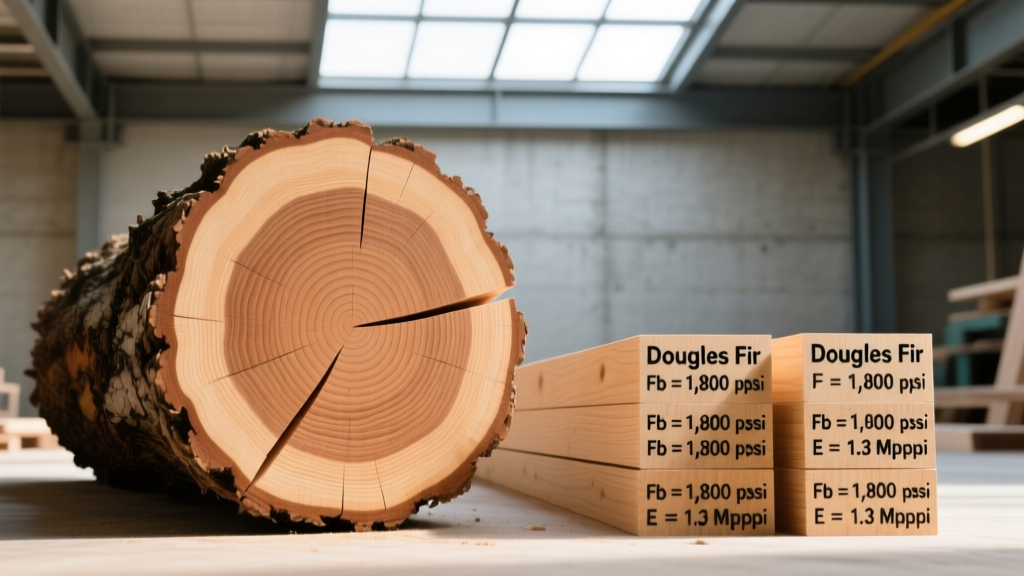
Comparative Structural Values (NDS Baseline for No. 2 Grade 2x Lumber)
The following table illustrates the baseline design values for the most common types of wood trees used in structural framing. These values assume dry service conditions (moisture content ≤ 19%) and standard load duration.
| Species Group | Bending (Fb) psi | Tension (Ft) psi | Shear (Fv) psi | Stiffness (E) psi | Specific Gravity (G) |
|---|---|---|---|---|---|
| Douglas Fir-Larch | 900 | 575 | 180 | 1,600,000 | 0.50 |
| Southern Pine | 1,050 | 675 | 175 | 1,600,000 | 0.55 |
| Spruce-Pine-Fir (SPF) | 875 | 450 | 135 | 1,400,000 | 0.42 |
| Hem-Fir | 850 | 525 | 150 | 1,500,000 | 0.43 |
Note: Always consult the latest USDA Forest Products Laboratory Wood Handbook for size factors, wet service factors, and repetitive member adjustments before finalizing structural calculations.
Decoding the Grade Stamp: Verifying the Tree Species on Site
Selecting the right types of wood trees is only half the battle; verifying it on the job site is critical for structural liability. Every piece of structural lumber bears an ink stamp that serves as its structural passport. When inspecting a load of lumber, look for these specific elements:
- Species Identification: Stamped as abbreviations like DF-L, SP, S-P-F, or HEM-FIR. If a structural plan calls for DF-L and the lumber stamp reads S-P-F, the joists may be under-designed for the required span.
- Grade: Select Structural, No. 1, No. 2, or Stud. No. 2 is the standard for floor and roof framing; "Stud" grade is restricted to vertical, load-bearing walls and cannot be used horizontally.
- Condition: S-DRY (surfaced dry, ≤19% moisture) or S-GRN (surfaced green, >19% moisture). Using S-GRN lumber in enclosed, climate-controlled environments will result in severe shrinkage and structural fastener loosening.
Edge Cases and Failure Modes: When the Wrong Species Fails
Misunderstanding the mechanical properties of different types of wood trees leads to specific, predictable failure modes in the field:
Creep Deflection in SPF Floor Joists
While SPF is excellent for walls, using it for long-span floor joists at the absolute maximum allowable span often results in "creep"—a gradual, permanent sagging over time under sustained dead loads (like heavy tile flooring or stone countertops). For spans exceeding 14 feet at 16" on-center, upgrading to DF-L or Southern Pine prevents long-term deflection issues.
Fastener Withdrawal in Low-Density Woods
In high-wind zones or seismic regions, the sheer strength of a shear wall relies heavily on the nail-holding capacity of the framing. SPF (Specific Gravity 0.42) has roughly 25% less nail withdrawal resistance than Southern Pine (Specific Gravity 0.55). If an engineer specifies 10d common nails at 2" O.C. for a shear wall, substituting SPF for Southern Pine without adjusting the nailing schedule can result in catastrophic fastener pull-through during a storm event.
Checking and Splitting in Heavy Timber
When using solid sawn heavy timber (6x6 or larger) for exposed structural beams, Southern Pine is highly prone to deep surface checking as the thick core dries. While checks rarely compromise the structural bending capacity, they are visually unappealing in architectural applications. In these cases, specifying DF-L or transitioning to Glulam (Glued Laminated Timber) mitigates aesthetic and localized shear failures.
Engineered Wood Integration: Does the Tree Species Still Matter?
The rise of engineered wood products (EWP) like LVL (Laminated Veneer Lumber), PSL (Parallel Strand Lumber), and I-Joists has changed how types of wood trees are utilized. In EWP manufacturing, species are strategically layered. For example, an LVL beam will often use high-strength Douglas Fir veneers for the outer tension and compression flanges, while utilizing lower-cost SPF or Poplar veneers for the inner core. This hybrid approach optimizes the structural performance of the tree while minimizing material costs. When specifying I-Joists, the flange material (often LVL or solid sawn Southern Pine) dictates the moment capacity, while the OSB web dictates the shear capacity.
Frequently Asked Questions
Can I mix different types of wood trees in the same structural floor system?
No. Mixing species (e.g., alternating DF-L and SPF joists) creates uneven stiffness across the floor plane. This leads to differential deflection, causing the subfloor to flex unevenly, which results in popped nails, squeaks, and cracked tile. Always maintain uniform species and grade across a continuous structural diaphragm.
Why is Southern Pine often pressure-treated for structural sill plates?
Southern Pine's cellular structure features large, open resin canals that readily absorb water-borne preservatives (like ACQ or MCQ) deep into the sapwood. Most other types of wood trees, like Douglas Fir, have heartwood that is highly resistant to chemical penetration, making them poor candidates for standard pressure treatment without deep incising.
How does mass timber (CLT) change the species requirement?
Cross-Laminated Timber (CLT) panels are predominantly manufactured from SPF or Hem-Fir. Because CLT relies on cross-lamination for dimensional stability and shear transfer, the ultra-high stiffness of DF-L is less critical than in solid sawn beams. The focus in mass timber shifts toward the adhesive bond strength and the uniform density of the lamellas, making SPF an ideal, cost-effective candidate for multi-story mass timber construction.
Written by
James ThorntonJames Thornton is a construction industry veteran with 25 years of hands-on experience in wood framing, lumber grading, and residential building codes. He started as a framing carpenter in rural Oregon, earned his ICC Residential Building Inspector certification, and eventually became a senior plan reviewer for the City of Portland Bureau of Development Services. James holds a B.S. in Wood Science & Technology from Oregon State University and is a certified lumber grader through the West Coast Lumber Inspection Bureau (WCLIB). He has inspected over 3,000 residential construction sites and authored the city's internal guide on advanced framing techniques (2x6 at 24" O.C.). James lives in Bend, OR, where he builds custom timber-frame cabins and competes in lumberjack sports.
More from James Thornton
View all
Insulation
Best Home Insulation Materials: Complete 2026 Guide
Compare top home insulation materials for 2026. Find R-values, installed costs per square foot, and best uses for fiberglass, spray foam, and mineral wool.
Aug 4, 2026

Sustainable Building
Certify Your Green Building Material for LEED and WELL
Step-by-step guide to certifying a green building material for LEED v5 and WELL v2. Master EPDs, HPDs, and VOC limits for 2026 project specifications.
Aug 4, 2026

Stone & Masonry
Veneer Stacked Stone Panels: Interior Design & Style Showcase
Discover how veneer stacked stone panels transform interiors. Explore modern design profiles, material pairings, and technical installation specs.
Aug 4, 2026