Types of Wood Floors: Complete Species & Hardness Guide
Compare the top types of wood floors by species, Janka hardness, and cost. Find the perfect hardwood for your home's traffic levels and budget.
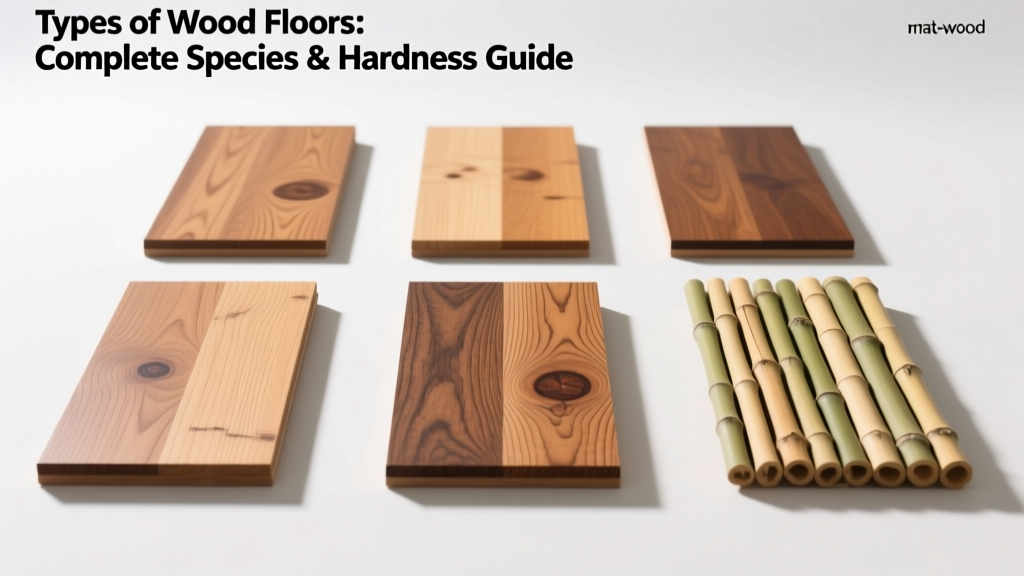
The Science of Species Selection: Beyond the Janka Scale
When evaluating types of wood floors, most buyers stop at the Janka hardness scale. While Janka (measured via ASTM D1037 standards) dictates dent resistance by measuring the force required to embed a 0.444-inch steel ball halfway into the wood, it completely ignores dimensional stability. A floor's true performance in a fluctuating climate depends equally on its tangential shrinkage rate and cellular structure. According to The Wood Database, a species with high hardness but high shrinkage will gap and cup more than a moderately hard, stable species if indoor relative humidity (RH) drops below 35%.
Domestic Hardwoods: The North American Standards
Domestic species remain the most popular types of wood floors due to reliable supply chains, predictable acclimation times, and classic aesthetics. However, their cellular differences dictate where they should be installed.
White Oak (Quercus alba)
- Janka Hardness: 1,360 lbf
- Tangential Shrinkage: 7.2%
- Average Material Cost: $6.00 - $10.00 / sq. ft.
White oak is the current benchmark for premium residential and commercial flooring. Unlike red oak, white oak contains tyloses—cellular plugs that make the wood's pores watertight. This natural moisture resistance makes it the only solid hardwood recommended for kitchens and powder rooms. Its tight grain also takes penetrating oils and hardwax finishes exceptionally well without blotching.
Red Oak (Quercus rubra)
- Janka Hardness: 1,290 lbf
- Tangential Shrinkage: 8.6%
- Average Material Cost: $4.00 - $7.00 / sq. ft.
Red oak features open, porous grain and a distinct pinkish undertone. Because it lacks tyloses, it absorbs moisture rapidly, making it prone to black tannin stains if exposed to standing water. It remains the most cost-effective traditional hardwood but requires strict climate control to prevent edge-cupping in winter months.
Hard Maple (Acer saccharum)
- Janka Hardness: 1,450 lbf
- Tangential Shrinkage: 9.9%
- Average Material Cost: $6.00 - $9.00 / sq. ft.
Maple offers a clean, contemporary look with minimal grain variation. Its extreme density makes it highly resistant to dents, but this same density makes it notoriously difficult to stain evenly. Dark stains on maple often result in a blotchy, uneven appearance. For dark floors, opt for factory-stained engineered maple or choose white oak instead.
Hickory (Carya spp.)
- Janka Hardness: 1,820 lbf
- Tangential Shrinkage: 7.8%
- Average Material Cost: $5.00 - $9.00 / sq. ft.
Hickory is the hardest commercially available domestic species. It features dramatic color variations between its light sapwood and dark heartwood. While incredibly durable, hickory is highly reactive to moisture changes. The National Wood Flooring Association (NWFA) mandates strict 14-day acclimation protocols and year-round HVAC humidity control (35%-55% RH) to prevent severe gapping.
American Black Walnut (Juglans nigra)
- Janka Hardness: 1,010 lbf
- Tangential Shrinkage: 5.5%
- Average Material Cost: $9.00 - $14.00 / sq. ft.
Walnut is prized for its rich, chocolate-brown heartwood and excellent dimensional stability (low shrinkage). However, it is one of the softest domestic flooring options and will dent easily under high heels or pet claws. Additionally, walnut is highly photosensitive; prolonged UV exposure will lighten the wood from dark brown to a pale, honey-like hue over time.
Exotic Species: Maximum Density and Sourcing Ethics
Exotic woods offer Janka ratings far exceeding domestic species, but they introduce complex challenges regarding acclimation and environmental ethics.
Brazilian Cherry (Jatoba)
With a Janka rating of 2,350 lbf, Jatoba is exceptionally hard and highly resistant to wear. It starts as a tan/salmon color but oxidizes rapidly into a deep, rich reddish-brown within weeks of UV exposure. Its interlocked grain makes it highly resistant to splitting but challenging to sand and refinish on-site.
Santos Mahogany (Myroxylon balsamum)
Rating at 2,200 lbf, Santos Mahogany offers a uniform, deep red color with excellent rot resistance. It is highly dimensionally stable compared to other exotics, making it a viable candidate for engineered flooring over concrete subfloors.
Softwoods: Character and Historical Authenticity
Heart Pine (Pinus palustris)
Though technically a softwood, reclaimed heart pine boasts a Janka hardness of 1,225 lbf—comparable to red oak. Sourced from old-growth longleaf pine (often salvaged from 19th-century industrial mills), it features incredibly tight growth rings and a high resin content. It is the premier choice for historical restorations, costing between $12.00 and $20.00 per square foot due to its scarcity.
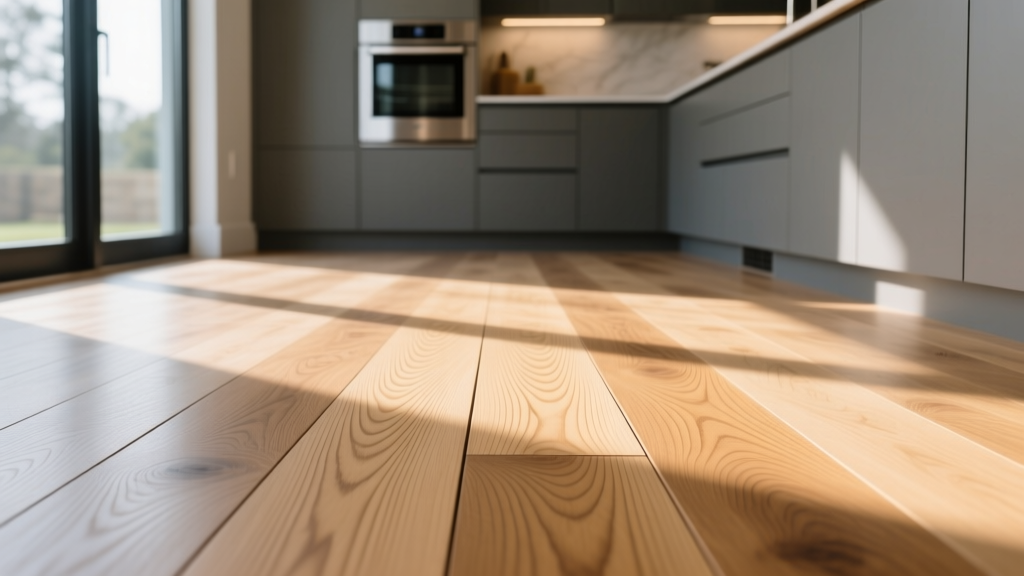
Species Performance Matrix
| Species | Janka (lbf) | Shrinkage % | Cost ($/sq ft) | Best Application |
|---|---|---|---|---|
| White Oak | 1,360 | 7.2% | $6 - $10 | Kitchens, high-traffic living areas |
| Red Oak | 1,290 | 8.6% | $4 - $7 | Living rooms, bedrooms (dry areas) |
| Hard Maple | 1,450 | 9.9% | $6 - $9 | Contemporary homes, light stains |
| Hickory | 1,820 | 7.8% | $5 - $9 | Rustic designs, heavy impact zones |
| Black Walnut | 1,010 | 5.5% | $9 - $14 | Master bedrooms, formal dining |
| Brazilian Cherry | 2,350 | 6.5% | $10 - $16 | Commercial spaces, luxury foyers |
| Heart Pine | 1,225 | 6.2% | $12 - $20 | Historical restorations, lofts |
How Milling Cuts Alter Species Performance
The way a log is sliced at the mill fundamentally changes the floor's stability and appearance, regardless of the species chosen.
- Plain Sawn (Flat Sawn): The most common and cost-effective cut. It produces a traditional 'cathedral' grain pattern but exhibits the highest tangential movement, making it the most prone to cupping.
- Quarter Sawn: The log is quartered and cut perpendicular to the growth rings. This exposes the medullary rays (fleck), creating a striking visual in white oak. More importantly, it reduces dimensional movement by up to 50% compared to plain sawn boards.
- Rift Sawn: Cut at a strict 30-60 degree angle to the rings, producing a tight, linear grain with zero fleck. Rift sawn flooring is the most dimensionally stable cut available but generates the highest mill waste, pushing costs 30% to 50% higher than plain sawn equivalents.
Decision Framework: Matching Species to Room Traffic
Selecting the right types of wood floors requires aligning the species' physical properties with the specific environmental and mechanical stresses of the room.
High-Traffic & Impact Zones (Mudrooms, Main Hallways)
Specify Hickory or Hard Maple. Opt for a site-finished application with a commercial-grade, moisture-cured polyurethane to create a seamless wear layer that prevents water from penetrating the seams.
Moisture-Prone Areas (Kitchens, Powder Rooms)
Specify solid or engineered White Oak. The tyloses in the wood's pores provide a secondary line of defense against spills. Avoid bevel-edged planks, which trap moisture and dirt; insist on square-edge milling.
Over Radiant Heating Systems
Avoid Hickory, Maple, and wide-plank solid woods entirely. The extreme thermal cycling will cause severe gapping. Instead, use engineered White Oak or engineered Walnut (due to Walnut's naturally low shrinkage rate), ensuring the total thickness does not exceed 5/8-inch to allow efficient heat transfer.
'When installing any solid hardwood over a crawl space or basement, a minimum 6-mil polyethylene vapor retarder is mandatory over the earth, and the subfloor moisture content must be within 2% to 4% of the flooring's moisture content before a single plank is fastened.' — NWFA Installation Guidelines.
Written by
James ThorntonJames Thornton is a construction industry veteran with 25 years of hands-on experience in wood framing, lumber grading, and residential building codes. He started as a framing carpenter in rural Oregon, earned his ICC Residential Building Inspector certification, and eventually became a senior plan reviewer for the City of Portland Bureau of Development Services. James holds a B.S. in Wood Science & Technology from Oregon State University and is a certified lumber grader through the West Coast Lumber Inspection Bureau (WCLIB). He has inspected over 3,000 residential construction sites and authored the city's internal guide on advanced framing techniques (2x6 at 24" O.C.). James lives in Bend, OR, where he builds custom timber-frame cabins and competes in lumberjack sports.
More from James Thornton
View all
Insulation
Best Home Insulation Materials: Complete 2026 Guide
Compare top home insulation materials for 2026. Find R-values, installed costs per square foot, and best uses for fiberglass, spray foam, and mineral wool.
Aug 4, 2026

Sustainable Building
Certify Your Green Building Material for LEED and WELL
Step-by-step guide to certifying a green building material for LEED v5 and WELL v2. Master EPDs, HPDs, and VOC limits for 2026 project specifications.
Aug 4, 2026

Stone & Masonry
Veneer Stacked Stone Panels: Interior Design & Style Showcase
Discover how veneer stacked stone panels transform interiors. Explore modern design profiles, material pairings, and technical installation specs.
Aug 4, 2026