Types of Wood Panels Compared: 2026 Buyer's Guide
Compare the top types of wood panels for construction in 2026. Expert breakdown of OSB, plywood, MDF, and particleboard costs, uses, and limits.
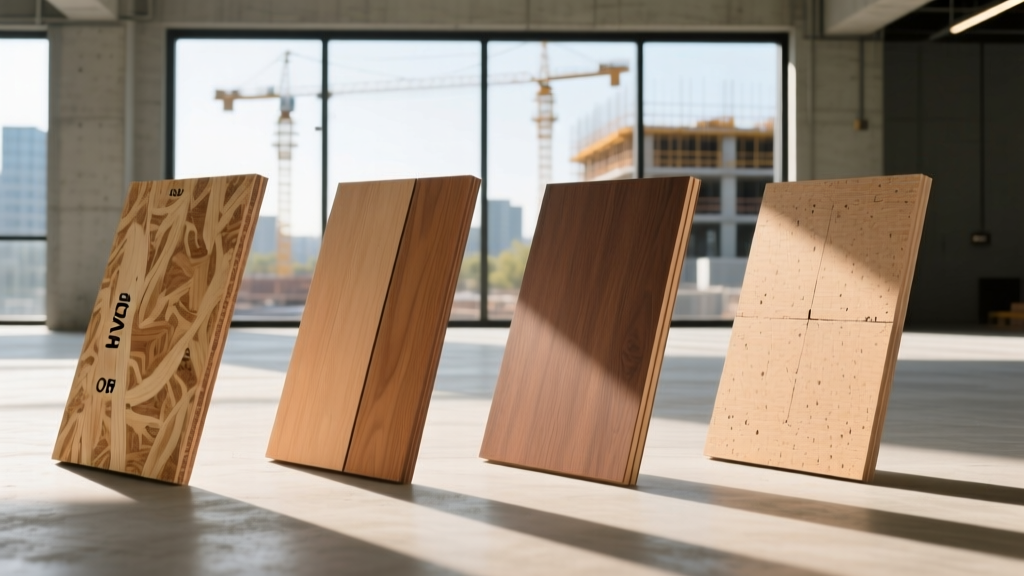
The 2026 Wood Panel Landscape: Structural vs. Decorative
Selecting the correct sheathing and substrate is one of the most critical decisions in modern framing and interior millwork. The market for engineered and solid wood composites has evolved significantly, with 2026 manufacturing standards offering improved moisture resistance, tighter span ratings, and stricter formaldehyde emission controls. However, misapplication remains a leading cause of structural callbacks and interior finish failures. Understanding the distinct mechanical properties, moisture tolerances, and fastener-holding capacities of different types of wood panels is essential for general contractors, architects, and specialized carpenters.
This comparison review dissects the primary categories of wood panels available in the current building materials market, contrasting structural sheathing (OSB and CDX plywood) with interior substrates (MDF, particleboard, and hardwood plywood). We evaluate real-world pricing, structural span ratings, and specific failure modes to provide an actionable procurement framework.
Comprehensive Comparison Matrix: Types of Wood Panels
The following matrix outlines the baseline specifications and 2026 market pricing for standard 4x8-foot sheets. Pricing reflects national averages for wholesale/contractor tiers and fluctuates based on regional timber supply chains.
| Panel Type | Core Composition | Standard Thickness | 2026 Avg. Cost (4x8) | Moisture Tolerance | Primary Application |
|---|---|---|---|---|---|
| OSB (Oriented Strand Board) | Compressed rectangular wood strands with wax/resin | 7/16", 1/2", 5/8" | $38 - $48 | Moderate (Exposure 1) | Roof, wall, and floor sheathing |
| CDX Plywood | Softwood veneer plies, cross-laminated (C/D grade) | 1/2", 5/8", 3/4" | $65 - $85 | High (Exposure 1) | Structural sheathing, concrete formwork |
| MDF (Medium-Density Fiberboard) | Refined wood fibers with synthetic resin binder | 1/2", 5/8", 3/4" | $52 - $68 | Very Low | Painted cabinetry, interior trim, furniture |
| Particleboard | Coarse wood chips and sawdust with urea-formaldehyde | 5/8", 3/4" | $35 - $45 | Very Low | Subfloor underlayment, budget shelving |
| Hardwood Plywood | Softwood or MDF core with hardwood face/back veneers | 1/4", 1/2", 3/4" | $110 - $165 | Low to Moderate | Stained cabinetry, architectural millwork |
Deep Dive: Structural Sheathing Panels
CDX Plywood vs. OSB (Oriented Strand Board)
For exterior wall, roof, and subfloor sheathing, the debate between CDX plywood and OSB dominates the framing stage. Both panels carry an Exposure 1 rating, meaning they can withstand construction delays and weather exposure during the framing phase without structural degradation, provided they are not subjected to continuous moisture.
OSB is manufactured by compressing rectangular wood strands in specific orientations with wax and synthetic resins. It is generally 15-20% cheaper than CDX plywood and offers highly consistent shear strength across the entire sheet, lacking the core voids sometimes found in lower-grade plywood. However, OSB's primary vulnerability is edge swell. When the cut edges of OSB are exposed to standing water, the panel thickness can swell by up to 15%, leading to visible ridges under flooring or roofing materials.
CDX Plywood consists of cross-laminated softwood veneers. The 'C' and 'D' denote the grade of the face and back veneers (allowing for knots and minor repairs), while the 'X' signifies Exposure 1 exterior-grade glue. Plywood dries out faster than OSB after getting wet and exhibits minimal edge swell. According to the APA - The Engineered Wood Association, both materials perform identically in structural shear wall testing when properly nailed, but plywood remains the preferred choice for high-humidity climates or flat-roof applications where water pooling is a risk.
When purchasing roof sheathing, check the span rating stamp (e.g., 24/16). This indicates the panel can support a 24-inch rafter spacing for roofs and 16-inch joist spacing for floors. If using 7/16" OSB on 24-inch roof trusses, building codes mandate the use of H-clips at the unsupported long edges to prevent panel deflection and sagging under snow loads.
Deep Dive: Interior & Decorative Panels
MDF vs. Particleboard: The Cabinet Core Debate
Interior millwork relies heavily on engineered composite panels. MDF is created by breaking down hardwood or softwood residuals into fine wood fibers, combining them with wax and a resin binder, and applying high temperature and pressure. The result is a dense, heavy panel with a completely smooth, grain-free surface. MDF is the undisputed champion for painted cabinetry and routed door profiles because it will not telegraph wood grain through the paint over time.
Particleboard, conversely, uses larger, coarser wood chips. It is lighter and cheaper than MDF but suffers from severe sagging on shelves spanning more than 32 inches. Furthermore, particleboard crumbles when routed and offers poor screw-holding strength compared to MDF or plywood. While particleboard is common in ready-to-assemble (RTA) furniture and budget underlayment, it should be avoided for heavy-load built-in shelving.
Hardwood Plywood: Premium Veneer Core
When the design calls for stained wood, clear-coated architectural panels, or high-end furniture, hardwood plywood is required. These panels feature a core of either softwood veneer, MDF, or particleboard, faced with thin slices of premium hardwoods like Red Oak, Walnut, or Baltic Birch. Baltic Birch plywood, specifically, features a multi-ply core of solid birch veneers with zero voids, offering exceptional screw-holding strength and a visually striking exposed edge that is highly sought after in modern furniture design. Expect to pay a premium, with 3/4" pre-finished maple hardwood plywood frequently exceeding $150 per sheet in 2026.
Failure Modes and Edge Cases in Panel Selection
Even experienced contractors encounter panel failures when environmental conditions exceed material limitations. Be aware of these specific edge cases:
- The MDF Bathroom Vanity Trap: Using standard MDF for bathroom vanity base cabinets is a frequent failure point. Once water breaches the toe-kick or sink cutout, MDF acts like a sponge, expanding irreversibly and destroying the structural integrity of the hinge mounting points. Always specify Marine-Grade Plywood or exterior-rated MDF alternatives for wet areas.
- OSB Subfloor Delamination: If an OSB subfloor is exposed to rain for months before the building is dried in, the resin bonds can degrade. Even if the panel dries out, it may lose up to 30% of its bending stiffness. Inspect for 'flaking' at the edges before laying underlayment.
- Fastener Blowout in MDF: Driving screws near the edge of MDF without pre-drilling will cause the panel to split or 'blow out.' Always use specialized MDF screws with aggressive threads and pre-drill clearance holes within 2 inches of any edge.
Decision Framework: Which Panel Type Do You Need?
Use this sequential logic tree to specify the correct panel for your 2026 project scope:
- Is the panel exposed to the exterior or supporting structural loads?
- Yes: Choose OSB for standard walls/roofs to optimize budget. Choose CDX Plywood for subfloors, flat roofs, or high-moisture zones.
- No: Proceed to step 2.
- Will the surface be painted or routed with intricate profiles?
- Yes: Specify 3/4" Moisture-Resistant (MR) MDF. Avoid particleboard.
- No: Proceed to step 3.
- Will the surface be stained, clear-coated, or left with exposed edges?
- Yes: Specify Hardwood Plywood with a veneer core or Baltic Birch.
- No: If used for hidden structural shelving or budget underlayment, Particleboard is acceptable if spans are kept under 24 inches.
Sourcing, Sustainability, and Air Quality Standards
When procuring interior wood panels, air quality is a non-negotiable factor. Composite panels (MDF, Particleboard, and some Plywoods) are manufactured using resins that can off-gas volatile organic compounds (VOCs), primarily formaldehyde. As of 2026, all composite wood panels sold in the United States must comply with the EPA's TSCA Title VI regulations, which align with the stringent California Air Resources Board (CARB) Phase 2 standards. Always verify that your supplier's documentation explicitly states CARB2 Compliant or ULEF (Ultra-Low Emitting Formaldehyde) to ensure safe indoor air quality for residential and commercial occupants.
For structural panels, look for the USDA Forest Products Laboratory grading stamps and certification from the Sustainable Forestry Initiative (SFI) or the Forest Stewardship Council (FSC) to ensure the timber was harvested from responsibly managed tracts. Understanding the nuanced differences between these types of wood panels ensures your builds remain structurally sound, aesthetically superior, and financially optimized.
Written by
James ThorntonJames Thornton is a construction industry veteran with 25 years of hands-on experience in wood framing, lumber grading, and residential building codes. He started as a framing carpenter in rural Oregon, earned his ICC Residential Building Inspector certification, and eventually became a senior plan reviewer for the City of Portland Bureau of Development Services. James holds a B.S. in Wood Science & Technology from Oregon State University and is a certified lumber grader through the West Coast Lumber Inspection Bureau (WCLIB). He has inspected over 3,000 residential construction sites and authored the city's internal guide on advanced framing techniques (2x6 at 24" O.C.). James lives in Bend, OR, where he builds custom timber-frame cabins and competes in lumberjack sports.
More from James Thornton
View all
Insulation
Best Home Insulation Materials: Complete 2026 Guide
Compare top home insulation materials for 2026. Find R-values, installed costs per square foot, and best uses for fiberglass, spray foam, and mineral wool.
Aug 4, 2026

Sustainable Building
Certify Your Green Building Material for LEED and WELL
Step-by-step guide to certifying a green building material for LEED v5 and WELL v2. Master EPDs, HPDs, and VOC limits for 2026 project specifications.
Aug 4, 2026

Stone & Masonry
Veneer Stacked Stone Panels: Interior Design & Style Showcase
Discover how veneer stacked stone panels transform interiors. Explore modern design profiles, material pairings, and technical installation specs.
Aug 4, 2026